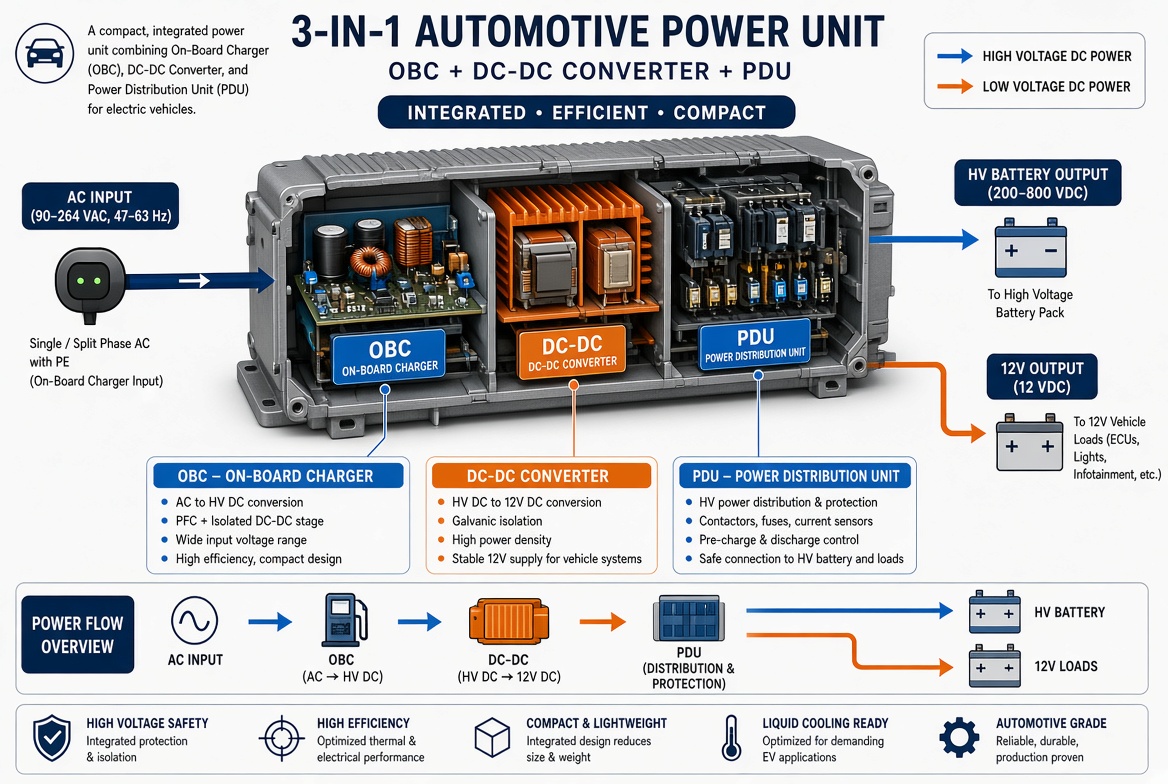
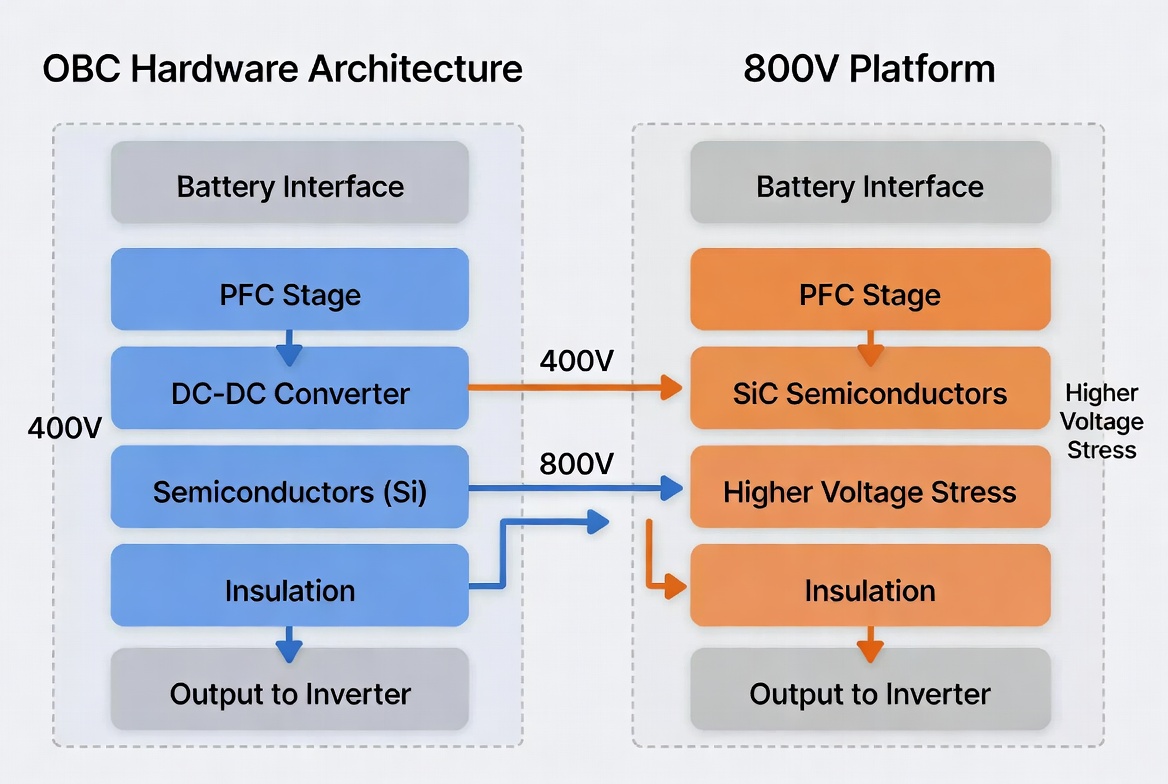
Differences in OBC Hardware Architecture Between 400V and 800V High-Voltage Platforms

Differences in OBC Hardware Architecture Between 400V and 800V High-Voltage [...]
Differences in OBC Hardware Architecture Between 400V and 800V High-Voltage Platforms
The transition from 400V to 800V high-voltage platforms in electric vehicles significantly impacts the hardware architecture of On-Board Chargers (OBCs). While 400V systems remain dominant in many current models, 800V platforms — increasingly adopted in premium and high-performance EVs — require higher voltage ratings, different insulation strategies, advanced semiconductor devices, and optimized topologies to maintain efficiency, safety, and power density.
 |
1. Voltage Stress and Component Requirements
The most obvious difference lies in voltage handling capability.
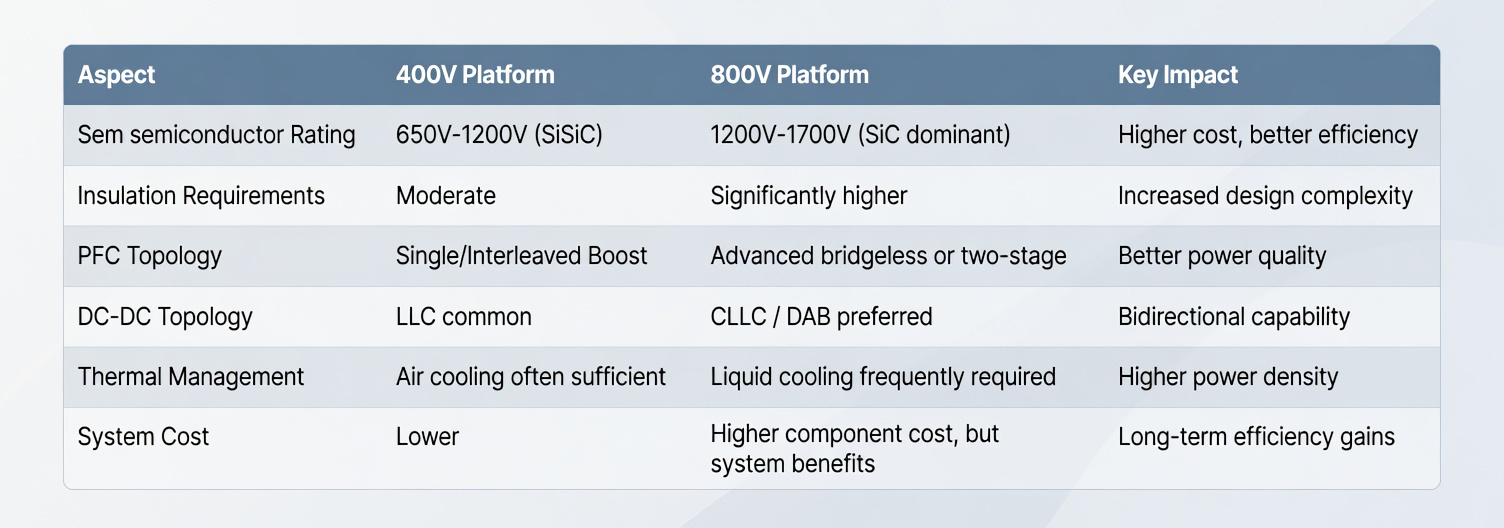
- 400V Platforms: OBCs typically manage a DC bus voltage around 400–450V. Standard silicon (Si) IGBTs or MOSFETs with 650V–1200V ratings are sufficient. Insulation requirements are relatively moderate, and cost-effective components can be used.
- 800V Platforms: The DC bus voltage often reaches 800–950V. This demands semiconductors with higher breakdown voltage (usually 1200V–1700V SiC MOSFETs), reinforced insulation materials, and creepage/clearance distances that comply with stricter safety standards.
Ovar Tech’s OBC solutions are designed to support both platforms, with 800V variants incorporating wide-bandgap SiC devices to handle elevated voltages while maintaining compact size.
2. Power Factor Correction (PFC) Stage Differences
The PFC stage is critical for converting AC grid power into a stable DC bus.
-
400V Systems: A single-stage or interleaved boost PFC is common. It operates efficiently with lower voltage stress on switches.
- 800V Systems: Higher output voltage requires either a two-stage PFC or advanced bridgeless topologies to manage increased voltage gain and reduce switching losses. SiC devices become almost mandatory to maintain high efficiency at elevated frequencies.
3. Isolated DC-DC Converter Stage
This stage provides galvanic isolation and regulates output voltage for the battery.
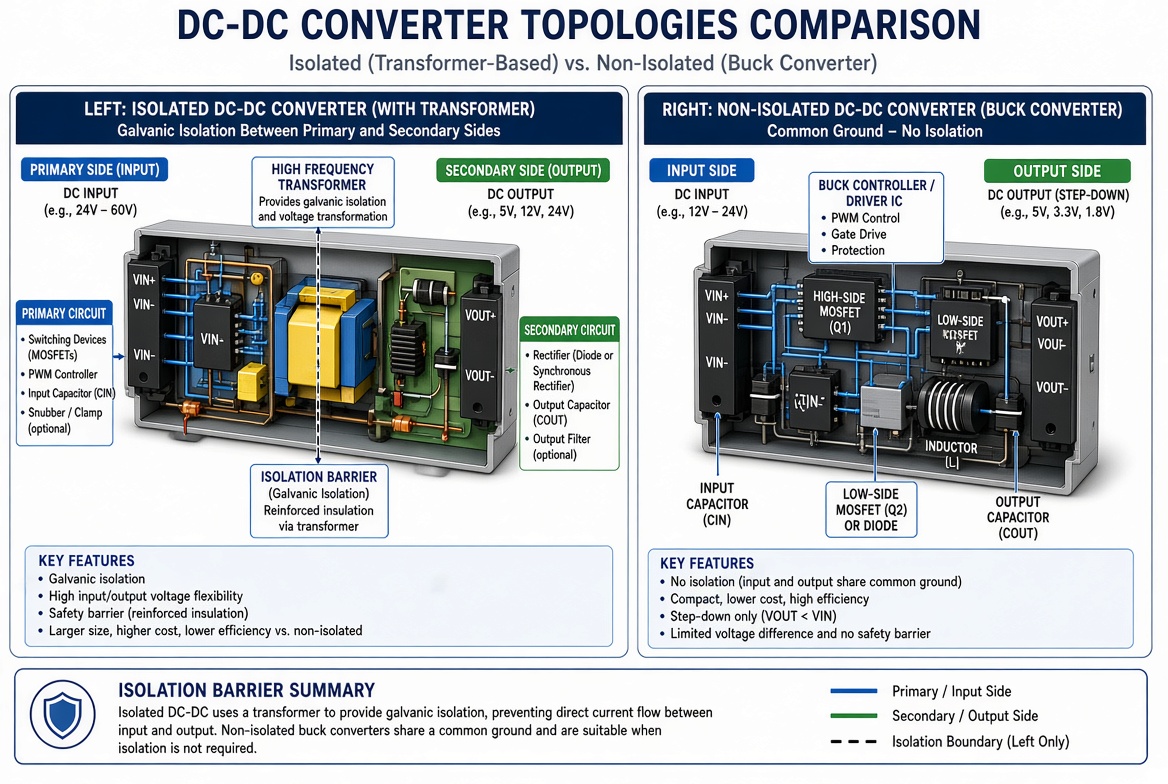
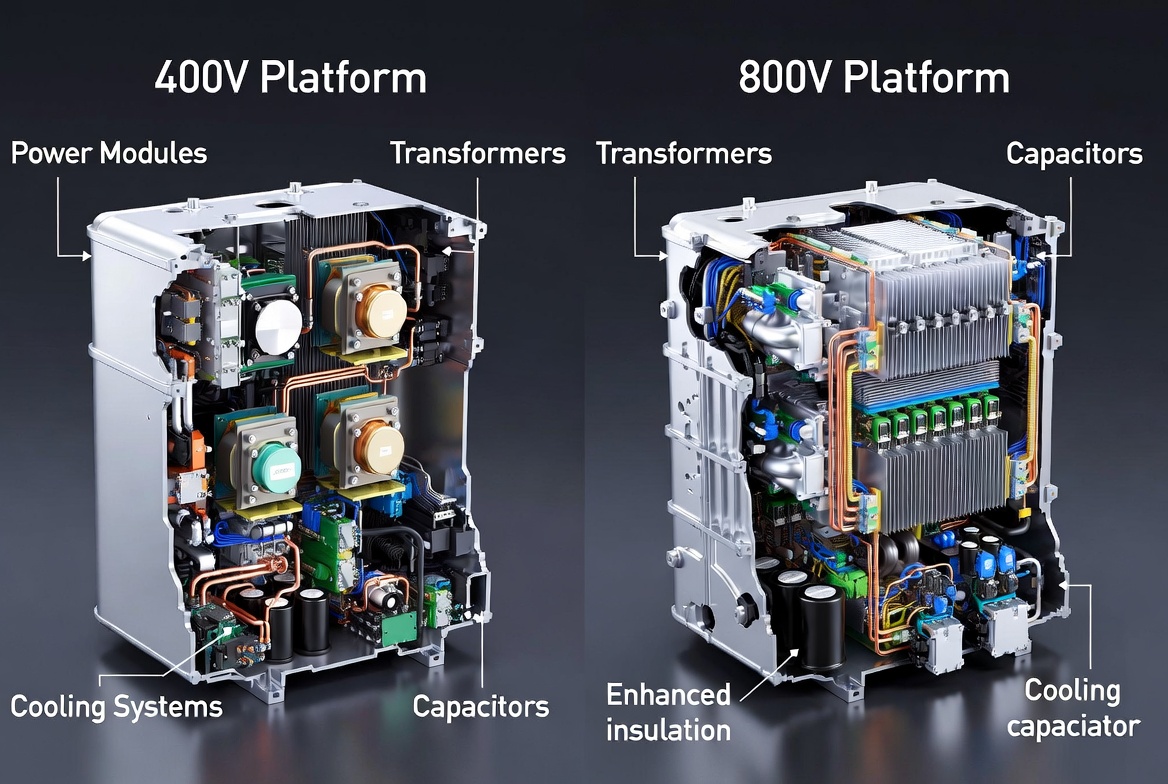
- 400V Architecture: LLC resonant converters are widely used due to their excellent efficiency and relatively simple control. Transformer turns ratio and insulation are designed for 400V–500V operation.
- 800V Architecture: Higher voltage demands stronger isolation (higher dielectric strength materials) and often CLLC or Dual Active Bridge (DAB) topologies for bidirectional capability. The transformer must handle higher voltage stress, which increases design complexity and material costs.
Ovar Tech’s integrated 11kW OBC + DC-DC modules exemplify these adaptations, offering robust performance across both 400V and 800V platforms.
 |
4. Semiconductor and Thermal Management
- Semiconductors: 400V OBCs can rely more on cost-effective silicon devices. 800V platforms heavily favor SiC MOSFETs for lower switching losses and higher temperature tolerance.
- Thermal Design: Higher voltage often leads to different loss distributions. 800V systems may require enhanced cooling solutions — such as liquid cooling channels — to manage heat from higher voltage stress and power density.
Ovar Tech’s air-cooled and liquid-cooled OBC variants are engineered to address these thermal challenges effectively in both voltage classes.
5. Safety, Insulation, and EMC Considerations
- Insulation: 800V platforms require significantly higher isolation voltage ratings (e.g., 4kV+ reinforced insulation) and greater physical distances to prevent arcing.
- EMC/EMI: Higher dv/dt from SiC devices in 800V systems can generate more electromagnetic interference, necessitating advanced filtering and shielding strategies.
- Functional Safety: Both platforms follow ISO 26262, but 800V systems often demand higher ASIL levels due to increased energy levels.
6. Practical Implications and Ovar Tech Solutions
For vehicle manufacturers, choosing between 400V and 800V affects not only OBC design but also overall system cost, charging speed, and future-proofing. 800V platforms enable faster charging with thinner cables and reduced losses but introduce greater engineering challenges for the OBC.
Ovar Tech provides flexible OBC solutions that support both architectures. Their 6.6kW and 11kW integrated OBC + DC-DC modules are available in 400V and 800V configurations, offering high power density, excellent efficiency (up to 95.5%), and full automotive-grade reliability for commercial vehicles, passenger cars, and marine applications.
 |
Conclusion
The hardware architecture of On-Board Chargers differs substantially between 400V and 800V platforms, primarily in voltage handling, component selection, isolation strategies, and thermal design. While 400V remains cost-effective and widely used, 800V platforms are gaining traction for their fast-charging advantages and future scalability. Manufacturers like Ovar Tech bridge this gap by offering versatile, high-performance OBC solutions optimized for both voltage architectures, helping OEMs accelerate the transition to more efficient electrified vehicles.
この記事を共有する