How Do Home Charging Piles, Portable Chargers, and Wall Boxes Differ in Their Power Requirements for OBCs?

How Do Home Charging Piles, Portable Chargers, and Wall Boxes [...]
How Do Home Charging Piles, Portable Chargers, and Wall Boxes Differ in Their Power Requirements for OBCs?
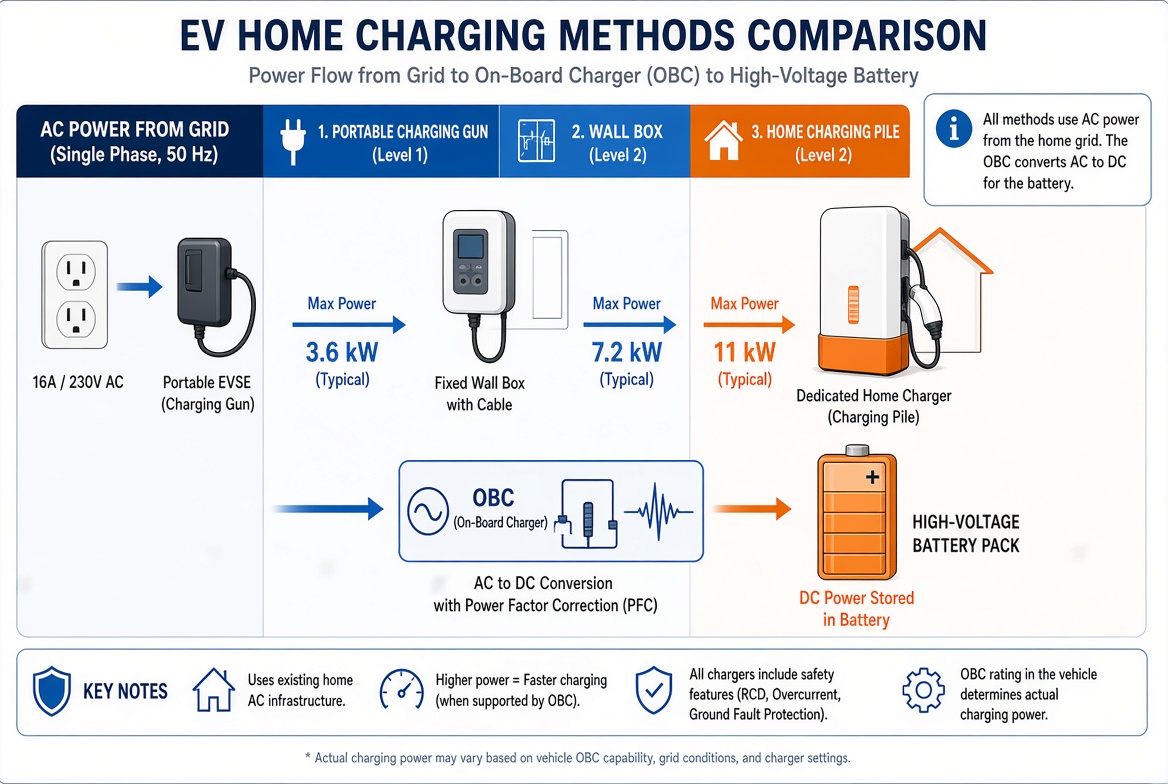
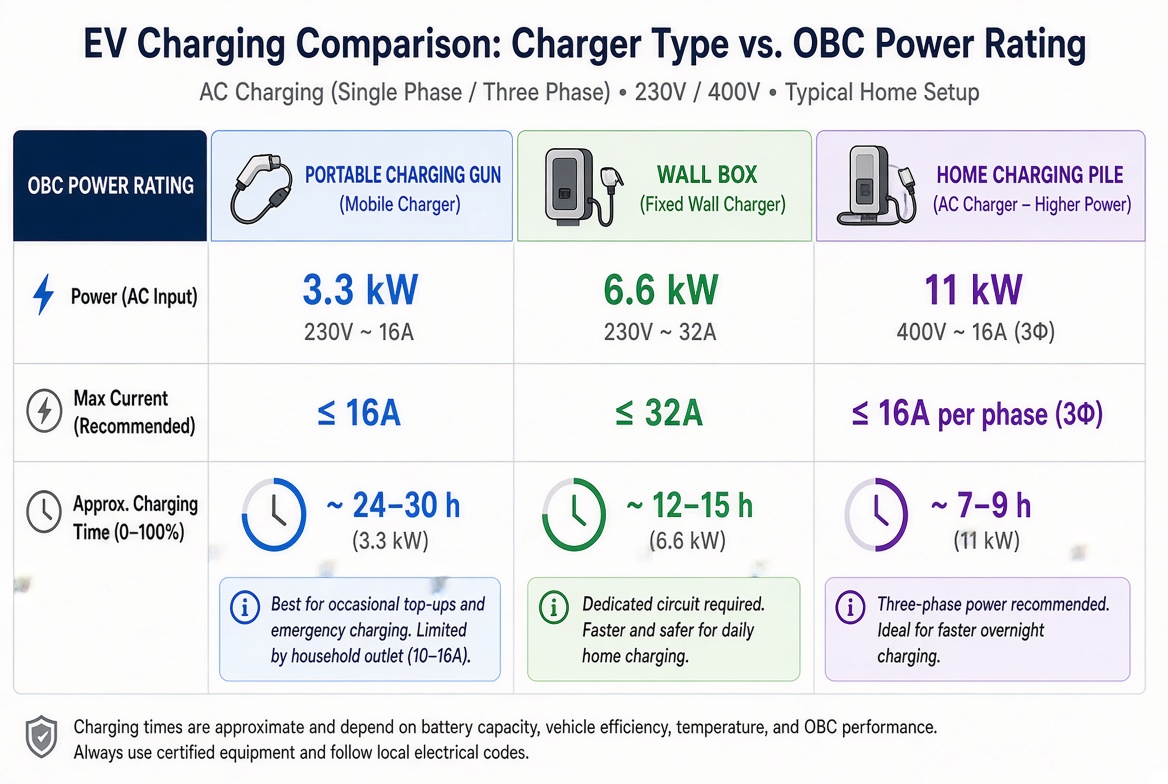
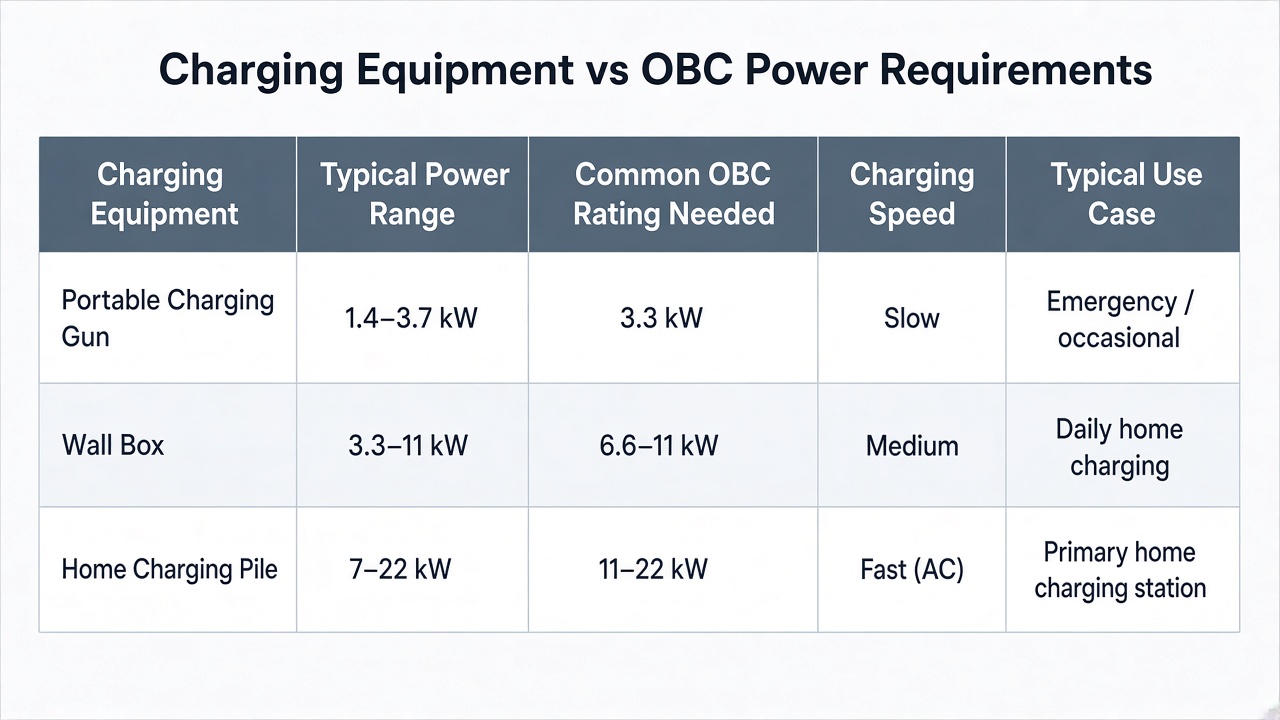
Home charging piles, portable charging guns, and wall boxes place different power demands on the vehicle’s On-Board Charger (OBC) primarily due to differences in available grid connection capacity, installation type, and intended use. Portable chargers typically deliver 1.4–3.7 kW (Level 1), wall boxes and dedicated home charging piles usually provide 3.3–22 kW (Level 2), and the OBC must be designed to safely accept and convert the power supplied by each type of equipment. Matching OBC power rating to the expected charging infrastructure is essential for optimal charging speed, efficiency, and system reliability.
 |
1. Portable Charging Guns (Level 1 / Emergency Chargers)
Portable charging guns (also called portable EVSE or “charging guns”) are designed for maximum convenience and mobility. They typically plug into a standard household outlet (120 V in North America or 230 V in Europe/Asia).
Typical power output:
- 1.4–2.0 kW on 120 V (North America)
- 2.2–3.7 kW on 230 V single-phase
Impact on OBC:
- Requires only a low-power OBC (commonly 3.3 kW is more than sufficient).
- The OBC operates at partial load most of the time, which can slightly reduce efficiency but poses minimal thermal stress.
- Ideal for emergency or occasional use, but charging times are long (often 10–20+ hours for a full charge).
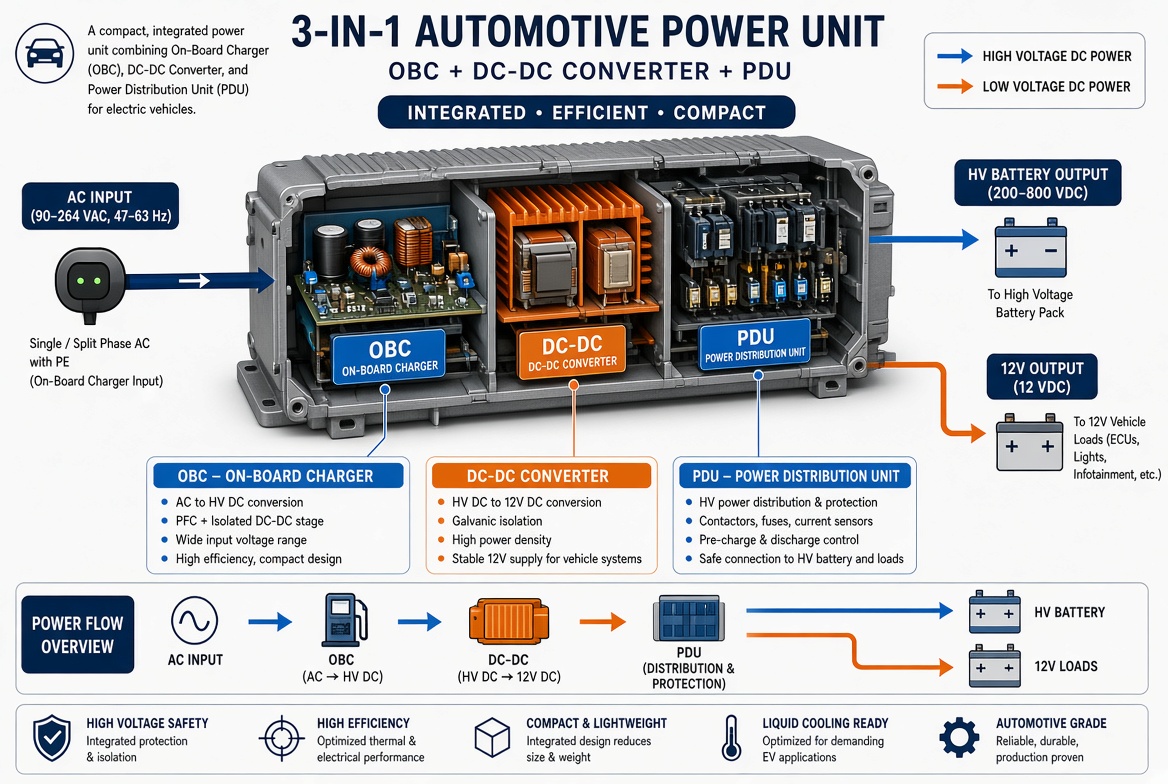
Ovar Tech’s 3.3 kW OBC modules are well-suited for vehicles that primarily rely on portable chargers or low-power home outlets.
2. Wall Boxes (Residential Level 2 Chargers)
Wall boxes are fixed or semi-fixed units installed on a wall, usually connected to a dedicated 230 V or 240 V circuit with higher current capacity (16 A, 32 A, or more).
Typical power output:
- 3.3–7.4 kW (single-phase 16–32 A)
- Up to 11–22 kW when three-phase power is available
Impact on OBC:
- Most passenger EVs are equipped with 6.6 kW or 11 kW OBCs to fully utilize wall-box power.
- The OBC must handle continuous higher current and maintain high efficiency under sustained load.
- Thermal design becomes more important because the charger may operate for several hours at elevated power.
Ovar Tech’s 6.6 kW OBC and integrated 6.6 kW OBC + 1.5/2 kW DC-DC modules are popular choices for vehicles intended for regular wall-box charging.
3. Home Charging Piles (Dedicated Residential Charging Stations)
Home charging piles (also called residential charging stations or “charging piles”) are more robust outdoor or indoor units, often with higher power ratings, better weather protection, and sometimes smart features (app control, load management, RFID).
Typical power output:
- 7–22 kW (single-phase or three-phase)
- Some high-end residential piles reach 22 kW
Impact on OBC:
- Requires a higher-power OBC (11 kW or 22 kW) to take full advantage of the available power.
- The OBC must support three-phase input in many markets and maintain stable performance under high continuous load.
- Advanced communication (e.g., ISO 15118) and bidirectional capability become more relevant for smart charging and future V2G use.
Ovar Tech’s 11 kW and 22 kW OBC solutions, including bi-directional versions, are designed for vehicles that will regularly use higher-power home charging piles.
 |
4. Key Differences in OBC Power Requirements
 |
5. Practical Considerations for Vehicle Manufacturers and Users
- Over-sizing the OBC allows the vehicle to take full advantage of higher-power infrastructure when available, but increases cost, weight, and thermal management requirements.
- Under-sizing limits charging speed even when a high-power wall box or pile is present.
- Integrated OBC + DC-DC modules (such as Ovar Tech’s 6.6 kW + 1.5/2 kW and bi-directional 11 kW + 3 kW solutions) help optimize space and weight while still supporting a wide range of charging equipment.
In markets where three-phase power is common (Europe, China, etc.), 11 kW OBCs have become the mainstream choice for new passenger vehicles, while commercial and specialty vehicles often adopt 22 kW units.
Conclusion
Portable charging guns, wall boxes, and home charging piles impose progressively higher power demands on the vehicle’s On-Board Charger. A 3.3 kW OBC is adequate for portable use, a 6.6–11 kW unit is optimal for most wall-box scenarios, and 11–22 kW OBCs are required to fully utilize dedicated home charging piles. Selecting the right OBC power rating — and considering integrated solutions from manufacturers such as Ovar Tech — ensures the best balance of charging speed, cost, efficiency, and future-proofing for different usage patterns.
この記事を共有する