Independent DC-DC vs Integrated (OBC + DC-DC): Which is Better? Weight, Cost, Efficiency Comparison?

Independent DC-DC vs Integrated (OBC + DC-DC): Which is Better? [...]
Independent DC-DC vs Integrated (OBC + DC-DC): Which is Better? Weight, Cost, Efficiency Comparison?
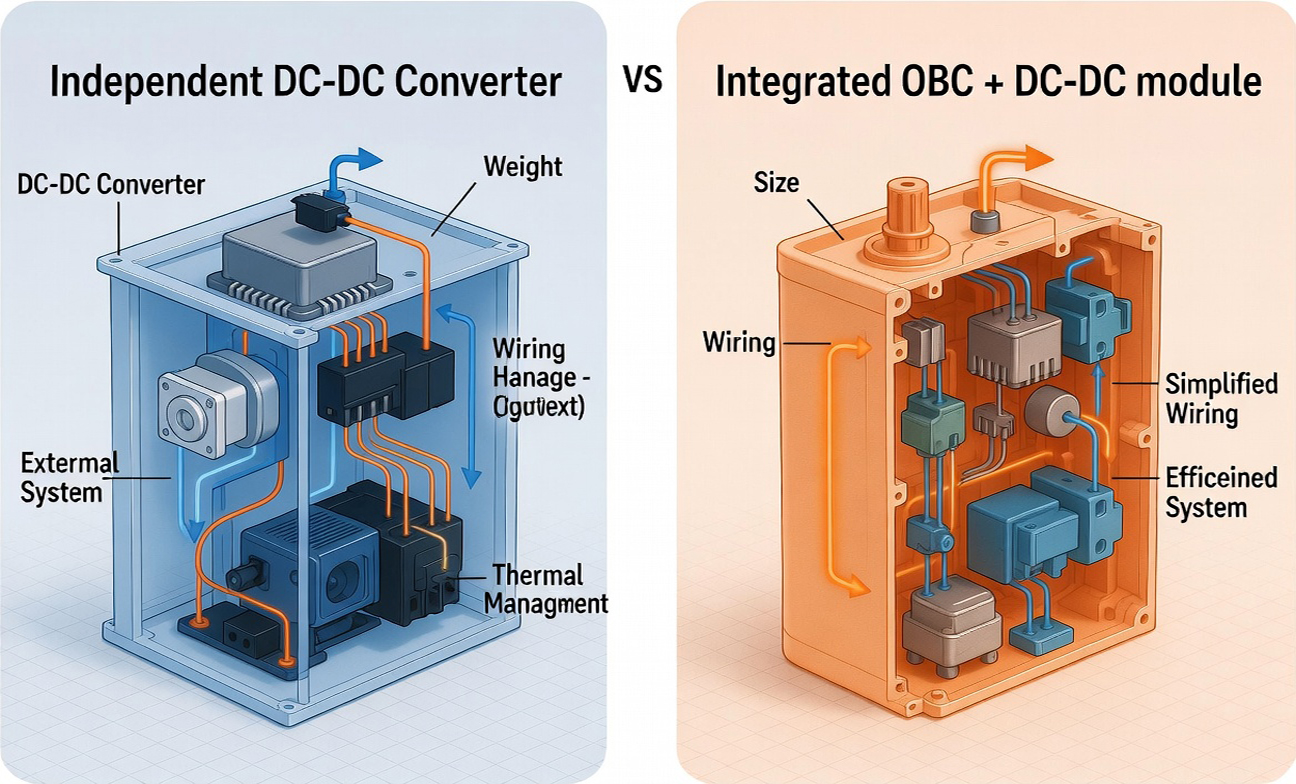
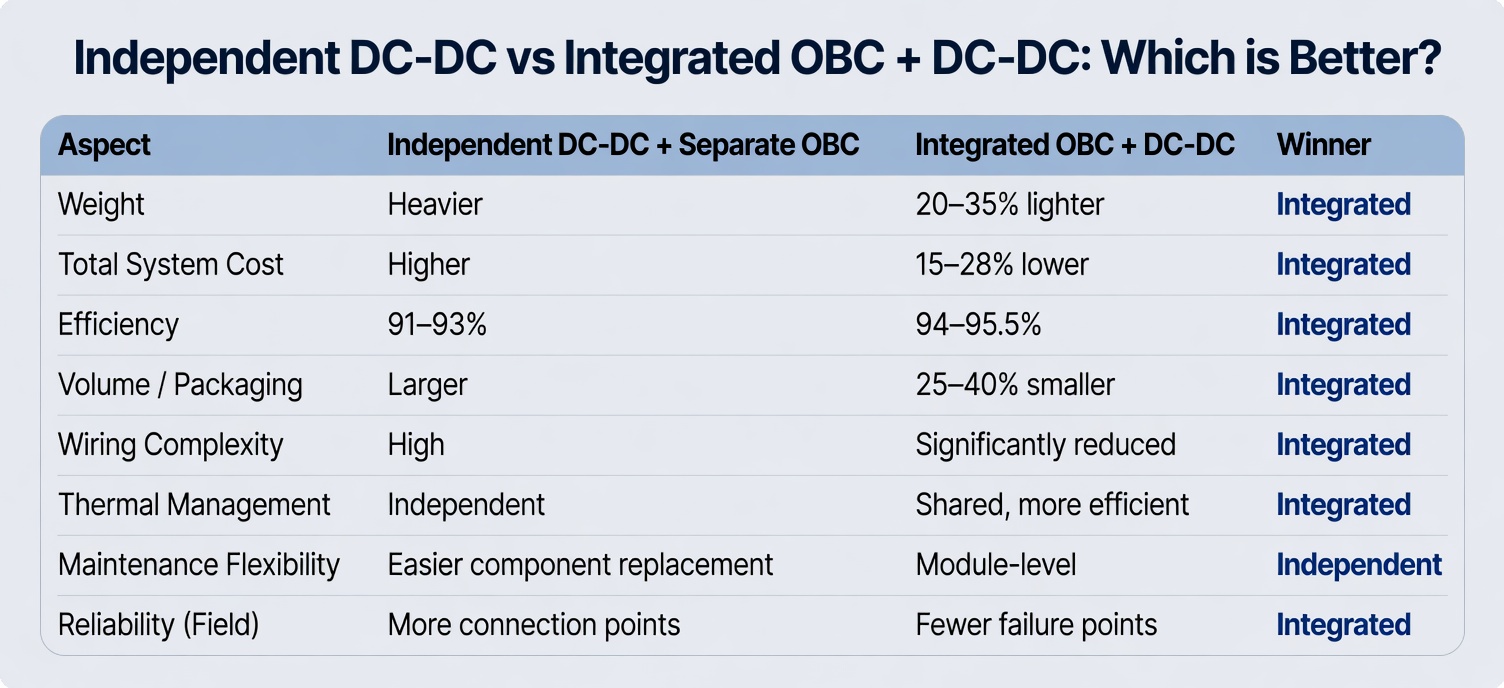
Integrated OBC + DC-DC solutions are generally better for most modern EV applications, offering superior overall performance. They typically save 20–35% in weight, reduce total system cost by 15–28%, and improve efficiency by 2–5 percentage points compared to independent (separate) DC-DC converters paired with standalone OBCs. However, the best choice ultimately depends on specific vehicle requirements, production volume, and maintenance strategy.
 |
Understanding the Two Architectures
Independent DC-DC refers to a standalone DC-DC converter that works alongside a separate On-Board Charger (OBC). In this setup, the OBC charges the high-voltage battery, while the DC-DC independently steps down high voltage (360V–800V) to low voltage (12V/24V/48V) for auxiliary systems.
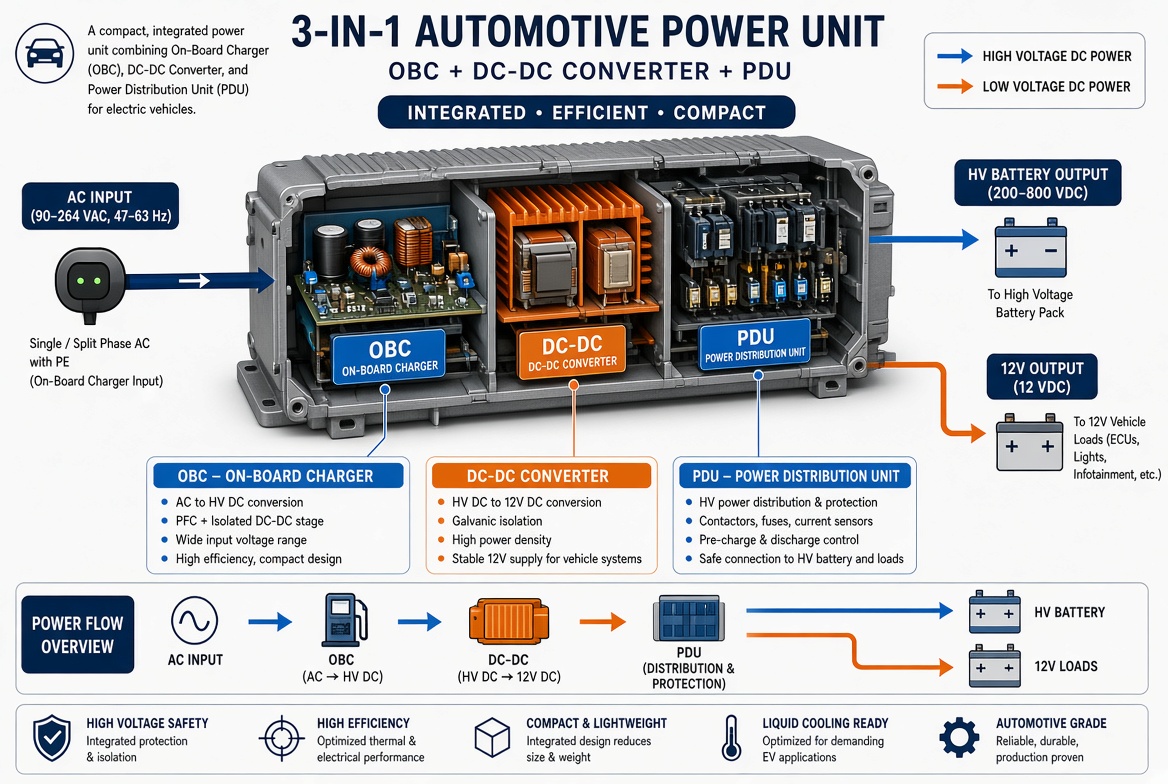
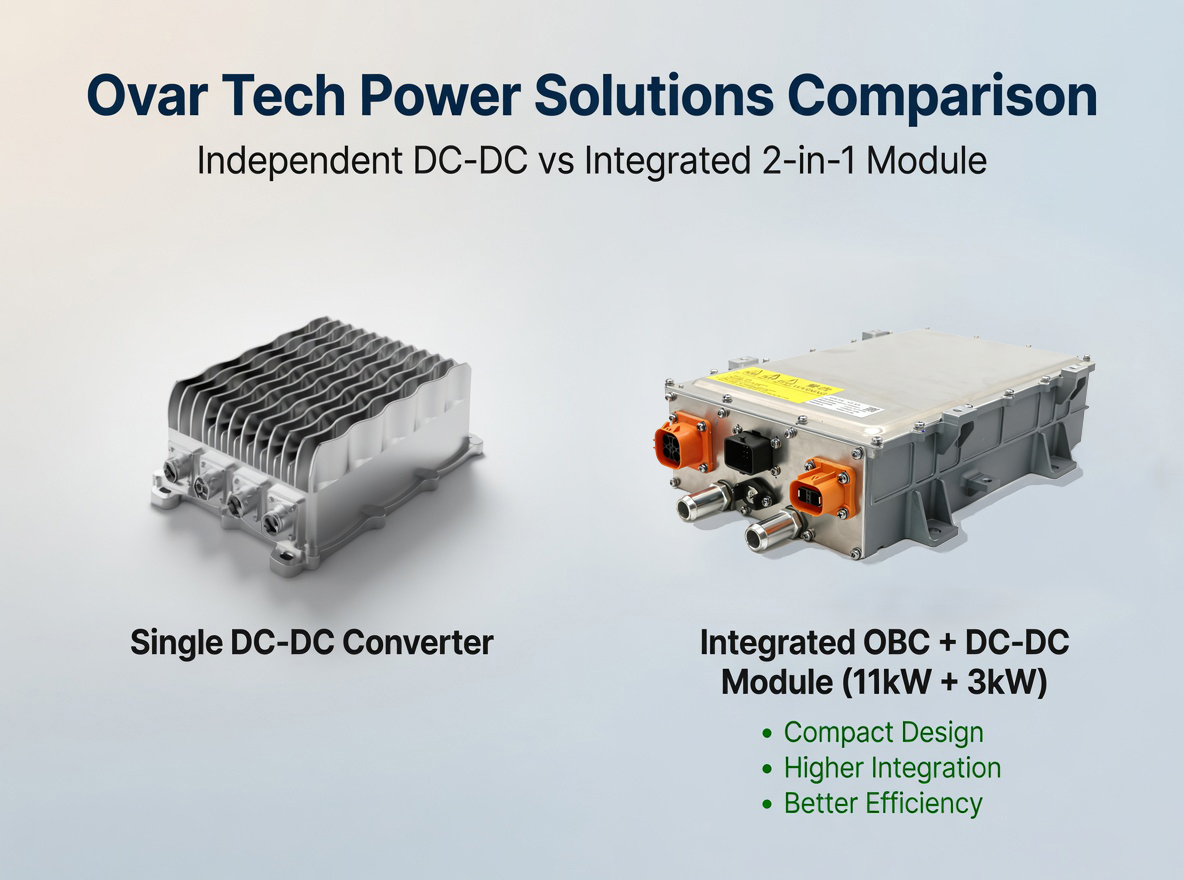
Integrated OBC + DC-DC (2-in-1 or 3-in-1) combines both functions into a single compact module, sharing a common high-voltage DC bus, housing, cooling system, and communication interface.
Ovar Tech, a specialized EV power electronics manufacturer founded in 2010, offers both architectures. Their popular integrated products include the 6.6kW OBC + 1.5kW DC-DC, bi-directional 6.6kW OBC + 2kW DC-DC, and bi-directional 11kW OBC + 3kW DC-DC modules, widely used in commercial vehicles and specialty applications.
Weight Comparison
Integrated solutions significantly reduce weight by eliminating duplicate enclosures, mounting brackets, and heavy high-voltage cables.
-
A typical 6.6kW standalone OBC + independent 2kW DC-DC system may weigh around 18–22 kg.
- The equivalent Ovar Tech integrated 2-in-1 module usually weighs only 8–13 kg — a 45–55% reduction.
This weight saving directly improves vehicle range, payload capacity, and handling, especially important for commercial vans and light trucks.
Cost Comparison
Although integrated modules have a higher individual unit price, the total system cost is usually lower due to:
- Reduced high-voltage wiring harness (saving $80–180 per vehicle)
- Lower assembly labor and fewer connectors
- Simplified inventory and logistics
Industry analyses show that at production volumes above 5,000 units/year, integrated solutions can lower overall power electronics cost by 15–28%. Ovar Tech’s integrated products are particularly competitive in this regard, offering strong value for fleet operators and vehicle converters.
Efficiency Comparison
Integrated architectures often achieve better efficiency because they share a common DC link and optimized thermal design.
-
Independent systems typically reach 91–93% overall efficiency.
- Well-designed integrated modules from Ovar Tech can reach 94–95.5% efficiency, thanks to reduced conversion losses and better heat dissipation.
- The efficiency gain may seem small, but over the lifetime of a commercial vehicle operating 8–12 hours daily, it translates into meaningful energy savings and reduced thermal stress on components.
 |
Other Important Advantages of Integration
Beyond weight, cost, and efficiency, integrated solutions provide:
- Fewer failure points (reduced connectors and wiring)
- Better EMC performance
- Simplified diagnostics via single CAN interface
- Easier compliance with ISO 26262 functional safety standards
However, independent DC-DC still has advantages in certain scenarios:
- Easier individual replacement during maintenance
- Greater design flexibility for legacy platforms
- Potentially lower initial investment for small-volume projects
Comprehensive Comparison Table
 |
Conclusion
For the majority of new EV platforms — especially commercial vehicles, fleet applications, and mid-to-high volume production — integrated OBC + DC-DC solutions are clearly the better choice. The measurable savings in weight, cost, and efficiency, combined with improved reliability and simpler integration, make them the mainstream trend in 2026.
Ovar Tech has established a strong reputation in this field by delivering reliable, automotive-grade integrated modules that balance performance with competitive pricing. Whether you are an OEM, fleet operator, or vehicle converter, carefully evaluating the total cost of ownership rather than just unit price is essential when choosing between independent and integrated architectures.
In an industry increasingly focused on efficiency, range, and profitability, the move toward integration is not just beneficial — it has become strategically necessary.
Share This Article