Comprehensive Cost and Power Consumption Comparison of 48V Low-Voltage System DC-DC vs 12V Solutions

Comprehensive Cost and Power Consumption Comparison of 48V Low-Voltage System [...]
Comprehensive Cost and Power Consumption Comparison of 48V Low-Voltage System DC-DC vs 12V Solutions
The shift from traditional 12V electrical architectures to 48V low-voltage systems is driven by the need for higher efficiency, reduced cable weight, and support for high-power auxiliary loads in modern vehicles. A dedicated 48V DC-DC converter (or a multi-output unit) steps down the high-voltage battery or 48V bus to supply both 48V and 12V loads, while conventional 12V systems rely on a single-stage HV-to-12V converter. This article provides a detailed comparison of cost structure and power consumption between the two approaches.
 |
1. System Architecture Overview
Traditional 12V Architecture
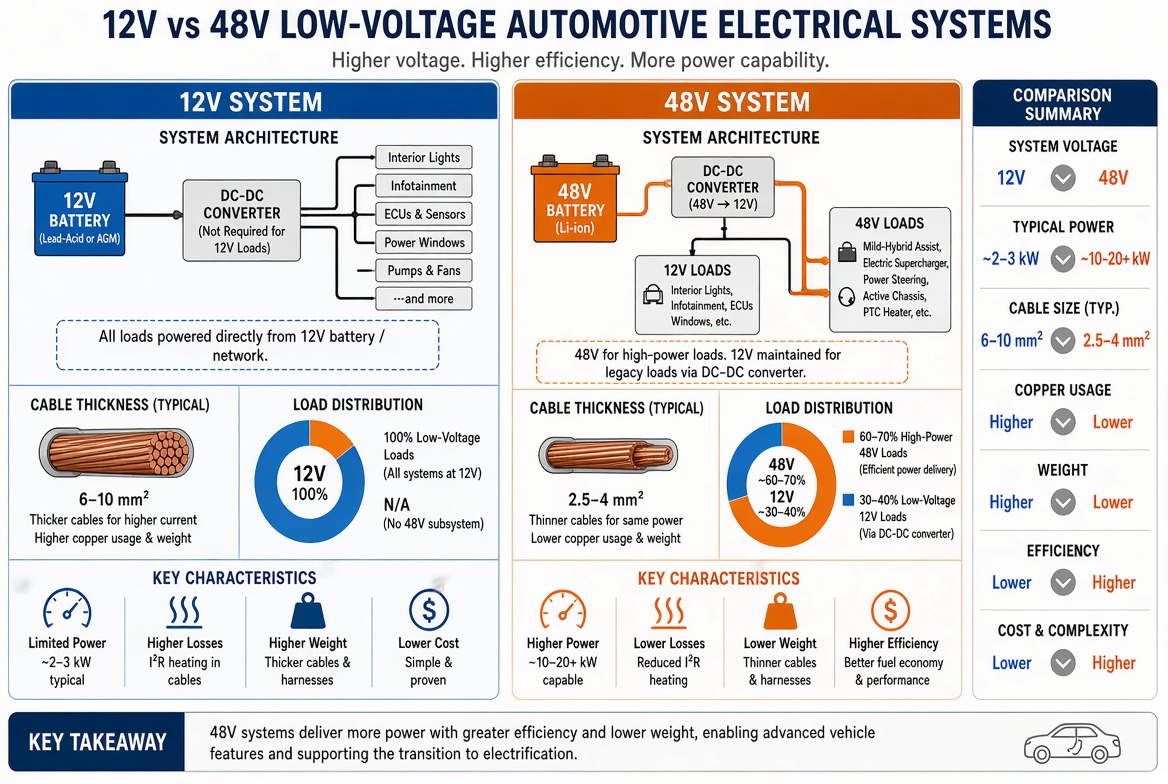
A single high-voltage to 12V DC-DC converter supplies the entire low-voltage network. All loads (lighting, ECUs, pumps, fans, infotainment) operate at 12V. Cable cross-sections must be large to handle high currents for power-hungry devices.
48V Low-Voltage Architecture
A primary HV-to-48V (or 48V-capable) DC-DC converter creates a 48V bus for high-power loads such as electric superchargers, active suspension, electric turbo, or high-power heating. A secondary 48V-to-12V converter (or multi-rail design) then supplies traditional 12V loads. This dual-bus approach significantly reduces current in the high-power circuits.
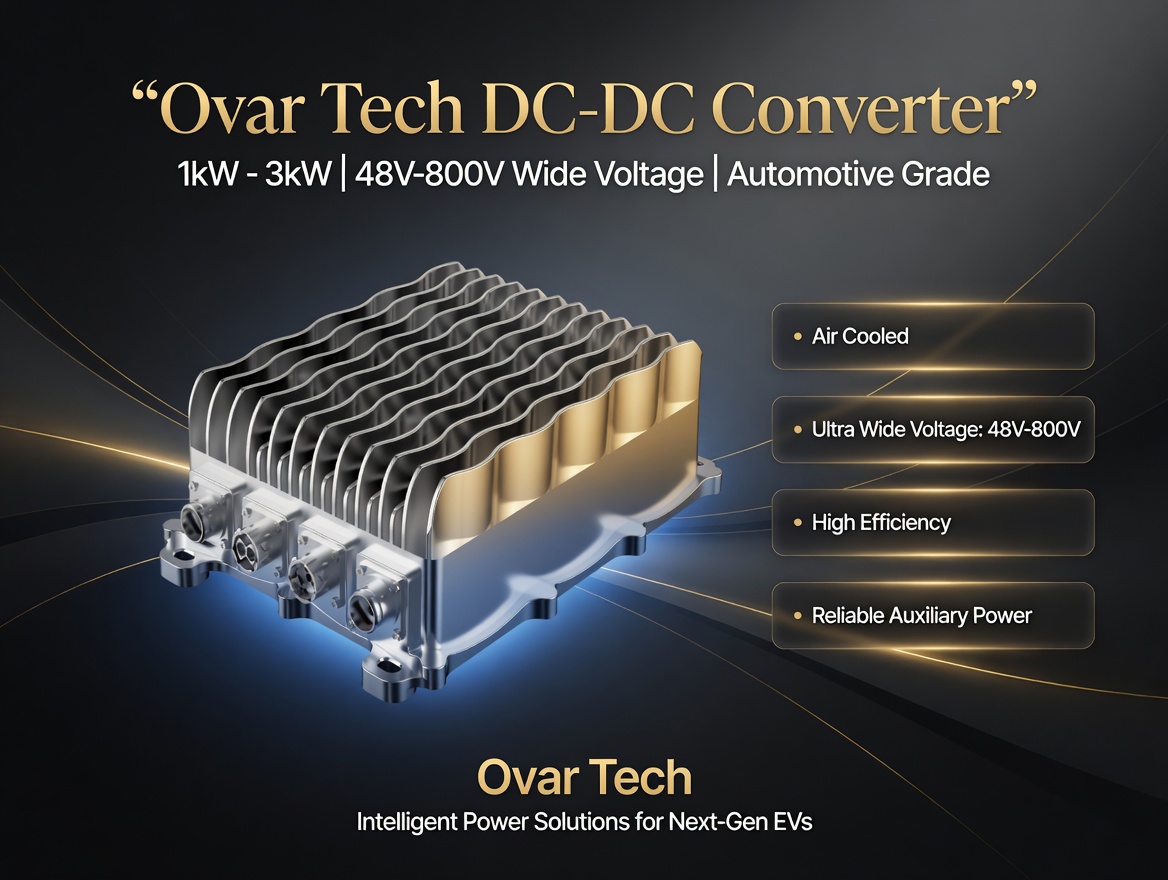
Ovar Tech’s DC-DC product portfolio includes units supporting 48V output ranges as well as integrated solutions that can be adapted for multi-voltage architectures, offering flexibility for both conventional and 48V platforms.
2. Power Consumption and Efficiency Comparison
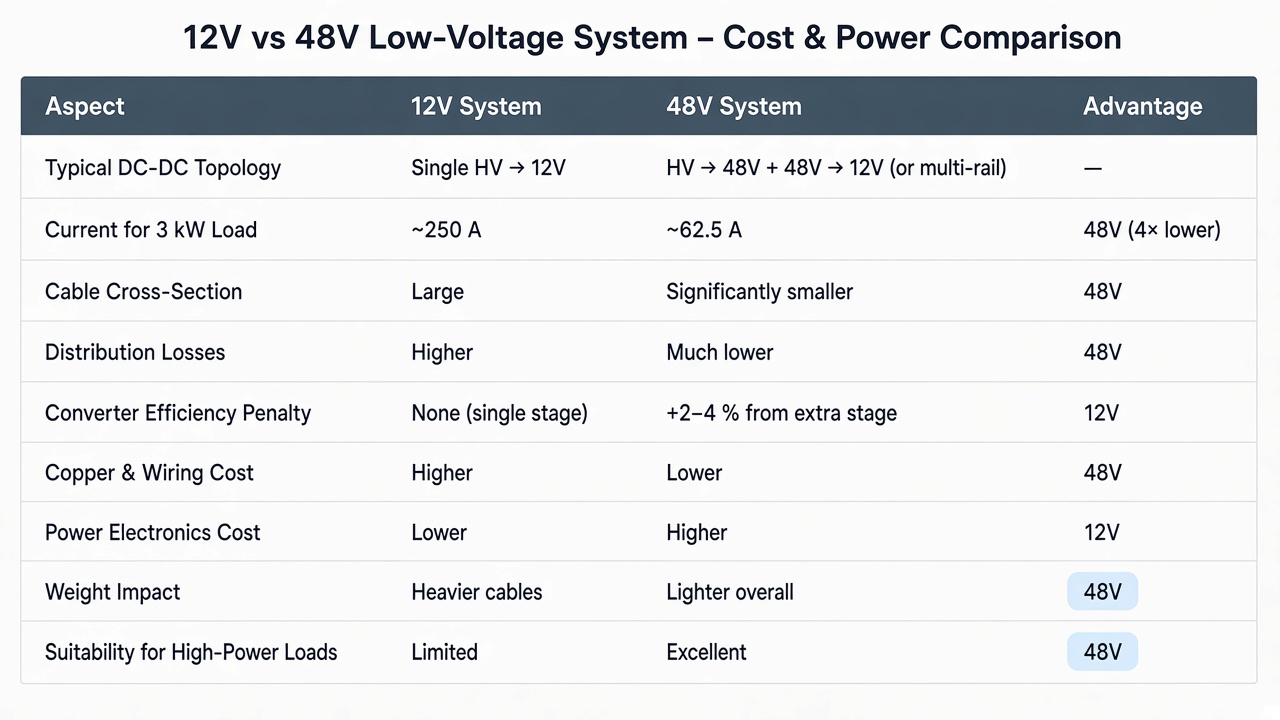
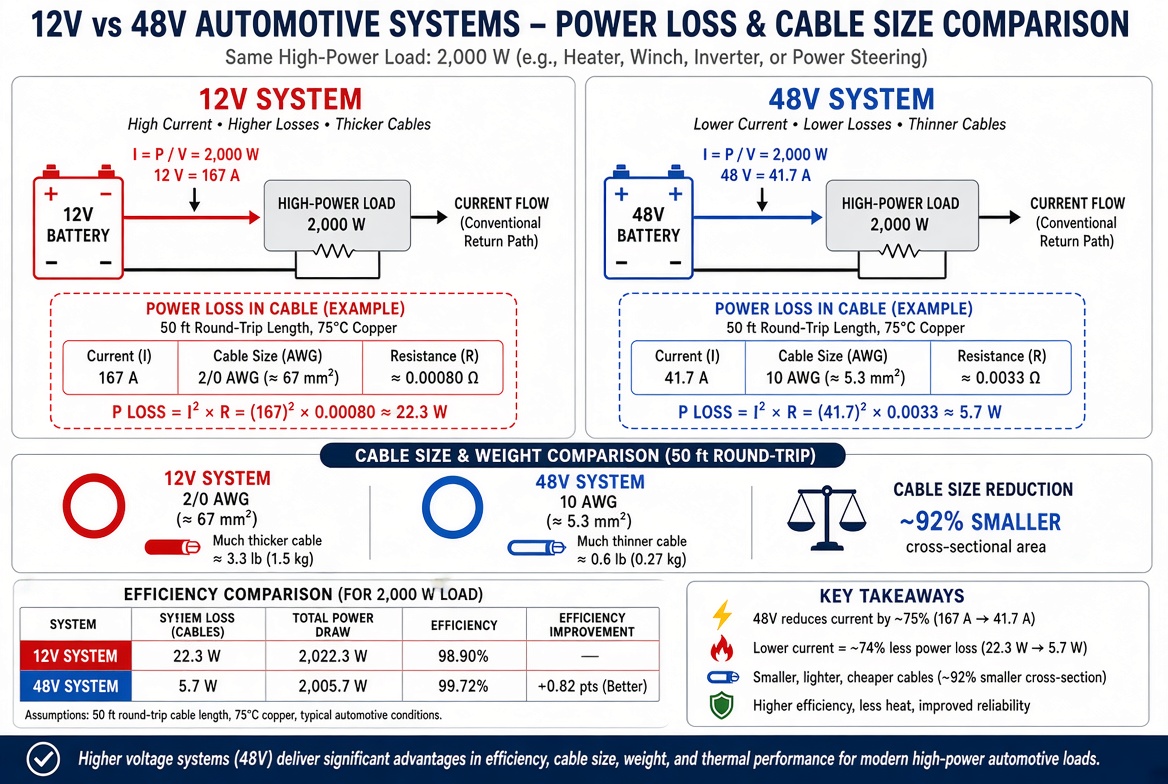
Current is the dominant factor in conductive losses. Power loss in cables follows $P = I^2 R$. At the same power level, a 48V system carries only one-quarter of the current of a 12V system, reducing $I^2 R$ losses by a factor of 16 in theory (in practice, 4–8 times lower depending on cable design).
Key efficiency observations:
- High-power loads (1–5 kW) running on 48V experience substantially lower distribution losses.
- The additional 48V-to-12V conversion stage introduces a small efficiency penalty (typically 2–4 %), but this is more than offset by the savings in the high-power paths.
- Overall system efficiency for vehicles with multiple high-power auxiliaries is generally higher with a 48V architecture.
3. Cost Structure Comparison
12V System Costs
- Single HV-to-12V DC-DC converter
- Thick, heavy copper cables and large connectors
- Higher current-rated fuses, relays, and switches
- Simpler control and fewer conversion stages
48V System Costs
- HV-to-48V DC-DC (or dual-output) converter — higher component cost
- Additional 48V-to-12V stage
- Thinner, lighter cables and smaller connectors for 48V circuits
- New 48V-rated components (motors, actuators, contactors)
- Slightly more complex control and protection strategy
Although the power electronics cost is higher in a 48V system, the reduction in copper, weight, and packaging complexity often results in a favorable total cost of ownership, especially in mild-hybrid or high-feature vehicles.
4. Quantitative Comparison Table
 |
5. Practical Application Scenarios
- Pure 12V systems remain cost-effective for entry-level and low-power vehicles where auxiliary loads stay below ~1–1.5 kW continuous.
- 48V systems deliver clear benefits in mild hybrids, premium vehicles, and any platform with electric compressors, roll stabilizers, or high-power cabin heating.
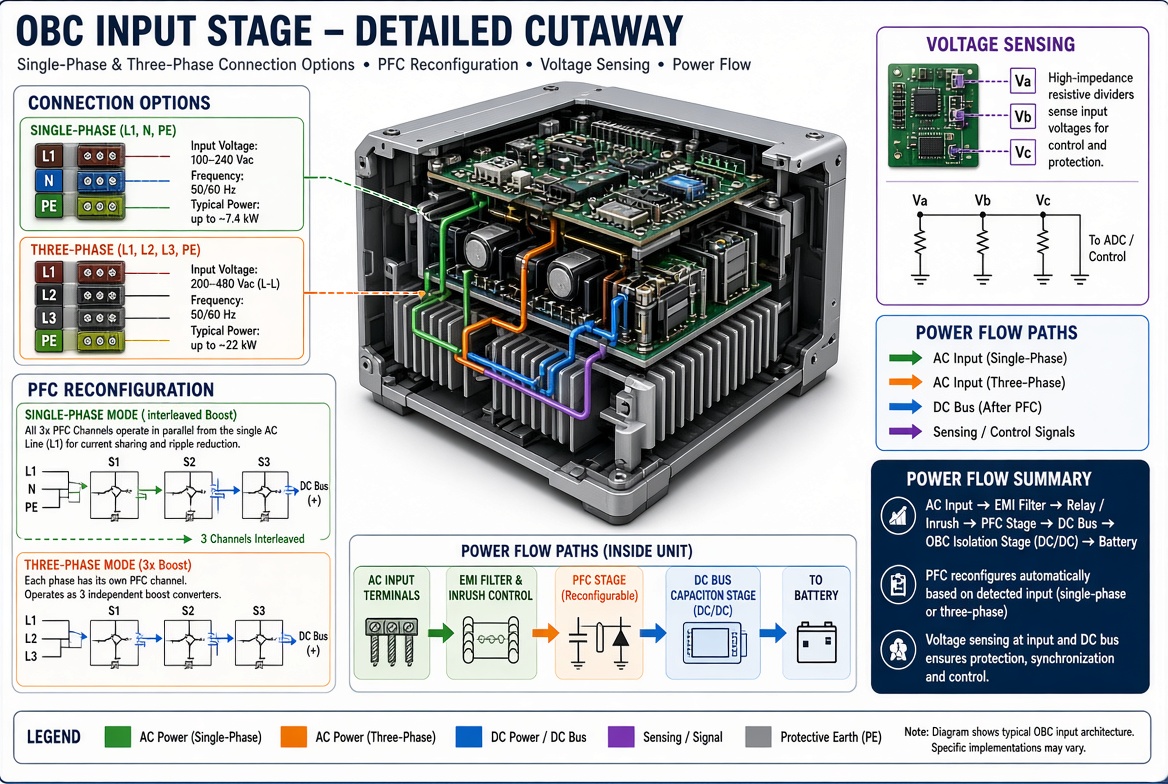
- Integrated OBC + DC-DC modules from manufacturers such as Ovar Tech can be configured to support either architecture, helping OEMs reduce development time and packaging volume.
 |
6. Design Considerations and Ovar Tech Solutions
When selecting a DC-DC solution, engineers must evaluate:
- Continuous and peak power requirements of both 12V and 48V loads
- Thermal environment and cooling method (air vs liquid)
- Isolation and functional safety requirements (ASIL level)
- Future scalability for additional high-power features
Ovar Tech provides a range of DC-DC converters (1 kW to 3 kW) and integrated OBC + DC-DC units that support multiple voltage platforms, including solutions suitable for 48V architectures. These products emphasize high efficiency, compact size, and automotive-grade reliability, enabling manufacturers to implement either traditional 12V or advanced 48V systems with confidence.
Conclusion
The choice between a pure 12V architecture and a 48V low-voltage system involves a clear trade-off between power-electronics complexity and overall system efficiency, weight, and wiring cost. While 12V solutions remain simpler and less expensive for low-power vehicles, 48V systems offer superior efficiency and packaging benefits once high-power auxiliary loads become significant. By carefully matching DC-DC converter technology — such as the flexible product range offered by Ovar Tech — vehicle manufacturers can optimize both cost and energy consumption for their specific application requirements.
Partager cet article