OBC Supported Voltage Platforms: Low Voltage (48V/96V/144V) vs. High Voltage (400V–850V) – What Are the Real-World Impacts?

OBC Supported Voltage Platforms: Low Voltage (48V/96V/144V) vs. High Voltage [...]
OBC Supported Voltage Platforms: Low Voltage (48V/96V/144V) vs. High Voltage (400V–850V) – What Are the Real-World Impacts?
The On-Board Charger (OBC) is one of the most critical components in any electric or electrified vehicle. It converts alternating current (AC) from the grid or wall charger into direct current (DC) to replenish the vehicle’s traction battery. However, not all OBCs are created equal — their design and performance are heavily tied to the vehicle’s voltage platform, requiring hardware precisely optimized for either low or high-voltage battery architectures.
Modern electrified vehicles operate on two broad voltage categories:
- Low-voltage systems (typically 48V, 96V, or 144V) — common in mild hybrids (MHEVs) and some light-duty or older EVs.
- High-voltage systems (400V to 850V, with 400V and 800V being the most prevalent) — standard in full battery electric vehicles (BEVs) and plug-in hybrids (PHEVs).
Understanding which voltage platforms an OBC supports — and the practical differences between low- and high-voltage architectures — helps explain everything from charging speed and efficiency to cost, safety, and long-term ownership experience.
What Voltage Platforms Do OBCs Typically Support?
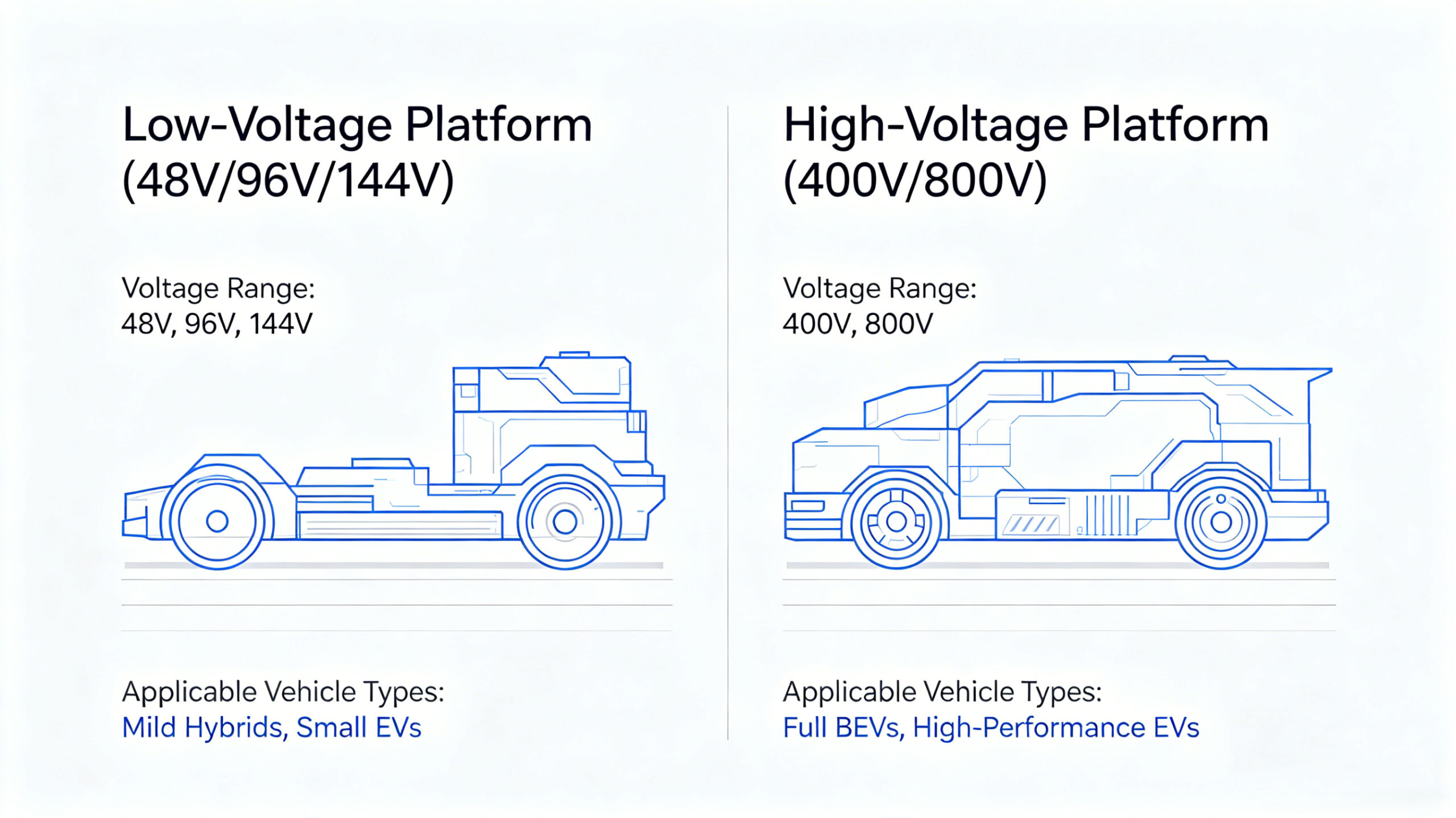 Figure 1: Comparison Diagram of Low-Voltage and High-Voltage Platforms Figure 1: Comparison Diagram of Low-Voltage and High-Voltage Platforms |
OBCs are engineered to match the output DC voltage required by the vehicle’s high-voltage (or traction) battery while accepting standard AC input from the grid (usually 120V/240V single-phase or 400V three-phase in Europe).
- Low-voltage OBCs (48V / 96V / 144V): These are mainly found in 48V mild-hybrid systems and some small or legacy electric vehicles. The OBC outputs relatively low DC voltage to charge a smaller battery pack used for assistance rather than primary propulsion. Power levels are modest, often 3–7 kW for AC charging. These systems rarely support high-power DC fast charging directly.This segment requires compact, rugged OBC hardware engineered for continuous stable operation, ideal for low-speed EV, marine, and industrial vehicle applications.
- High-voltage OBCs (400V–850V): Most modern full EVs use 400V or 800V (sometimes extending to 850V) battery architectures. The OBC must output DC at the exact battery voltage range (e.g., nominal 400V or 800V). Typical AC OBC power ratings range from 7–22 kW, while the vehicle’s DC fast-charging capability (which bypasses the OBC) can reach 150–350+ kW depending on the architecture.Modern high-voltage OBC designs prioritize high power density and thermal efficiency to support ultra-fast AC charging for mainstream passenger and commercial EV platforms.
Many newer OBCs are designed as multi-voltage compatible or modular, but the core power electronics (MOSFETs, diodes, transformers) are optimized for a specific voltage class.
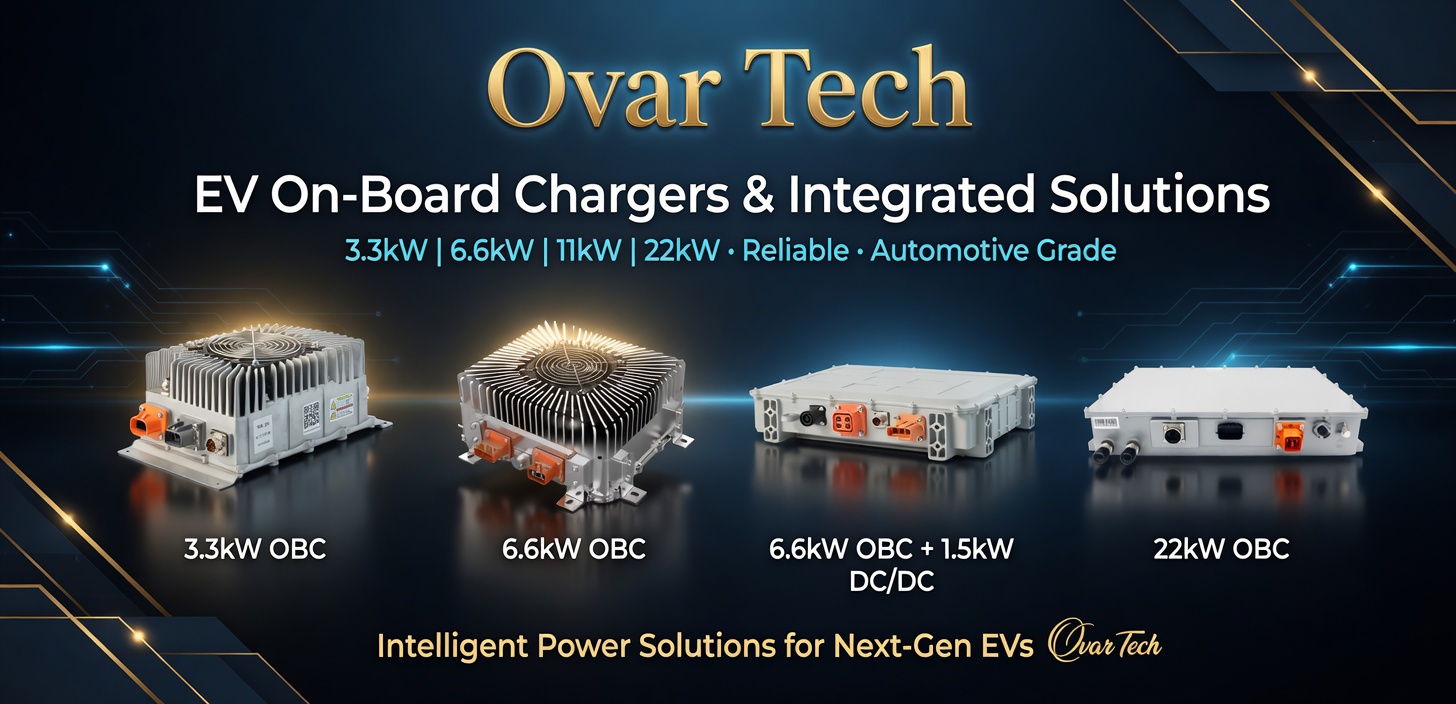 Figure 2: Ovar Tech On-Board Charger Portfolio Figure 2: Ovar Tech On-Board Charger Portfolio |
Low Voltage (48V/96V/144V) vs. High Voltage (400V–850V): Key Practical Impacts
The voltage platform fundamentally affects power delivery because electrical power follows the formula P = V × I (Power = Voltage × Current). For the same power output, higher voltage means lower current — leading to cascading effects across the entire vehicle.
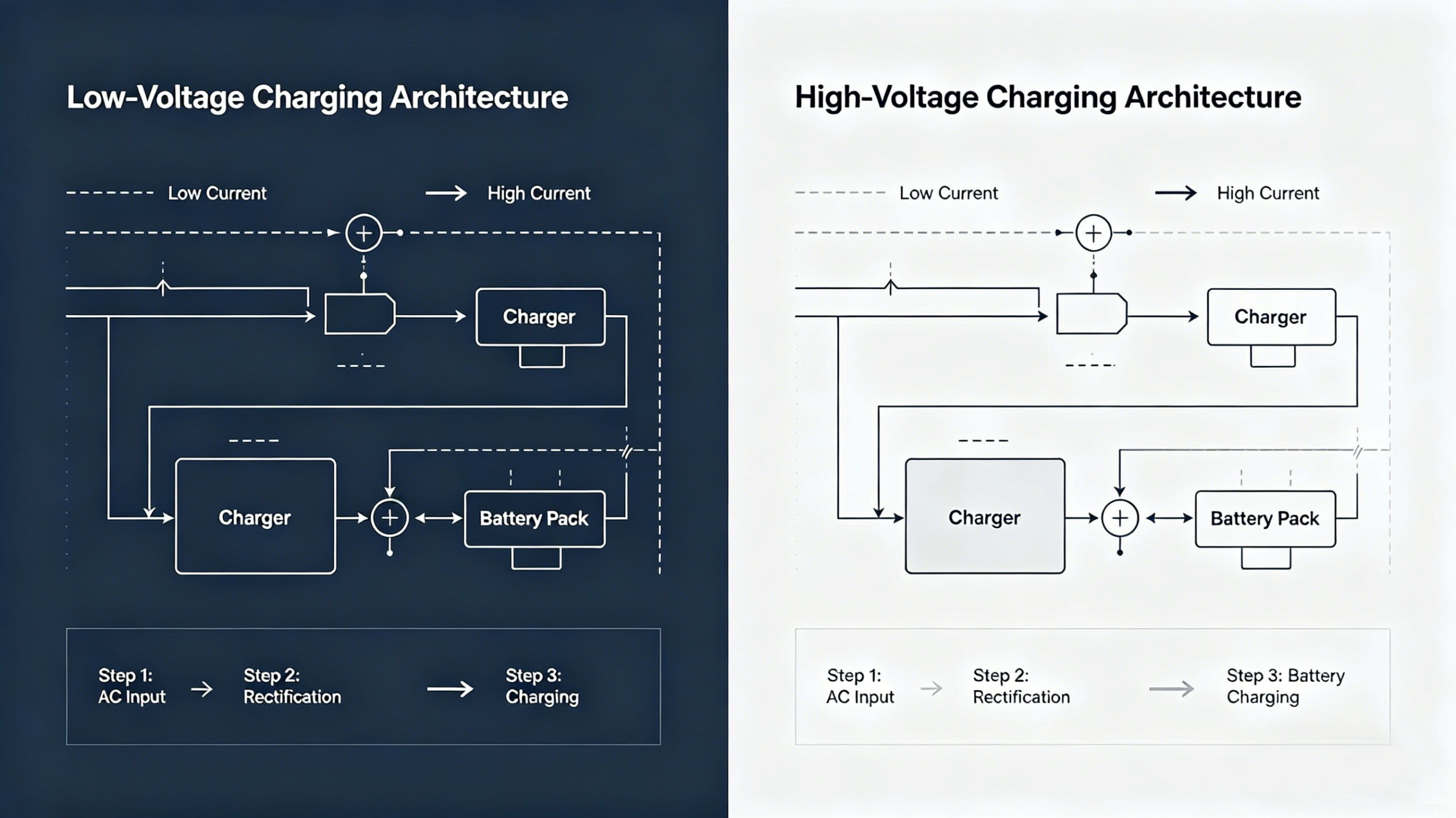 Figure 3:Principle Diagram of Low-Voltage vs. High-Voltage Vehicle Charging Architecture Figure 3:Principle Diagram of Low-Voltage vs. High-Voltage Vehicle Charging Architecture |
1. Charging Speed and Efficiency
- Low-voltage systems: Limited by higher current requirements. Charging is slower and generates more heat in cables and components. A 48V mild-hybrid might only support slow AC charging and offers minimal electric range.
- High-voltage systems: Significantly faster charging is possible. An 800V architecture can deliver the same power at roughly half the current of a 400V system, reducing heat losses and enabling ultra-fast DC charging (up to 350 kW or more). Real-world examples show 800V vehicles often reaching 80% charge in 18–25 minutes on compatible chargers, versus 30–40+ minutes for optimized 400V models.
For AC charging (where the OBC is active), higher-voltage OBCs still benefit from better thermal management and potentially higher power ratings (11–22 kW).
2. Cable Weight, Cost, and Vehicle Efficiency
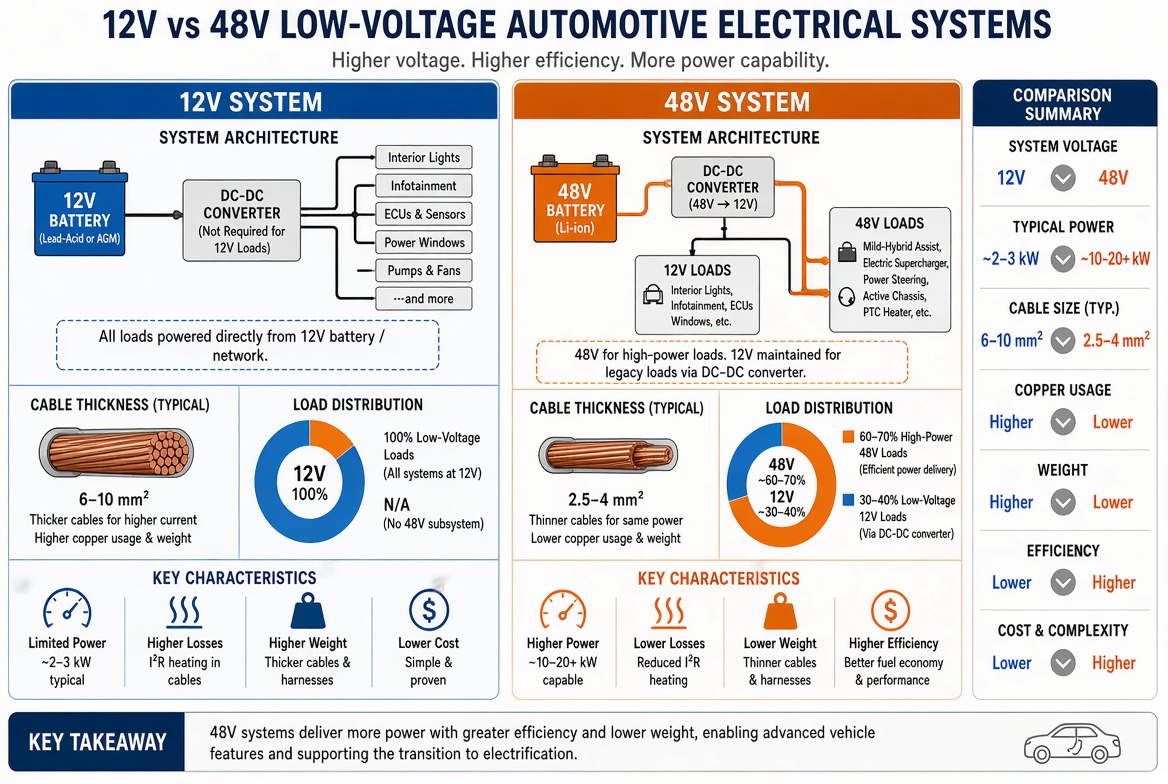
- Higher voltage allows manufacturers to use thinner, lighter copper cables and smaller wiring harnesses because current is lower. This reduces vehicle weight, improves range, lowers material costs, and reduces I²R heat losses.
- Low-voltage systems require thicker cables to handle higher currents safely, adding weight and cost — a notable drawback for efficiency-focused designs. Many system designers now prefer integrated OBC+DC-DC unified power units to simplify wiring layouts, reduce onboard components, and lower overall vehicle integration costs for both low and high voltage projects.
3. Component Design and Cost
- 400V OBCs: Can use mature, lower-cost silicon MOSFETs rated around 650V. Components are cheaper and the supply chain is well-established.
- 800V+ OBCs: Require higher-voltage semiconductors (e.g., 1200V MOSFETs or SiC/GaN devices), more robust diode bridges, adjusted transformer turn ratios, and sometimes upgraded microcontrollers. This increases upfront component cost but can improve long-term efficiency and power density.
Overall, 400V platforms remain cheaper to produce and are still dominant in mass-market EVs, while 800V is increasingly favored for premium and high-performance models.
4. Charging Infrastructure Compatibility
- 400V vehicles: Highly compatible with the vast majority of existing public DC fast chargers.
- 800V vehicles: Can charge on 400V stations (often via an onboard DC-DC boost converter or battery reconfiguration), but speeds are typically limited. Full benefit requires 800V-capable chargers, which are growing but still less common in many regions.
This compatibility gap is one of the main real-world drawbacks of jumping straight to 800V–850V platforms today.
5. Safety and Thermal Management
- Higher voltages demand stricter insulation, isolation, and safety systems (contactors, monitoring, etc.). However, because current is lower for the same power, thermal stress on components can actually be reduced.
- Low-voltage systems (especially 48V) sit below many lethal shock thresholds, simplifying certain safety requirements but limiting performance.
6. Use Cases and Vehicle Type
- 48V/96V/144V: Ideal for mild hybrids, light commercial vehicles, or cost-sensitive applications where full electrification is not needed. They improve fuel economy in ICE vehicles without the complexity and cost of high-voltage systems.
- 400V–850V: Essential for pure EVs and long-range PHEVs that demand high power, fast charging, and strong performance.
Which Voltage Platform Is Better?
There is no universal winner — it depends on priorities:
- Choose low-voltage (48V–144V) if cost, simplicity, and compatibility with existing mild-hybrid supply chains matter most.
- Choose high-voltage (400V–850V) for faster charging, better efficiency, lighter weight, and future-proof performance — especially as high-power charging infrastructure expands.
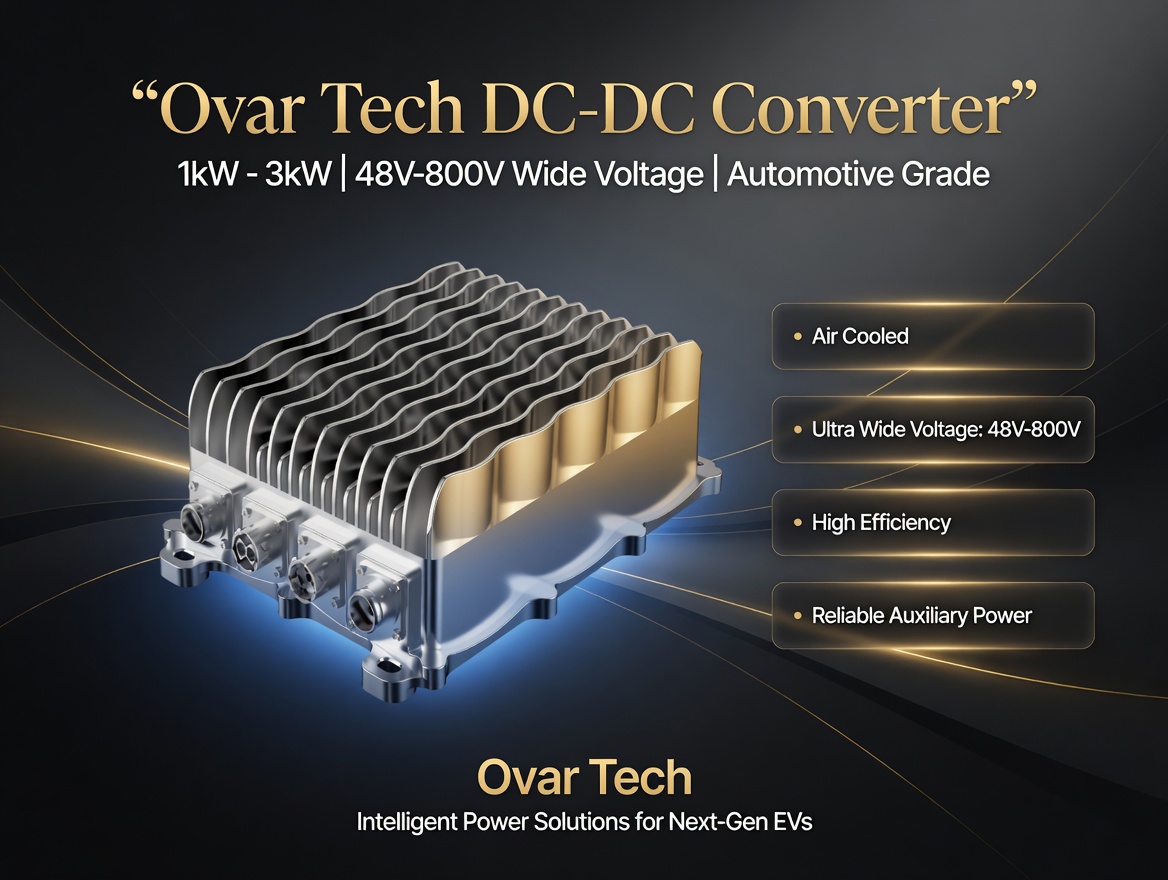
In 2026, the industry is transitioning toward 800V architectures for many new models, but 400V platforms continue to dominate due to mature technology and broad charger compatibility. OBC designers must balance these trade-offs carefully: supporting multiple voltage platforms adds flexibility but increases complexity and cost. Leading power conversion suppliers like Ovar Tech cover the full spectrum of low-to-high voltage OBC, integrated combo units, and standalone DC-DC hardware to match any architecture requirement for modern EV projects.
As EV adoption grows and charging networks evolve, the voltage platform — and the OBC designed for it — will remain a key factor in how quickly, efficiently, and affordably you can recharge on the road.
این مقاله را به اشتراک بگذارید