Complete Working Process of the Automotive High-Voltage DC-DC Converter: The Lifeline of the Low-Voltage 12V Power Supply

Complete Working Process of the Automotive High-Voltage DC-DC Converter: The [...]
Complete Working Process of the Automotive High-Voltage DC-DC Converter: The Lifeline of the Low-Voltage 12V Power Supply
The high-voltage DC-DC converter is the critical power electronics device that steps down the high-voltage battery (typically 200–800 V) to a stable low-voltage output (12 V or 24 V) to power the vehicle’s auxiliary systems. It serves as the “lifeline” of the traditional 12 V electrical architecture in electric and hybrid vehicles, continuously supplying energy to lighting, sensors, controllers, entertainment systems, and safety modules even when the high-voltage battery is the primary energy source.
 |
1. Why the High-Voltage DC-DC Converter Is Essential
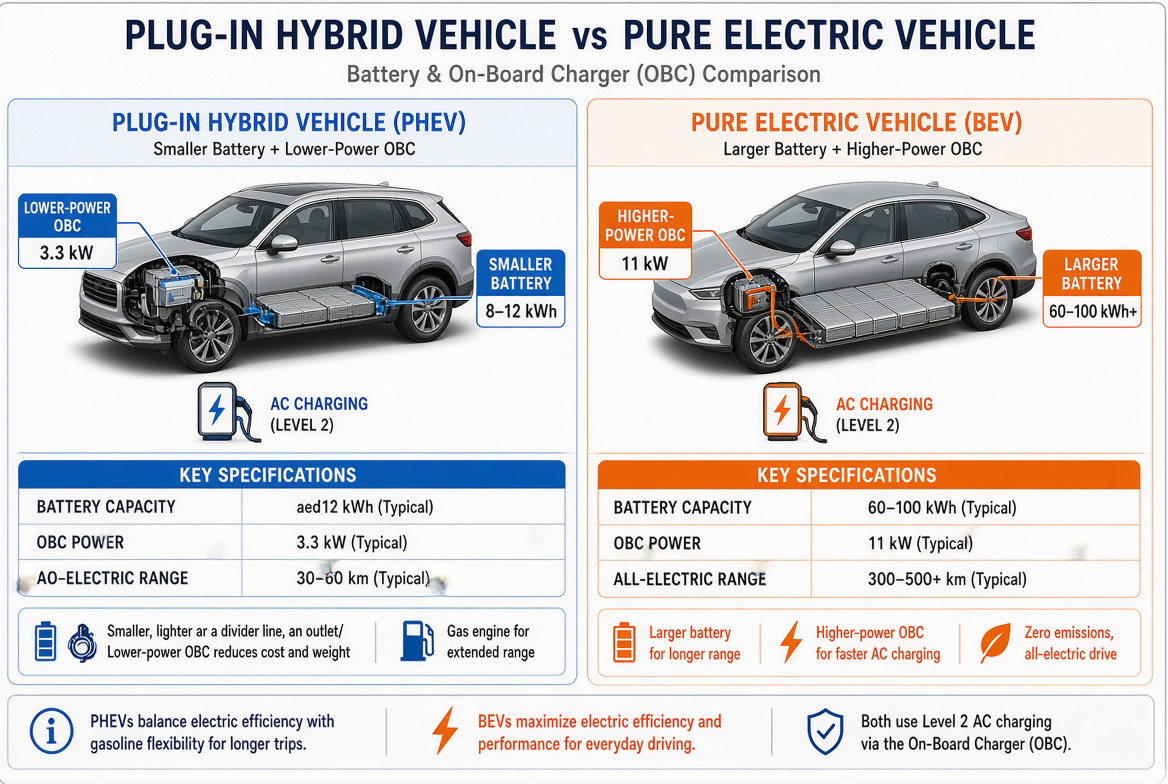
In pure electric and plug-in hybrid vehicles, the high-voltage battery (400 V or 800 V) is the main energy storage. However, nearly all low-power electronics still operate on a conventional 12 V (or 24 V in commercial vehicles) system. Without a reliable DC-DC converter, these systems would lose power once the 12 V auxiliary battery is depleted. The HV DC-DC converter therefore performs continuous step-down conversion, keeping the low-voltage network alive at all times.
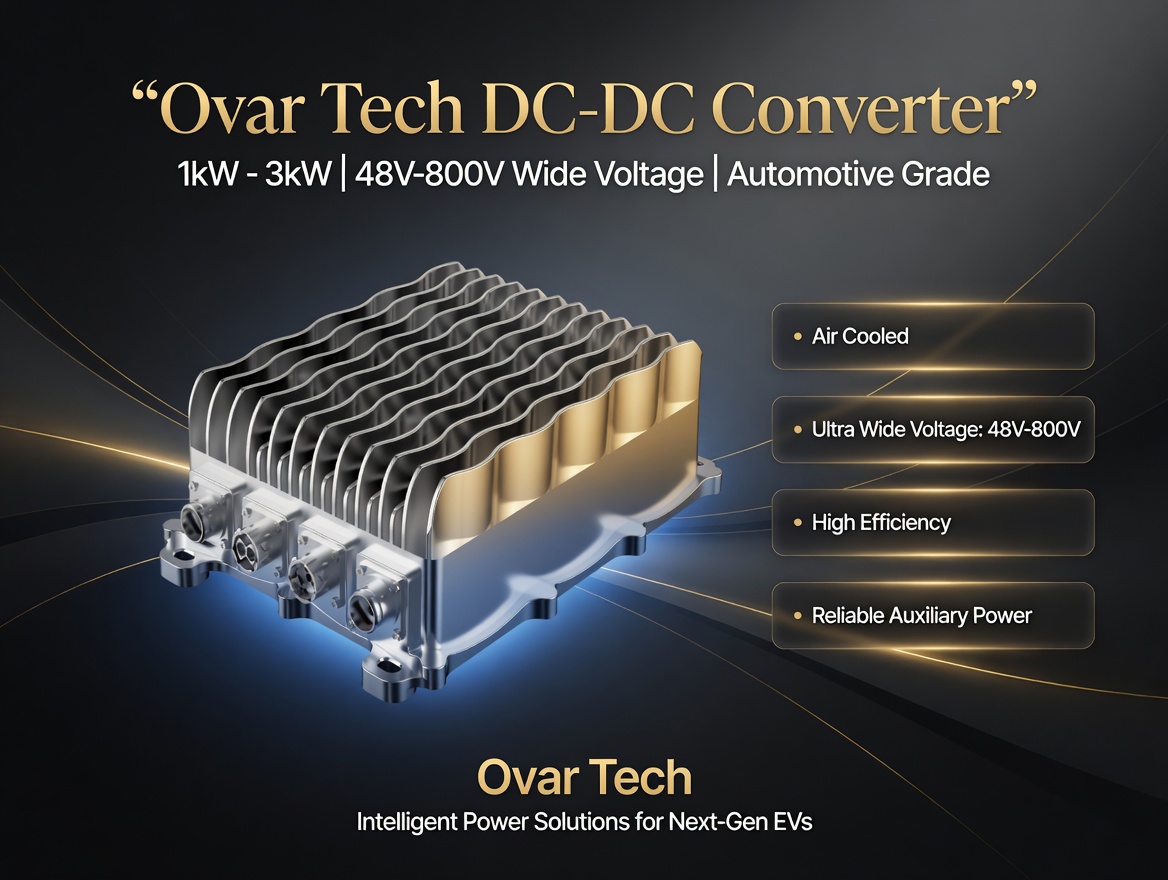
Ovar Tech offers a range of high-performance DC-DC converters (1 kW, 1.5 kW, 2 kW, and 3 kW) as well as integrated OBC + DC-DC modules that combine charging and low-voltage power supply functions in a single compact unit.
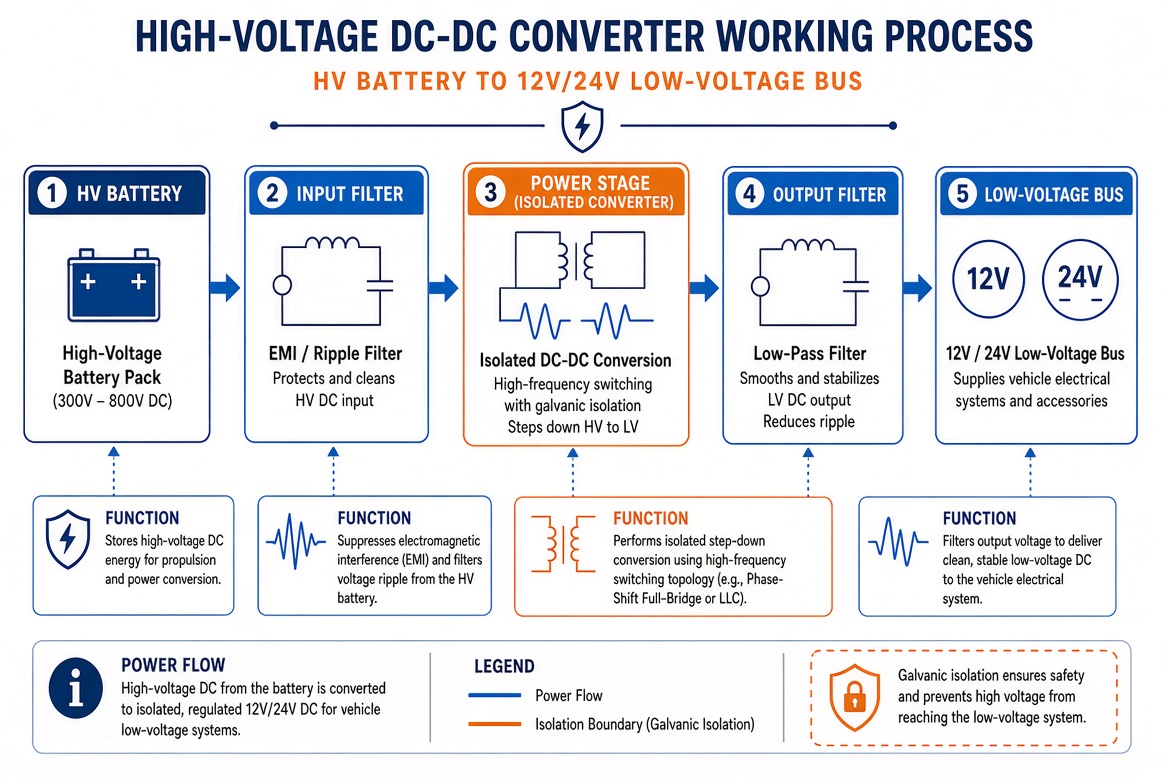
2. Complete Working Process Step by Step
Step 1: High-Voltage Input Stage
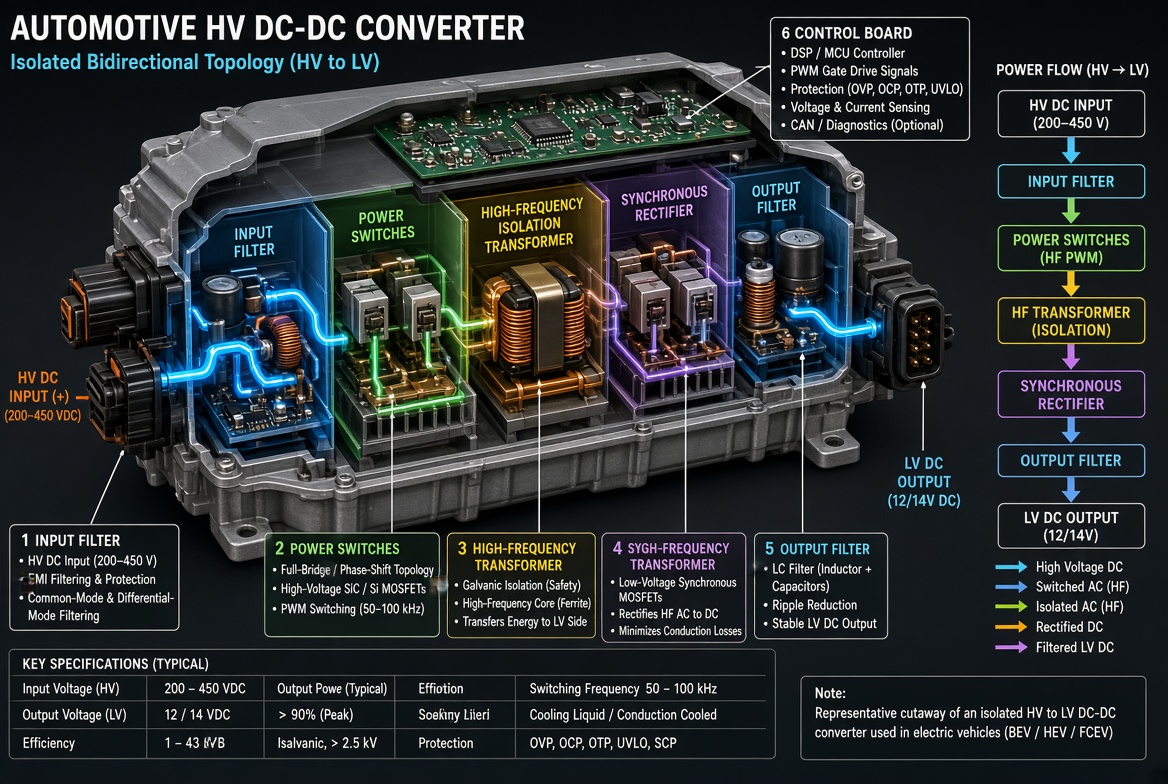
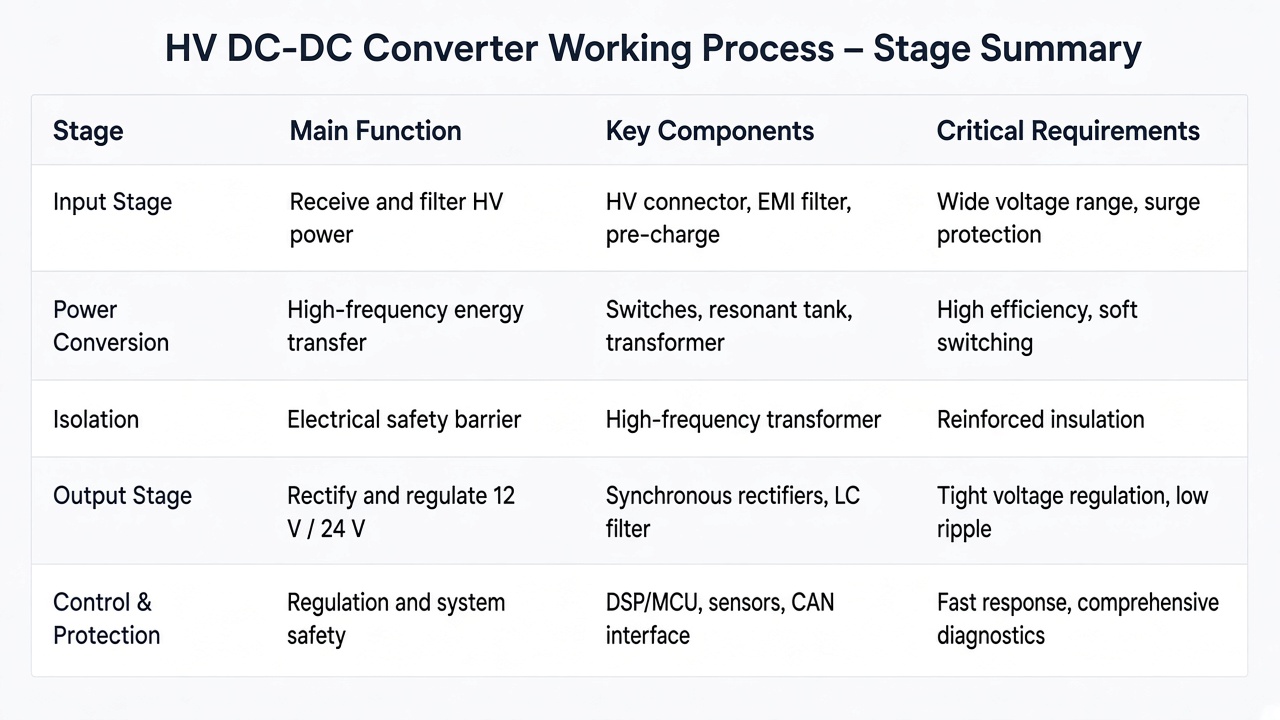
The converter receives power from the high-voltage battery pack through a high-voltage connector and input filter. The input voltage typically ranges from 200 V to 850 V depending on the vehicle platform. Input EMI filters and pre-charge circuits protect against voltage spikes and inrush current.
Step 2: Power Conversion Stage
Most automotive HV DC-DC converters use an isolated topology (commonly LLC resonant, phase-shifted full-bridge, or dual active bridge). High-frequency switching (usually 100–300 kHz) with wide-bandgap devices (SiC or advanced Si MOSFETs) converts the high-voltage DC into a high-frequency AC signal that is transferred across an isolation transformer.
Step 3: Galvanic Isolation
The high-frequency transformer provides reinforced galvanic isolation between the high-voltage and low-voltage domains, meeting strict automotive safety standards (ISO 6469, ISO 26262). This isolation is critical to protect passengers and low-voltage electronics from high-voltage hazards.
Step 4: Rectification and Output Filtering
On the secondary side, the high-frequency AC is rectified (synchronous rectification is preferred for high efficiency) and filtered by inductors and capacitors to produce a clean, stable 12 V or 24 V DC output.
Step 5: Voltage and Current Regulation
A digital control loop continuously adjusts the switching parameters to maintain precise output voltage regulation (typically ±2 % or better) under varying load and input conditions. The converter communicates with the vehicle’s Battery Management System (BMS) and Body Control Module via CAN bus.
Step 6: Protection and Monitoring
Comprehensive protection functions include over-voltage, under-voltage, over-current, short-circuit, over-temperature, and reverse polarity protection. Real-time diagnostics are reported to the vehicle network.
3. Key Performance Requirements
- Efficiency: Modern units achieve 92–95 % peak efficiency.
- Power Rating: 1–3 kW is typical for passenger cars; higher for commercial vehicles.
- Output Voltage: 12 V (passenger cars) or 24 V (trucks, buses).
- Cooling: Air-cooled or liquid-cooled depending on power level and packaging.
- Isolation Voltage: Usually 2.5–4 kV or higher.
Ovar Tech’s 1.5 kW and 2 kW DC-DC converters, as well as the integrated solutions (6.6 kW OBC + 1.5/2 kW DC-DC), are designed to meet these demanding requirements with high reliability and compact size.
 |
4. Integration with On-Board Charger (OBC)
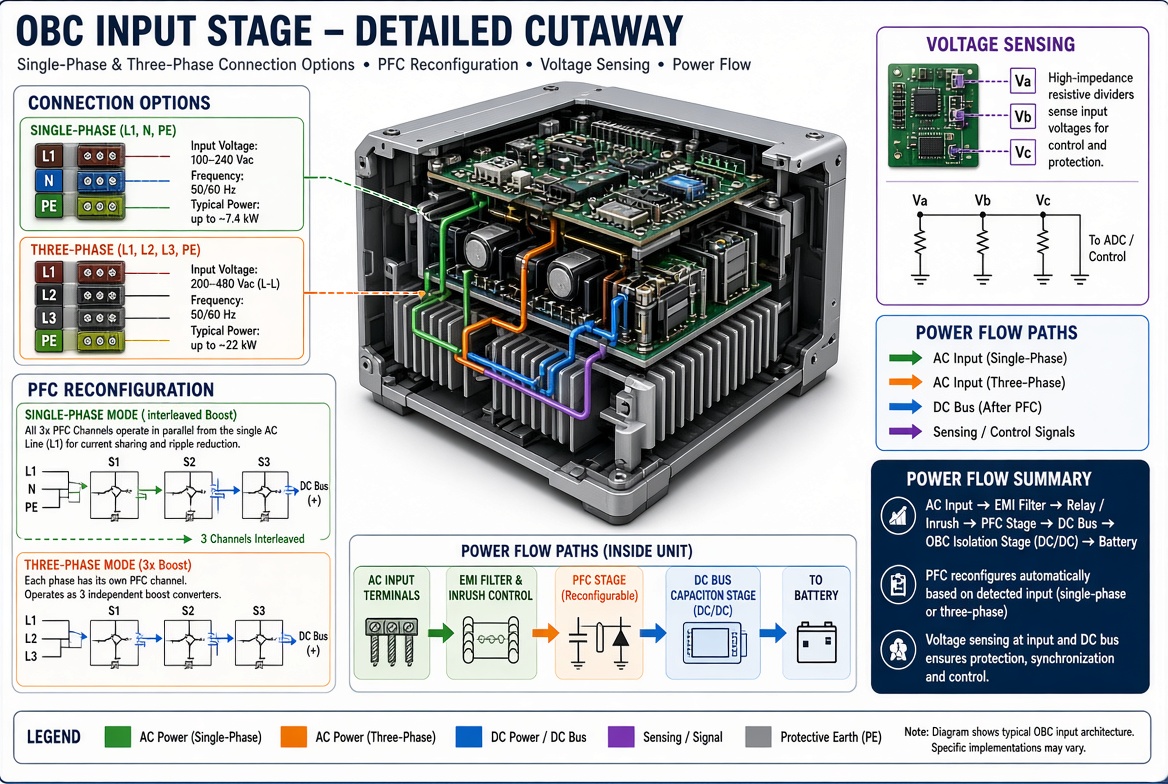
In many modern vehicles, the DC-DC converter is integrated with the OBC into a single 2-in-1 or 3-in-1 module. This approach reduces weight, volume, wiring complexity, and overall system cost. Shared cooling, housing, and control electronics further improve packaging efficiency. Ovar Tech’s integrated product line (including bi-directional versions) demonstrates this trend by combining high-power AC charging with reliable low-voltage power supply.
5. Summary of the Working Process
 |
Conclusion
The high-voltage DC-DC converter is the indispensable link between the high-voltage traction battery and the vehicle’s traditional 12 V electrical system. Through a carefully engineered sequence of input filtering, high-frequency isolated conversion, rectification, and precise regulation, it continuously delivers stable low-voltage power to all auxiliary loads. As electric vehicles evolve, integrated OBC + DC-DC solutions — such as those offered by Ovar Tech — further optimize weight, cost, and reliability, making the low-voltage power supply both efficient and robust. Understanding this complete working process is essential for engineers designing the next generation of electrified vehicles.
این مقاله را به اشتراک بگذارید