3.3kW / 6.6kW / 11kW / 22kW OBC Selection Guide: Adaptation Solutions for Passenger Cars, Commercial Vehicles, and Construction Machinery

3.3kW / 6.6kW / 11kW / 22kW OBC Selection Guide: [...]
3.3kW / 6.6kW / 11kW / 22kW OBC Selection Guide: Adaptation Solutions for Passenger Cars, Commercial Vehicles, and Construction Machinery
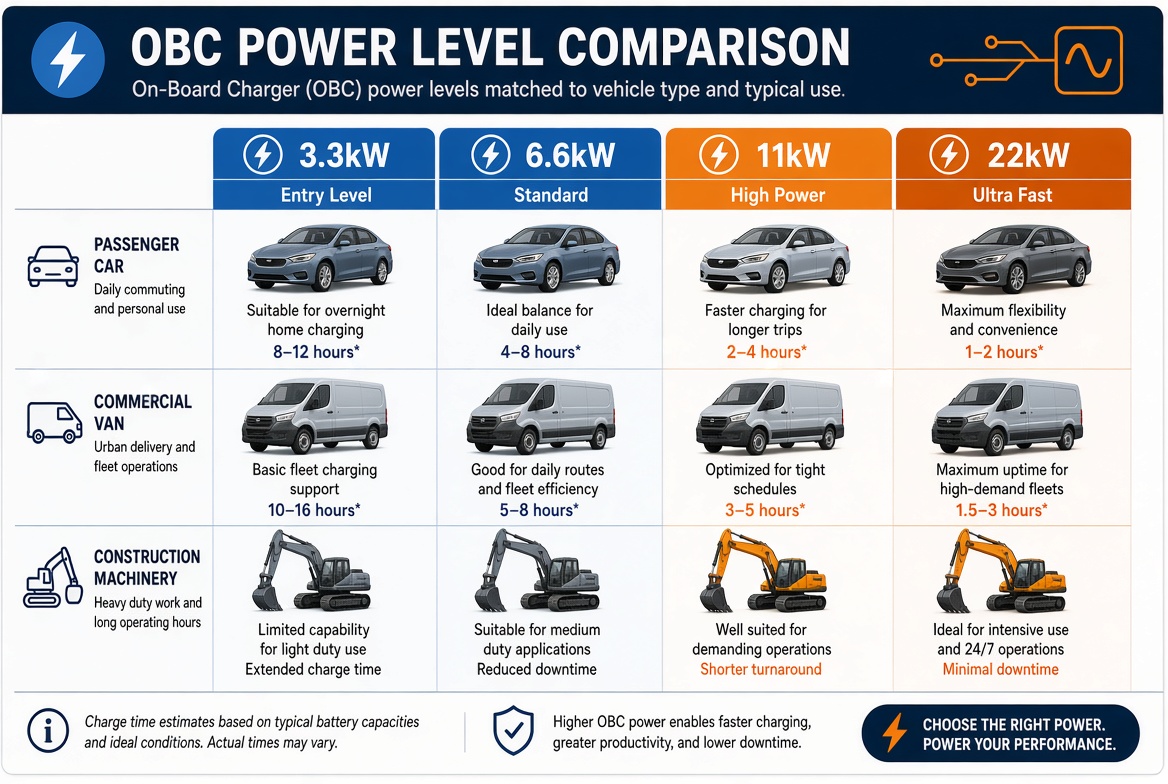
Selecting the right On-Board Charger (OBC) power rating — 3.3 kW, 6.6 kW, 11 kW, or 22 kW — depends primarily on vehicle type, battery capacity, daily energy consumption, available charging infrastructure, and cost targets. Passenger cars most commonly use 6.6 kW or 11 kW OBCs, light commercial vehicles often adopt 11 kW or 22 kW units, while construction machinery and specialized equipment may require tailored higher-power or ruggedized solutions. Matching OBC power to the application ensures optimal charging speed, system cost, and thermal performance.
 |
1. Overview of Common OBC Power Ratings
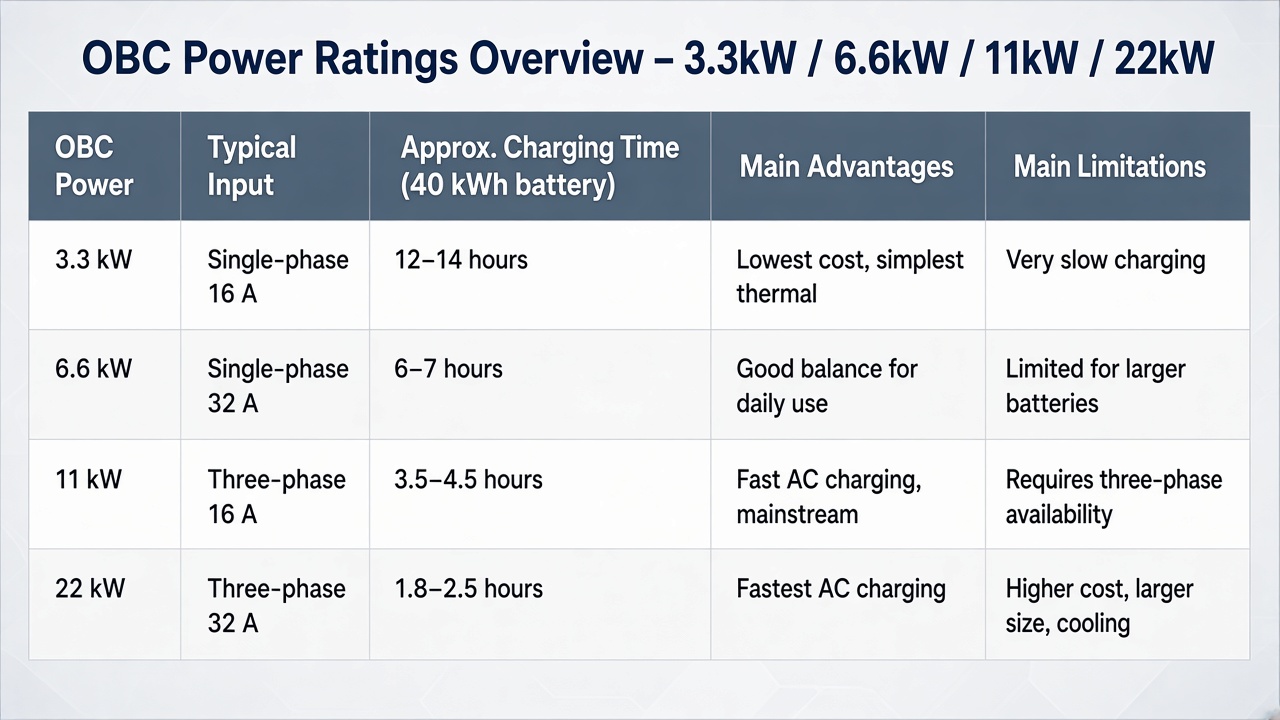 |
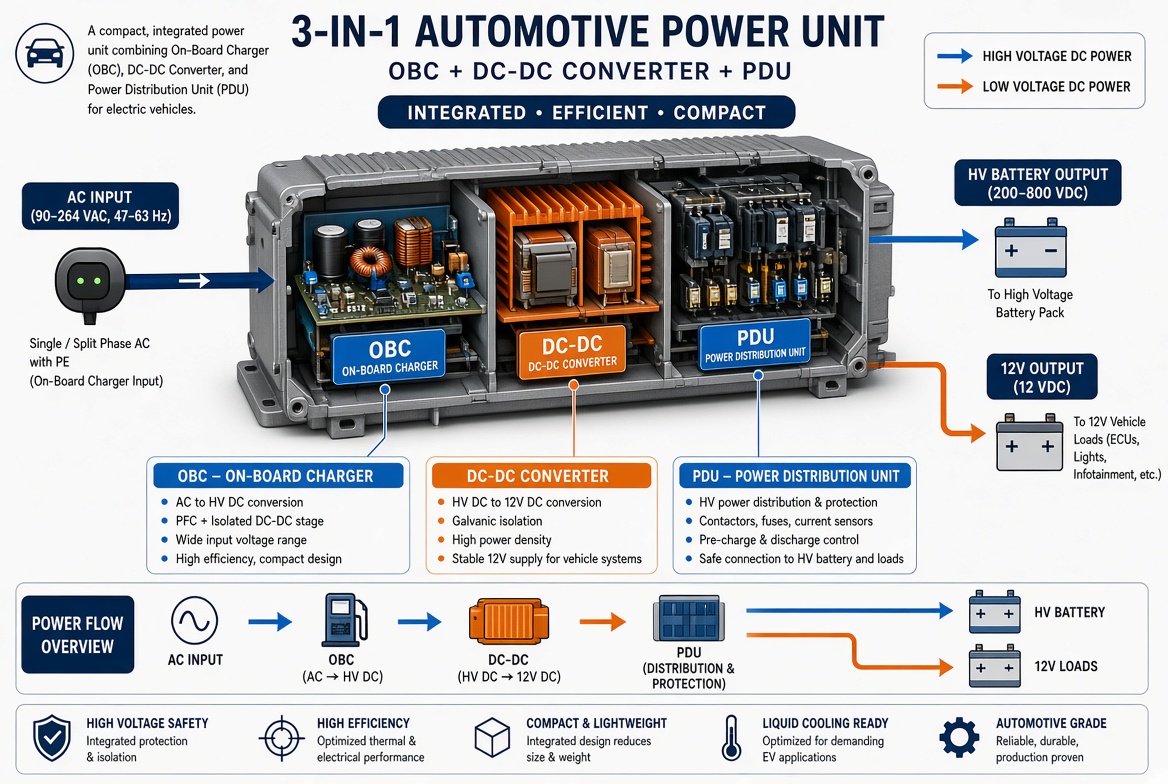
Ovar Tech offers a complete portfolio covering all these power levels: standalone OBCs at 3.3 kW, 6.6 kW, 11 kW, and 22 kW, as well as integrated OBC + DC-DC modules (6.6 kW + 1.5/2 kW and bi-directional 11 kW + 3 kW), providing flexible options for different vehicle platforms.
2. Selection Criteria by Vehicle Category
Passenger Cars (Sedans, SUVs, Crossovers)
- Battery size typically 40–100 kWh
- Daily driving range usually 50–150 km
- Charging mainly at home or workplace overnight
Recommended OBC:
- Entry-level / small EVs → 6.6 kW
- Mainstream models → 11 kW
- High-end or long-range models → 11 kW or 22 kW (if three-phase is common in the market)
Light & Medium Commercial Vehicles (Vans, Light Trucks)
- Higher daily energy use and longer operating hours
- Often return to depot for overnight charging
- Payload and space constraints remain important
Recommended OBC:
- 11 kW as baseline
- 22 kW preferred when fast turnaround is required
Construction Machinery & Specialized Vehicles (Excavators, Loaders, Mining Equipment, Port Machinery)
- Very high energy consumption during operation
- Harsh operating environments (dust, vibration, wide temperature range)
- Charging opportunities often limited to shift changes or depot returns
- Sometimes use DC fast charging as primary method, with OBC as backup
Recommended OBC:
- 11 kW or 22 kW ruggedized versions
- Emphasis on high protection grade (IP67+), wide temperature range, and high reliability
3. Detailed Adaptation Comparison
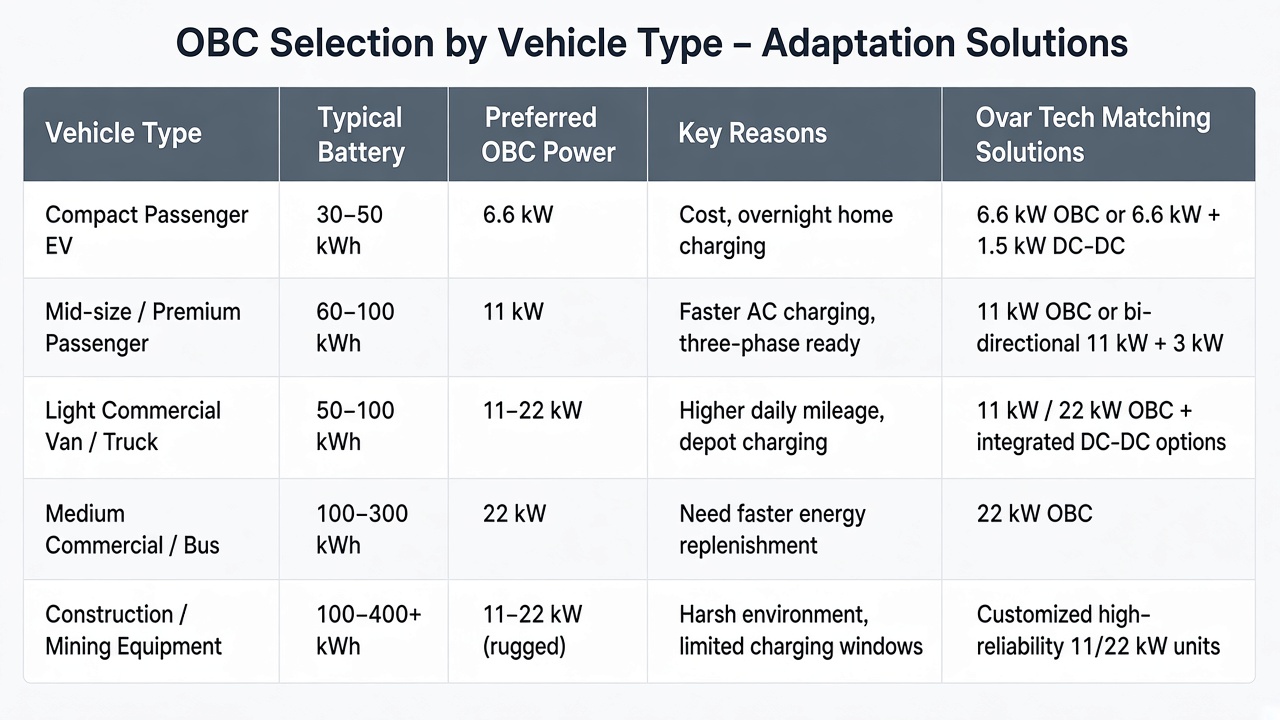 |
4. Practical Selection Guidelines
1)Calculate daily energy need — Match OBC power so that overnight or shift-break charging can restore the required energy.
2)Check grid availability — Single-phase grids limit practical power to 6.6–7.4 kW; three-phase enables 11 kW and 22 kW.
3)Evaluate thermal and packaging constraints — Higher power requires better cooling and more space.
4)Consider future-proofing — Choosing a slightly higher power rating can support battery capacity increases later.
5)Balance cost vs. charging speed — For many passenger cars, 11 kW offers the best overall value.
Ovar Tech’s product line supports all major power levels with both standalone and integrated solutions, allowing manufacturers to standardize on a reliable supplier across passenger, commercial, and specialized vehicle platforms.
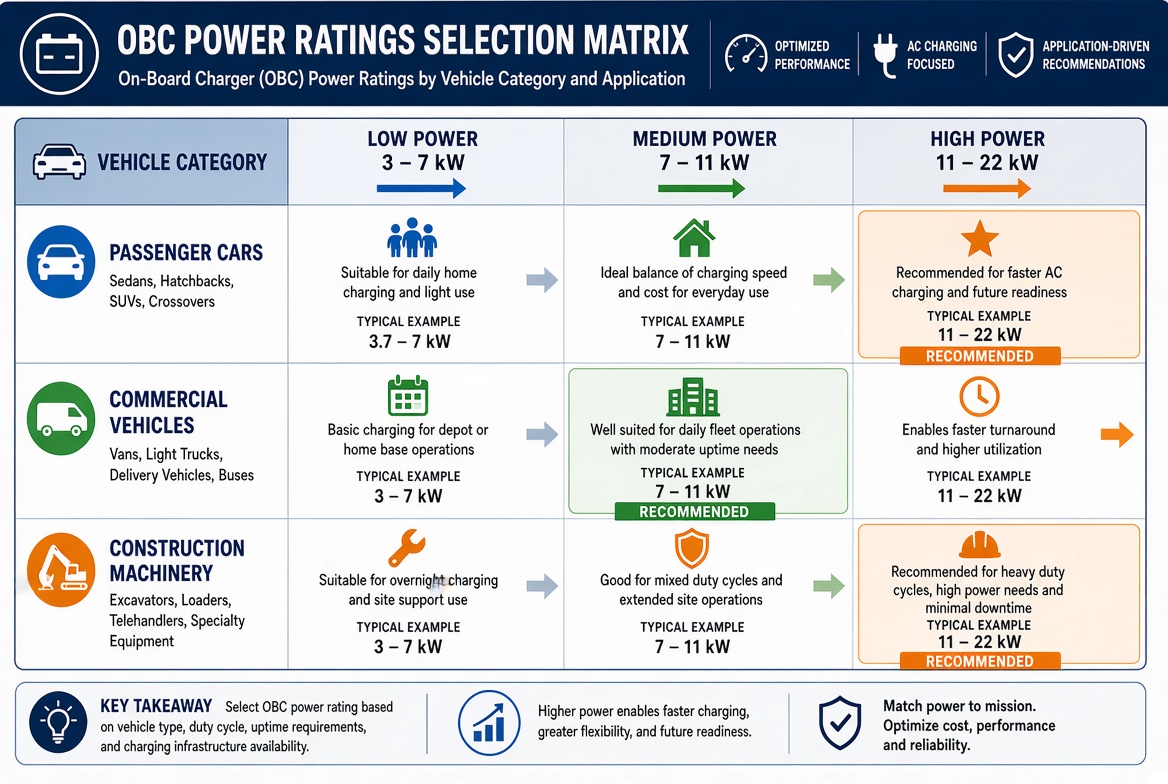 |
5. Summary Recommendation
- Passenger cars: 6.6 kW (entry) or 11 kW (mainstream)
- Light commercial vehicles: 11 kW or 22 kW
- Construction and heavy equipment: 11 kW or 22 kW with enhanced environmental protection
By aligning OBC power with real-world energy demand, charging infrastructure, and vehicle operating patterns, manufacturers can achieve the best balance of charging convenience, system cost, and reliability. Ovar Tech’s comprehensive OBC portfolio — from 3.3 kW to 22 kW, including integrated and bi-directional options — provides ready-to-adapt solutions for all three major vehicle segments.
این مقاله را به اشتراک بگذارید