Why Is the OBC Power Rating Generally Lower in Hybrid Vehicles Compared to Pure Electric Vehicles?

Why Is the OBC Power Rating Generally Lower in Hybrid [...]
Why Is the OBC Power Rating Generally Lower in Hybrid Vehicles Compared to Pure Electric Vehicles?
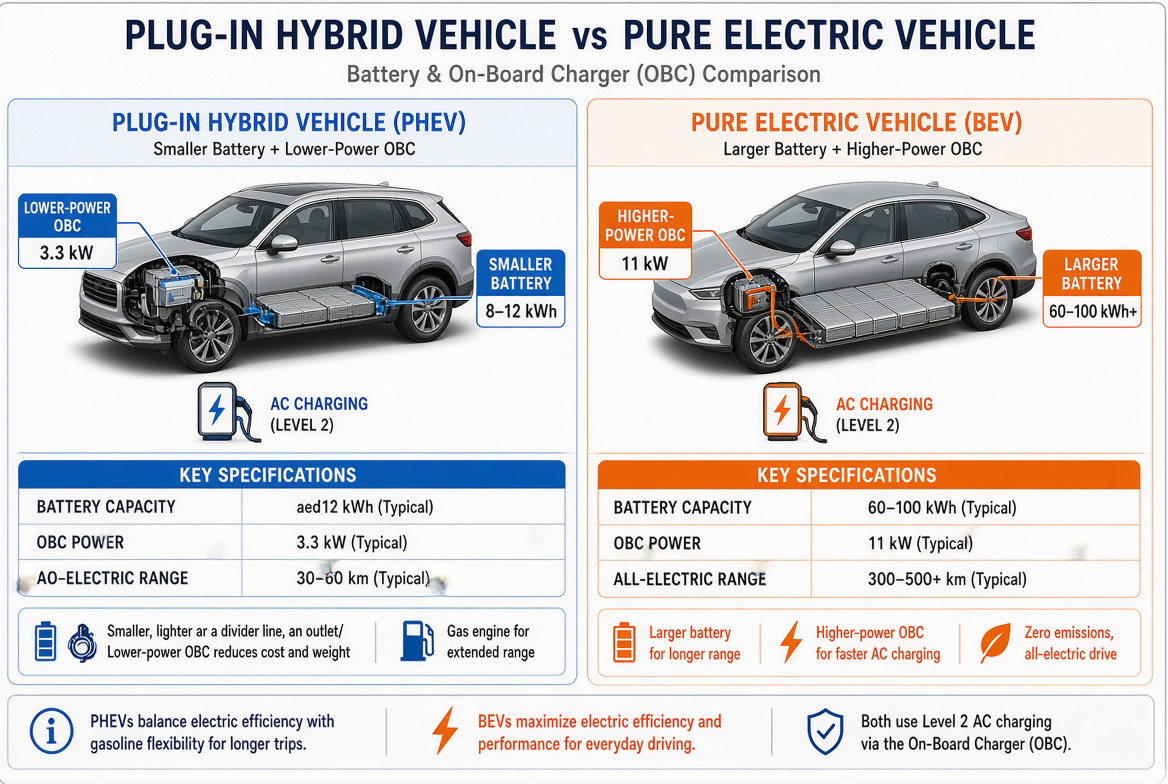
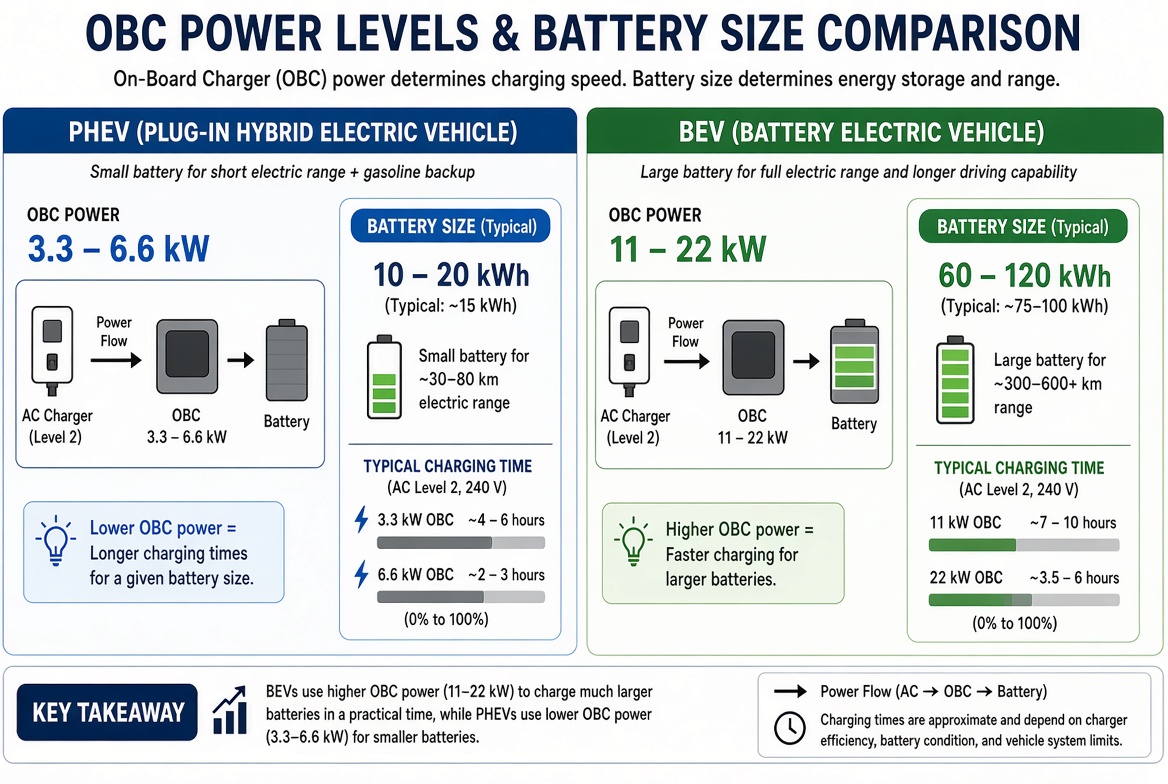
Hybrid vehicles (especially plug-in hybrids) typically use lower-power On-Board Chargers (OBCs) — often 3.3 kW or 6.6 kW — while pure battery electric vehicles (BEVs) commonly adopt 6.6 kW, 11 kW, or even 22 kW units. The main reasons are smaller battery capacity, reduced dependence on pure electric range, cost and weight optimization, and different daily usage patterns. In hybrids, the internal combustion engine provides backup energy, so ultra-fast AC charging is less critical than in pure electric vehicles that rely entirely on the battery.
 |
1. Battery Capacity Difference
The most fundamental reason is battery size.
- Pure Electric Vehicles (BEVs) usually carry 40–100+ kWh battery packs. To achieve acceptable charging times from a home wall box or public AC charger, a higher-power OBC (11 kW or 22 kW) is preferred.
- Plug-in Hybrid Electric Vehicles (PHEVs) typically have much smaller batteries — often 10–25 kWh. A 3.3 kW or 6.6 kW OBC can fully recharge these packs overnight or during a few hours of parking, which is usually sufficient.
Because the energy that needs to be replenished is significantly lower, there is little practical benefit in installing a high-power OBC.
2. Role of the Internal Combustion Engine
In hybrid vehicles, the gasoline or diesel engine can generate electricity or directly drive the wheels when the battery is depleted. This dual-power architecture reduces the urgency of rapid AC charging. Drivers of PHEVs can continue their journey even if the battery is empty, whereas BEV drivers depend entirely on finding a charging point. Consequently, manufacturers prioritize cost and packaging efficiency over maximum charging speed for hybrids.
3. Cost, Weight, and Packaging Considerations
Higher-power OBCs require:
- Larger magnetic components
-
Higher-current power semiconductors
- More robust cooling systems
-
Greater installation space
These factors increase both bill-of-materials cost and vehicle weight. For hybrid platforms, where every kilogram and every dollar is carefully managed (especially in high-volume models), a lower-power OBC offers a better cost-to-benefit ratio. Ovar Tech’s 3.3 kW and 6.6 kW OBC modules, as well as the compact integrated 6.6 kW OBC + 1.5/2 kW DC-DC solutions, are particularly well-suited for hybrid applications where space and cost efficiency are critical.
4. Typical Usage Patterns
PHEV owners often charge at home overnight using a standard wall box or even a portable charger. A 6.6 kW OBC can fully replenish a 15–20 kWh battery in 3–4 hours, which matches normal parking durations. In contrast, BEV owners with larger batteries benefit more from higher-power AC charging to reduce daily charging time.
5. Thermal and System Integration Aspects
Lower-power OBCs generate less heat, simplifying thermal management and allowing the use of simpler air-cooling solutions. This is advantageous in hybrid vehicles that already have complex thermal systems for both the engine and the battery. Higher-power OBCs more frequently require liquid cooling, adding cost and complexity that hybrid platforms often avoid.
 |
6. Summary Comparison
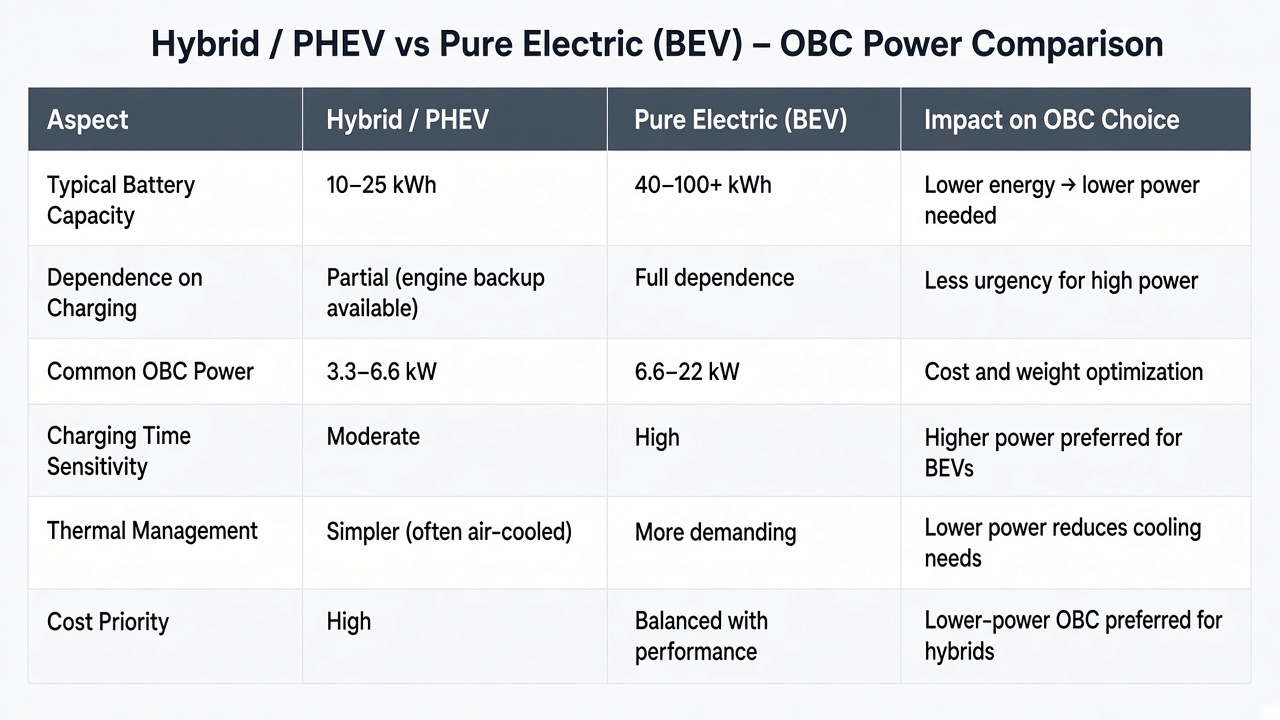 |
Conclusion
The lower OBC power ratings commonly found in hybrid and plug-in hybrid vehicles are a rational engineering choice driven by smaller battery sizes, the presence of an internal combustion engine, cost and weight constraints, and typical usage patterns. While pure electric vehicles benefit from higher-power OBCs to minimize charging time for large battery packs, hybrids achieve a better overall system balance with 3.3 kW or 6.6 kW units. Manufacturers such as Ovar Tech offer a full range of OBC solutions — from compact 3.3 kW and 6.6 kW modules to higher-power and integrated bi-directional systems — allowing vehicle makers to select the optimal power level for both hybrid and pure electric platforms.
Compartir este artículo