Discrete Power Modules vs Integrated Power Units: Understanding Vehicle Wiring Differences at a Glance

Discrete Power Modules vs Integrated Power Units: Understanding Vehicle Wiring [...]
Discrete Power Modules vs Integrated Power Units: Understanding Vehicle Wiring Differences at a Glance
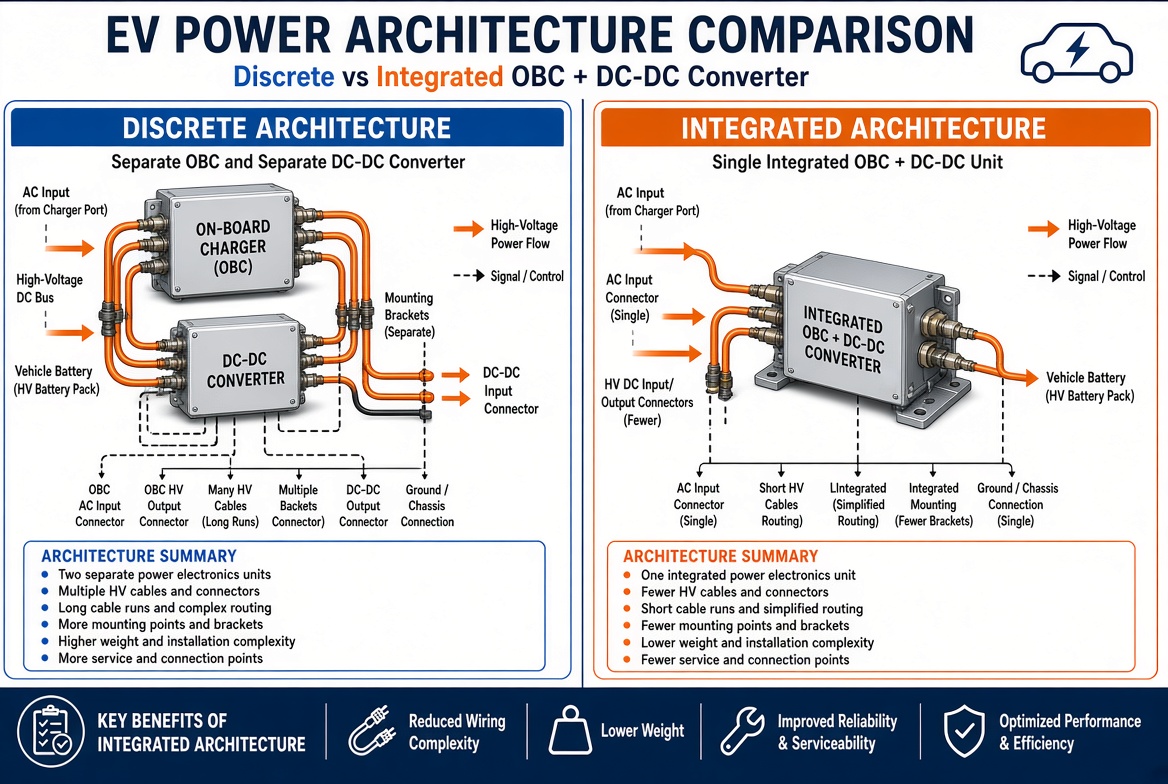
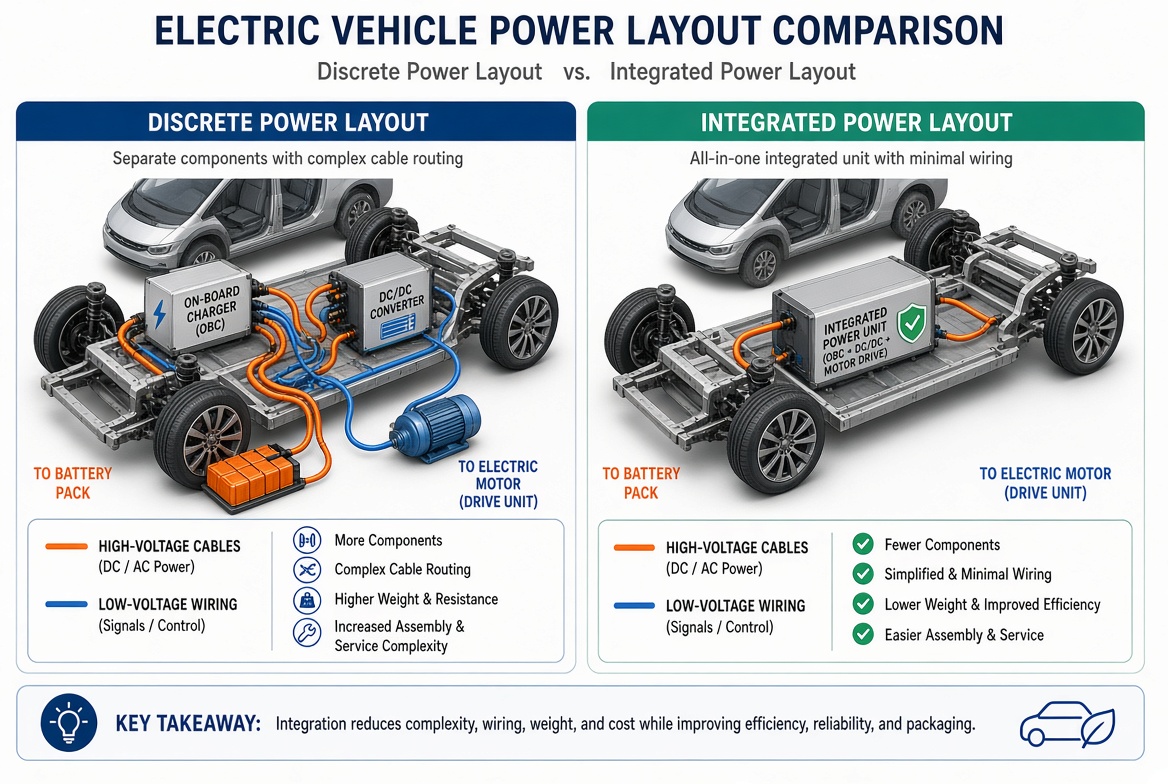
Discrete power modules (separate OBC and DC-DC converter) require significantly more high-voltage and low-voltage cables, connectors, and mounting points than an integrated power unit (OBC + DC-DC in a single housing). The integrated approach simplifies the entire vehicle electrical architecture, reduces harness complexity, lowers weight and cost, and improves assembly efficiency and long-term reliability. One clear system diagram is enough to reveal the dramatic difference in vehicle wiring.
 |
1. What “Discrete” and “Integrated” Mean in EV Power SystemsDiscrete (Separate) Power Architecture
Discrete (Separate) Power Architecture
- Independent On-Board Charger (OBC)
- Independent high-voltage DC-DC converter
- Each unit has its own housing, cooling circuit, control board, and high-voltage connectors
- Multiple long high-voltage cables run between battery, OBC, DC-DC, and other high-voltage loads
Integrated Power Architecture
- OBC and DC-DC functions combined inside one enclosure (2-in-1)
- Shared housing, shared cooling channels, shared control electronics
- Dramatically fewer external high-voltage cables and connectors
- Often further combined with a Power Distribution Unit (PDU) to become a 3-in-1 solution
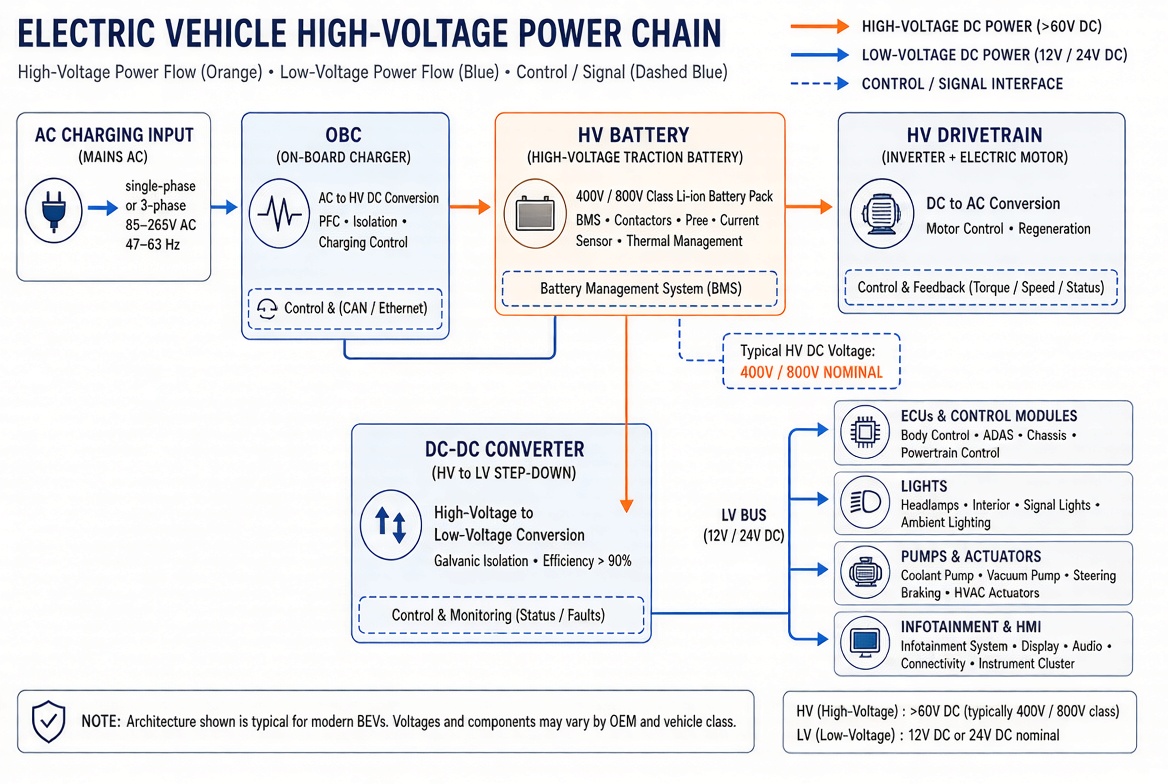
Ovar Tech already offers highly integrated solutions such as 6.6 kW OBC + 1.5/2 kW DC-DC and bi-directional 11 kW OBC + 3 kW DC-DC modules. These products directly reduce the wiring burden that discrete designs create.
2. Wiring Differences Explained
In a discrete layout the vehicle harness must include:
- AC input cables to the OBC
- High-voltage DC output cables from OBC to battery
- Separate high-voltage input cables from battery to the DC-DC converter
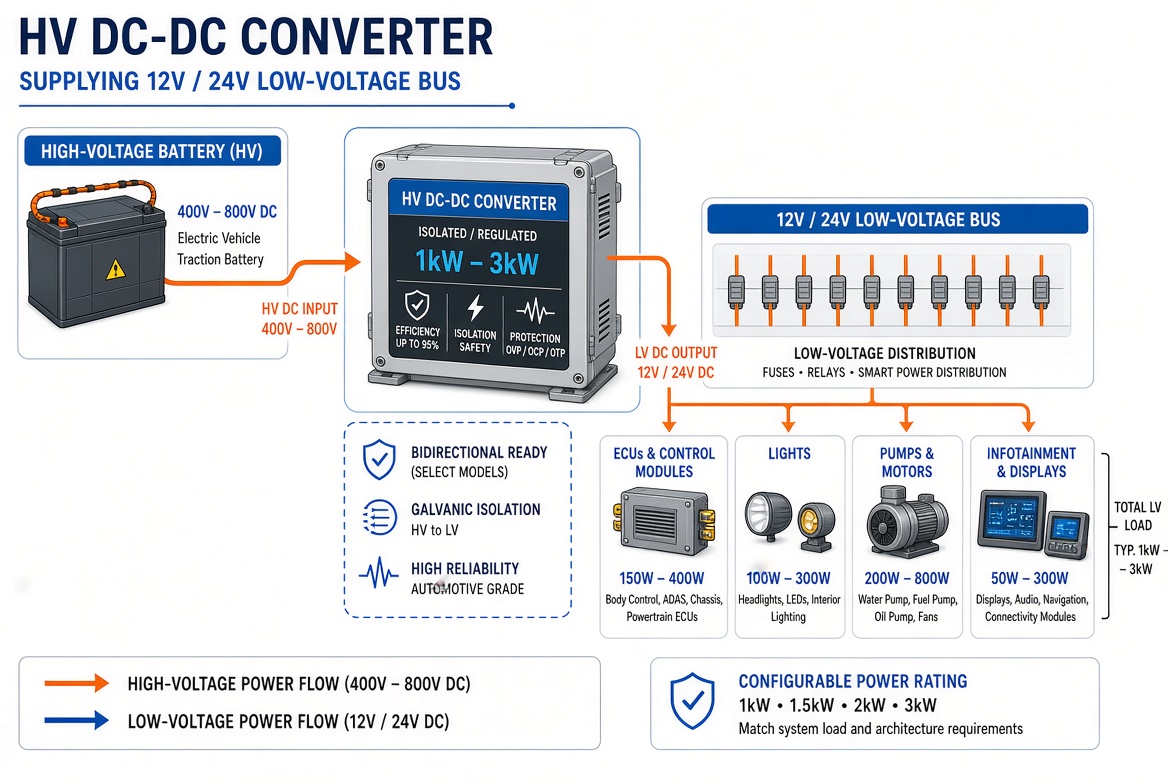
- Low-voltage output cables from DC-DC to the 12 V/24 V distribution box
- Multiple interlock, communication (CAN), and cooling lines for each unit
An integrated unit collapses most of these into:
- One AC input
- One high-voltage DC connection to the battery
- One low-voltage output to the vehicle’s 12 V/24 V bus
- Shared cooling and communication interfaces
The result is a much shorter, lighter, and simpler high-voltage harness.
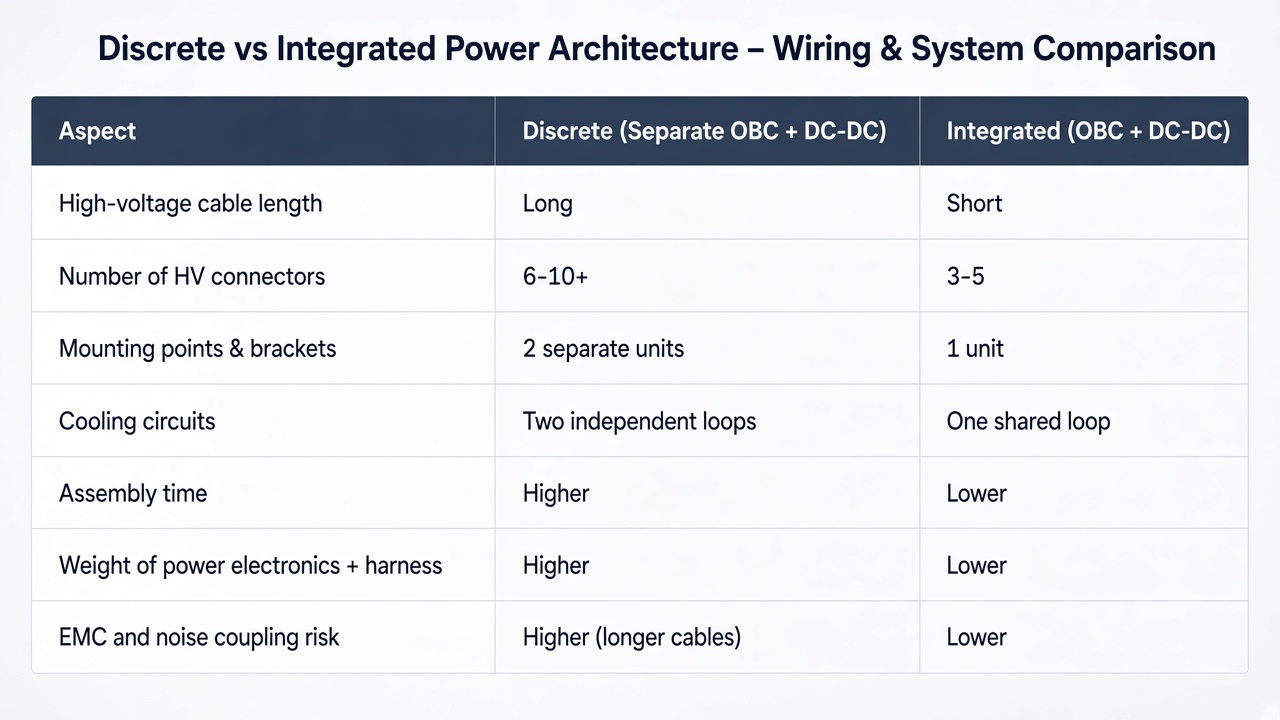
3. Quantitative Impact on Vehicle Wiring
 |
4. Real-World Vehicle Architecture Implications
Discrete architecture is still used when:
- Power ratings are very high and thermal management is difficult to share
- Different suppliers provide the OBC and DC-DC
- Platforms require maximum design flexibility
Integrated architecture is preferred when:
- Space and weight are critical (passenger cars, light commercial vehicles)
- Cost reduction and simplified assembly are priorities
- The platform is designed from the start for high integration
The wiring simplification also improves reliability: every connector and cable joint is a potential failure point. Fewer joints mean higher long-term durability.
5. Beyond Wiring – Additional System Benefits
- Thermal efficiency: Shared cold plate or liquid cooling loop improves heat dissipation management.
- Cost: One housing, one set of connectors, one control board, and reduced harness cost.
- Packaging freedom: Engineers can place a single compact module in an optimal location rather than finding space for two separate units.
- Software and diagnostics: Unified communication interface simplifies vehicle network design.
Ovar Tech’s integrated OBC + DC-DC product family is specifically engineered to deliver these advantages while maintaining high efficiency, automotive-grade reliability, and flexible voltage platforms (including both 400 V and 800 V systems).
 |
6. Selection Guidance
Choose a discrete solution when power levels, thermal constraints, or supplier strategies make separation necessary.
Choose an integrated solution when the goal is to minimize high-voltage harness complexity, reduce weight and cost, and accelerate vehicle assembly. For the majority of current passenger EV and light commercial platforms, the integrated approach is now the preferred direction.
Conclusion
The difference between discrete and integrated power architectures is most clearly visible in the vehicle wiring harness. A discrete system creates a complex network of high-voltage cables and connectors, while an integrated OBC + DC-DC unit dramatically simplifies the entire electrical layout. One system diagram is enough to show why most modern EV platforms are moving toward integration: fewer cables, lower weight, lower cost, higher reliability, and easier assembly.
Ovar Tech’s range of integrated charging and power modules gives vehicle manufacturers a practical, production-ready path to realize these wiring and system-level advantages.
Share This Article