OBC Grid Input Compatibility: Detailed Explanation of Single-Phase and Three-Phase Grid Adaptation

OBC Grid Input Compatibility: Detailed Explanation of Single-Phase and Three-Phase [...]
OBC Grid Input Compatibility: Detailed Explanation of Single-Phase and Three-Phase Grid Adaptation
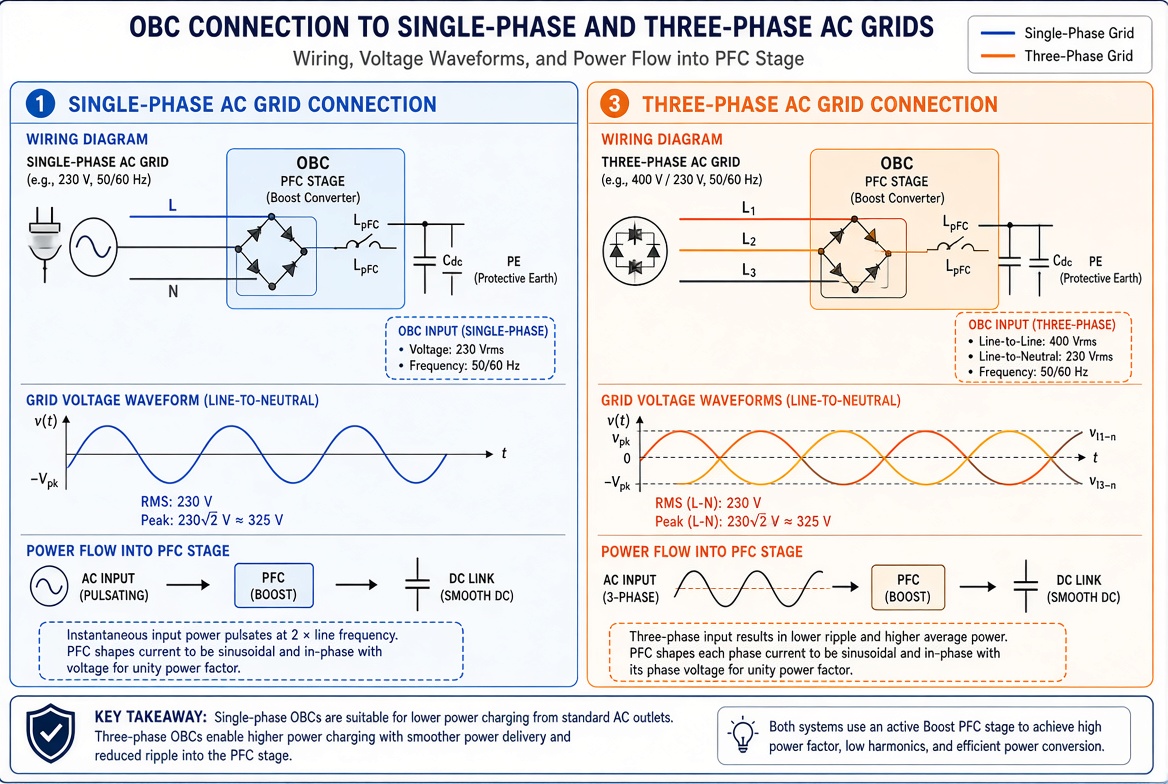
On-Board Chargers (OBCs) must be designed to safely and efficiently operate on both single-phase and three-phase AC grids, which differ significantly in voltage, available power, wiring, and harmonic behavior. Single-phase systems (common in residential settings) typically support lower power levels (up to 7.4 kW), while three-phase systems enable higher power (11–22 kW or more). Modern OBCs incorporate adaptive input stages, wide-range voltage detection, and flexible PFC topologies to ensure compatibility across global grid standards.
 |
1. Fundamental Differences Between Single-Phase and Three-Phase Grids
Single-Phase Grid
- Standard voltages: 120 V (North America), 230 V (Europe, Asia, most of the world)
- Two conductors: Line (L) + Neutral (N), sometimes with Protective Earth (PE)
- Maximum practical power for residential charging is usually limited by circuit breakers (16 A or 32 A), resulting in 3.7 kW or 7.4 kW
Three-Phase Grid
- Standard voltages: 400 V (line-to-line) in Europe and many regions, 208 V or 480 V in some industrial settings
- Four conductors: L1, L2, L3 + Neutral (optional) + PE
- Enables balanced power delivery and higher total power (11 kW at 16 A, 22 kW at 32 A)
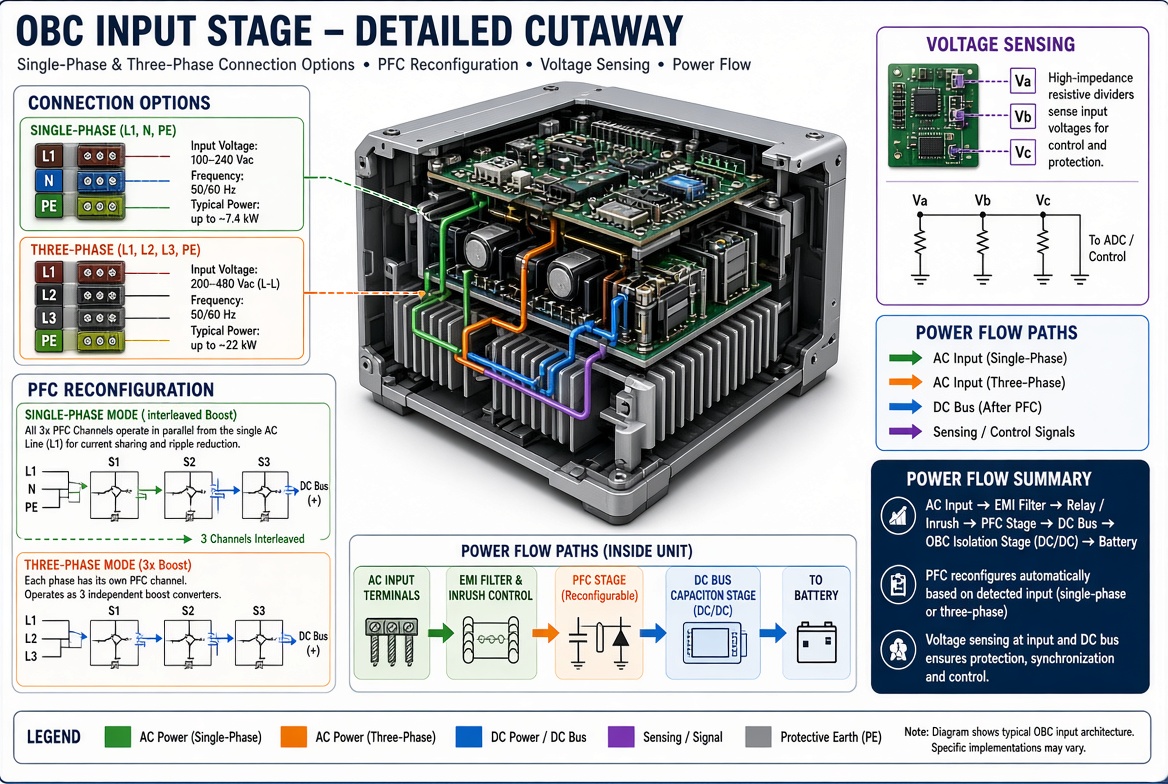
The OBC must detect the presence of one or three phases and adjust its internal power conversion strategy accordingly.
2. Key Adaptation Points in OBC Hardware Design
Input Voltage Range and Detection
Modern OBCs are designed for a wide input range (typically 85–265 V single-phase and 320–460 V three-phase). Automatic phase detection circuits measure the presence and phase sequence of incoming voltages. If only one phase is detected, the OBC operates in single-phase mode; if three phases are present, it switches to three-phase mode.
Power Factor Correction (PFC) Stage
- In single-phase mode, a boost or bridgeless PFC is used.
- In three-phase mode, a three-phase PFC (Vienna rectifier or three-phase boost) is activated to maintain high power factor and low harmonics on all phases.
- Ovar Tech’s higher-power OBCs (11 kW and 22 kW) incorporate advanced multi-mode PFC stages that automatically reconfigure based on the detected grid type.
Power Derating and Current Limits
When connected to a single-phase supply, even a 22 kW-rated OBC must reduce its output power to respect the current limit of the single phase (e.g., 32 A). Intelligent current sensing and communication with the charging station (via Control Pilot) ensure the OBC never exceeds the available grid capacity.
Neutral and Grounding Considerations
Three-phase systems may or may not provide a neutral conductor. OBCs must handle both 3-wire and 4-wire configurations safely. Proper protective earth connection and residual current detection remain critical in both cases.
3. Control and Communication Strategies
The OBC continuously monitors:
- Phase voltages and currents
- Phase sequence (to avoid reverse rotation issues)
- Grid frequency (50/60 Hz)
It communicates with the Electric Vehicle Supply Equipment (EVSE) using the Control Pilot signal and, in advanced systems, PLC or ISO 15118. This allows dynamic adjustment of charging current based on the actual grid capability.
Ovar Tech’s bidirectional and high-power OBC modules support both single-phase and three-phase operation with seamless mode switching, making them suitable for global vehicle platforms.
 |
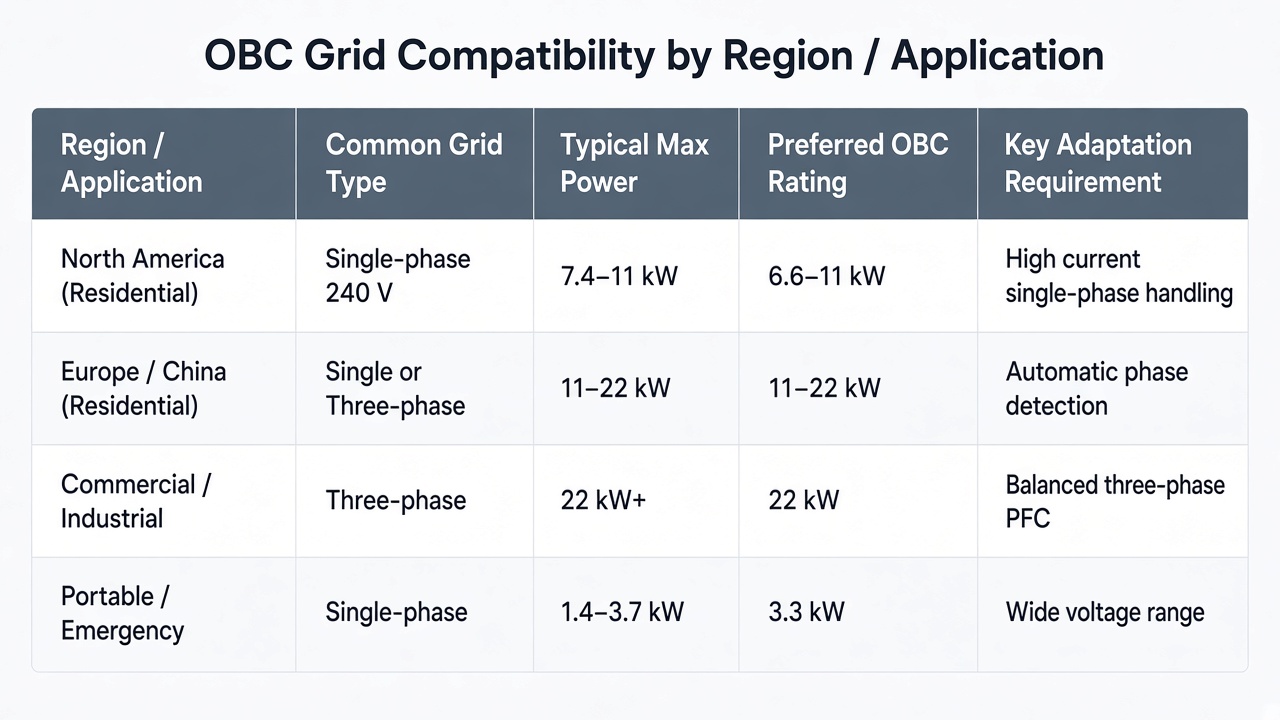
4. Regional and Practical Implications
 |
5. Practical Considerations for Vehicle Manufacturers and Users
- Over-sizing the OBC allows the vehicle to take full advantage of higher-power infrastructure when available, but increases cost, weight, and thermal management requirements.
- Under-sizing limits charging speed even when a high-power wall box or pile is present.
- Integrated OBC + DC-DC modules (such as Ovar Tech’s 6.6 kW + 1.5/2 kW and bi-directional 11 kW + 3 kW solutions) help optimize space and weight while still supporting a wide range of charging equipment.
In markets where three-phase power is common (Europe, China, etc.), 11 kW OBCs have become the mainstream choice for new passenger vehicles, while commercial and specialty vehicles often adopt 22 kW units.
Conclusion
Portable charging guns, wall boxes, and home charging piles impose progressively higher power demands on the vehicle’s On-Board Charger. A 3.3 kW OBC is adequate for portable use, a 6.6–11 kW unit is optimal for most wall-box scenarios, and 11–22 kW OBCs are required to fully utilize dedicated home charging piles. Selecting the right OBC power rating — and considering integrated solutions from manufacturers such as Ovar Tech — ensures the best balance of charging speed, cost, efficiency, and future-proofing for different usage patterns.
شارك هذا المقال