How to Control Standby Power Consumption of the DC-DC Converter When the Vehicle Is Off

How to Control Standby Power Consumption of the DC-DC Converter [...]
How to Control Standby Power Consumption of the DC-DC Converter When the Vehicle Is Off
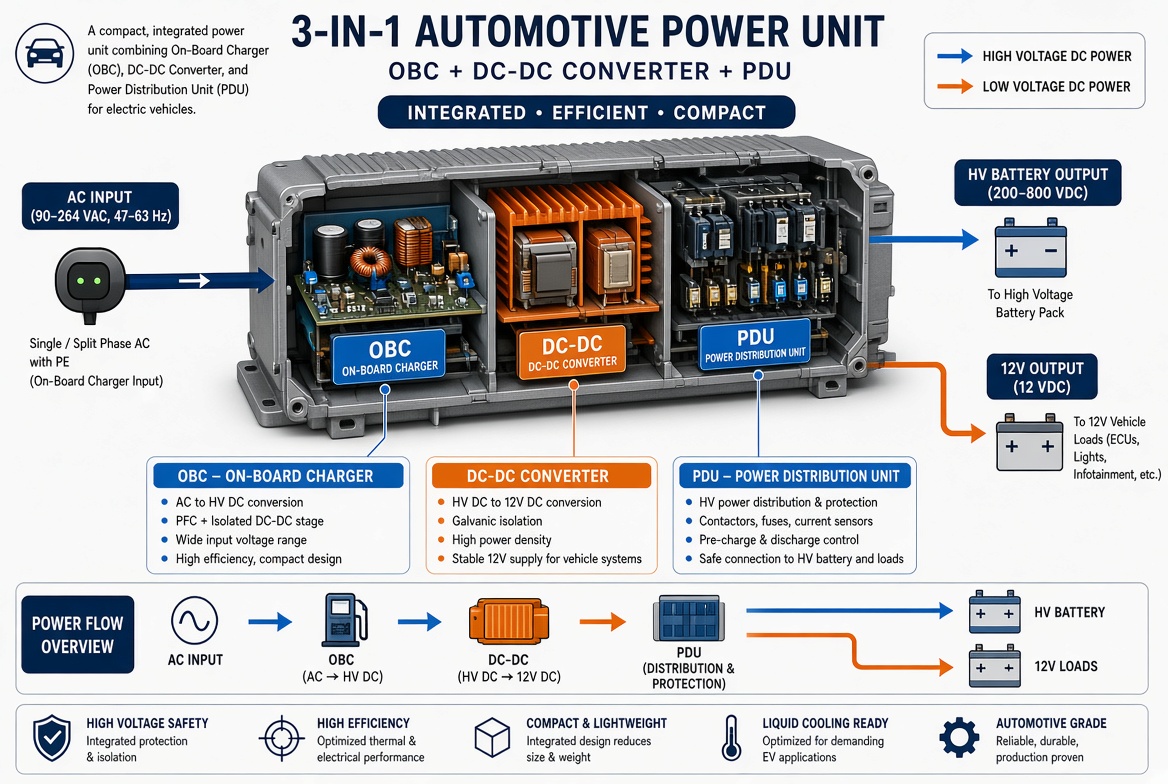
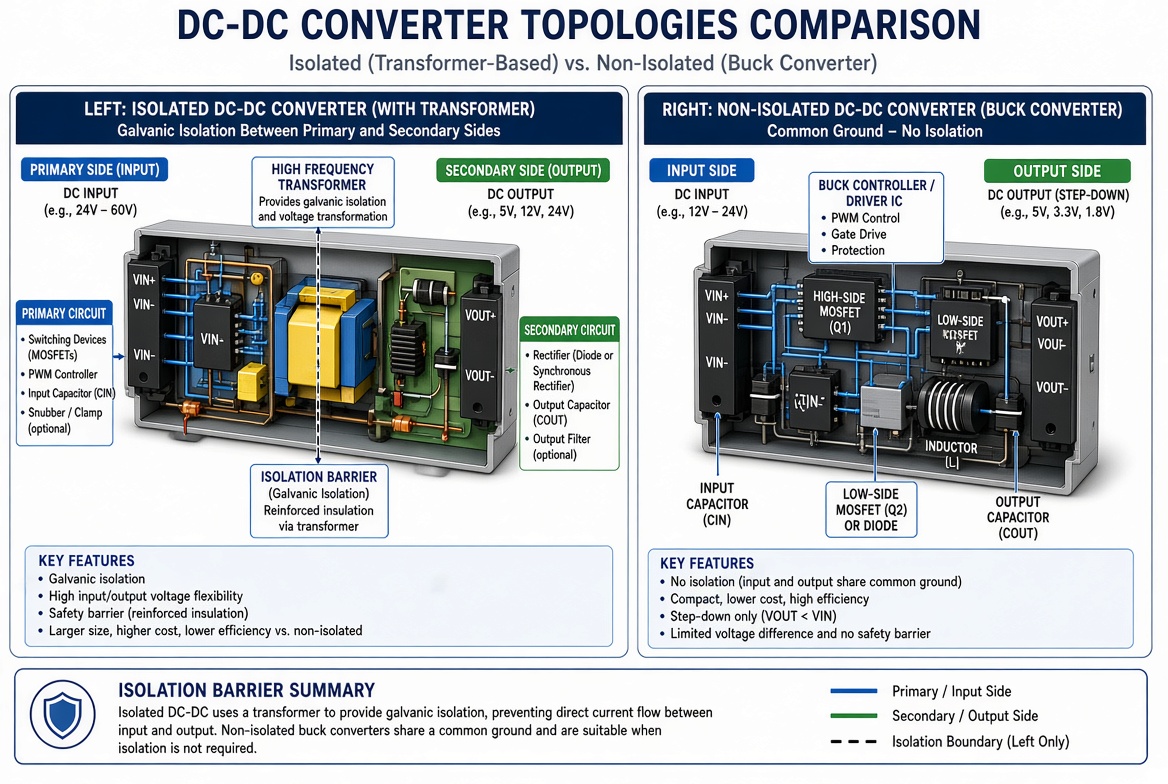
In modern electric and hybrid vehicles, virtually all low-voltage electrical systems rely on the high-voltage DC-DC converter for power, making standby (quiescent) power control of the DC-DC critical to prevent unnecessary drain of the high-voltage battery during key-off periods. Effective standby power management typically targets total DC-DC quiescent consumption below 1–2 W (or even lower in advanced designs) through multi-level sleep modes, intelligent enable/disable strategies, and ultra-low-power control circuits.
 |
1. Why Standby Power Control Matters
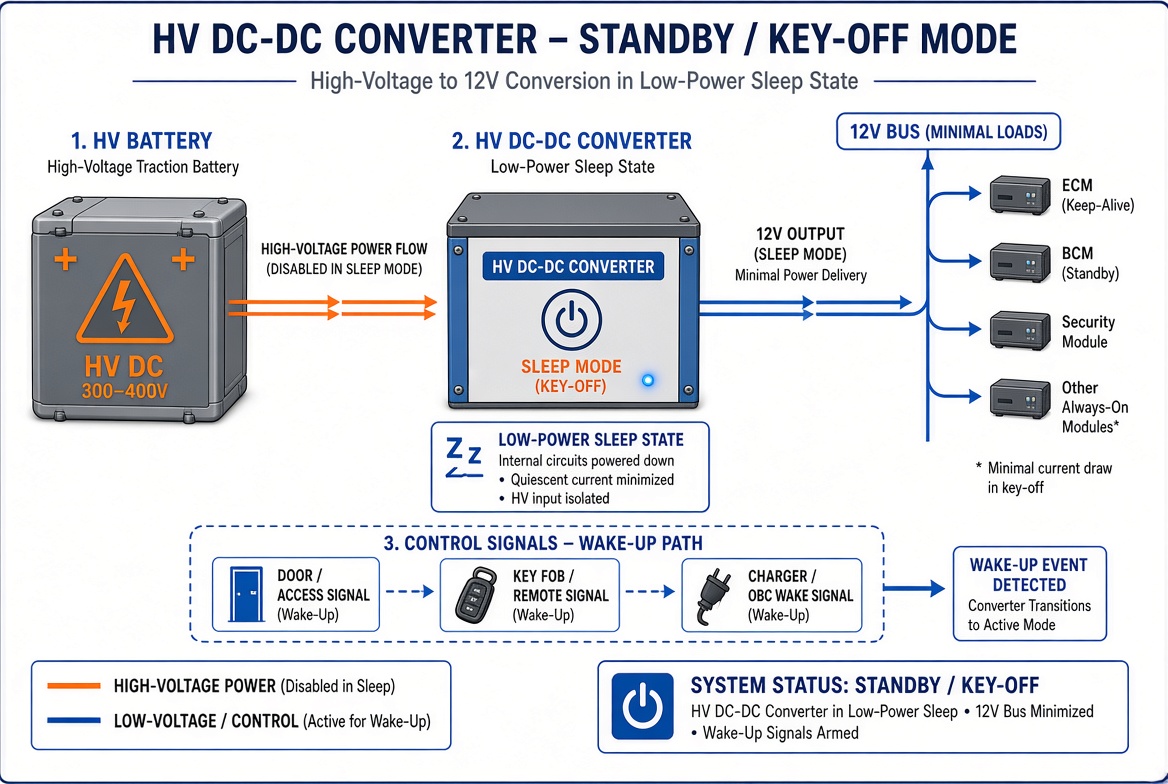
When the vehicle is switched off, the high-voltage battery remains the ultimate energy source. Continuous operation of the DC-DC converter at normal efficiency would slowly deplete the HV battery, reducing available range and potentially triggering low-voltage warnings or protection modes. In addition, many always-on loads (immobilizer, alarm, telematics, keyless entry, clock) still require a small amount of 12 V power. Therefore, the DC-DC must support an extremely low-power standby state while remaining ready to wake up quickly when needed.
Ovar Tech’s DC-DC converters (1 kW–3 kW range) and integrated OBC + DC-DC modules are designed with advanced low-standby architectures to meet these stringent vehicle-level requirements.
2. Typical Standby Power Targets
Automotive OEMs usually specify:
- DC-DC quiescent current / power in deep sleep: often < 100–300 mA at 12 V output equivalent, or total input power from HV bus < 1–2 W
- Wake-up time: typically < 50–100 ms from sleep to full regulation
- Compatibility with vehicle network sleep/wake protocols (CAN, LIN, Ethernet)
3. Key Technical Methods to Control Standby Power
Multi-Level Sleep Modes
Modern DC-DC converters implement several power states:
- Full operation
- Light sleep (output still regulated at reduced performance)
- Deep sleep (most power stages disabled, only essential monitoring circuits active)
- Shutdown (complete power-down, requires external wake signal)
Power Gating and Selective Enable
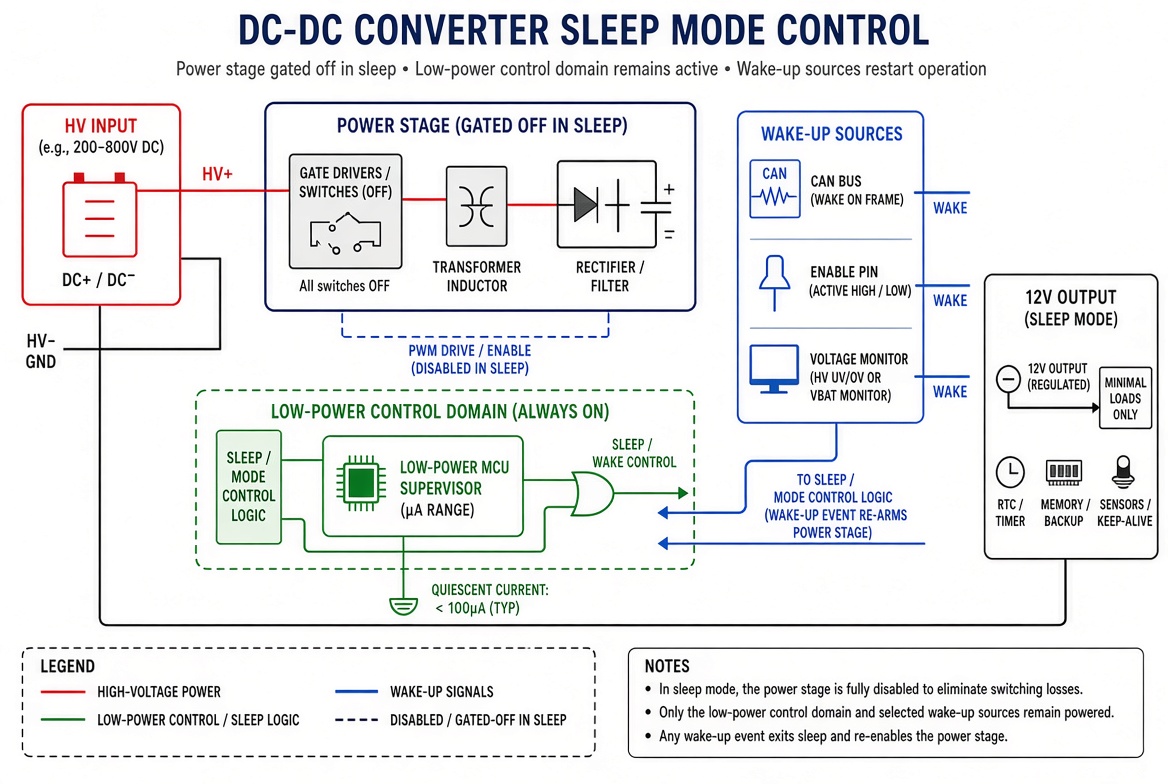
High-power switching stages, gate drivers, and auxiliary supplies are turned off. Only a low-power always-on domain (usually supplied from a small internal rail or the 12 V battery) remains active to monitor wake-up sources.
Intelligent Control and Communication
The DC-DC receives enable/disable commands from the Body Control Module or BMS via CAN. It can also wake autonomously on detection of:
- HV battery voltage changes
- External wake lines
- Network activity (CAN wake-up frames)
Ultra-Low-Power Control Circuits
Use of low-quiescent-current regulators, optimized microcontrollers in sleep mode, and minimal sensing circuitry significantly reduces baseline consumption.
Output Load Management
Even in standby, the 12 V network is carefully managed. Non-critical loads are disconnected via smart switches or relays so that the DC-DC only supports essential always-on functions.
4. System-Level Strategies
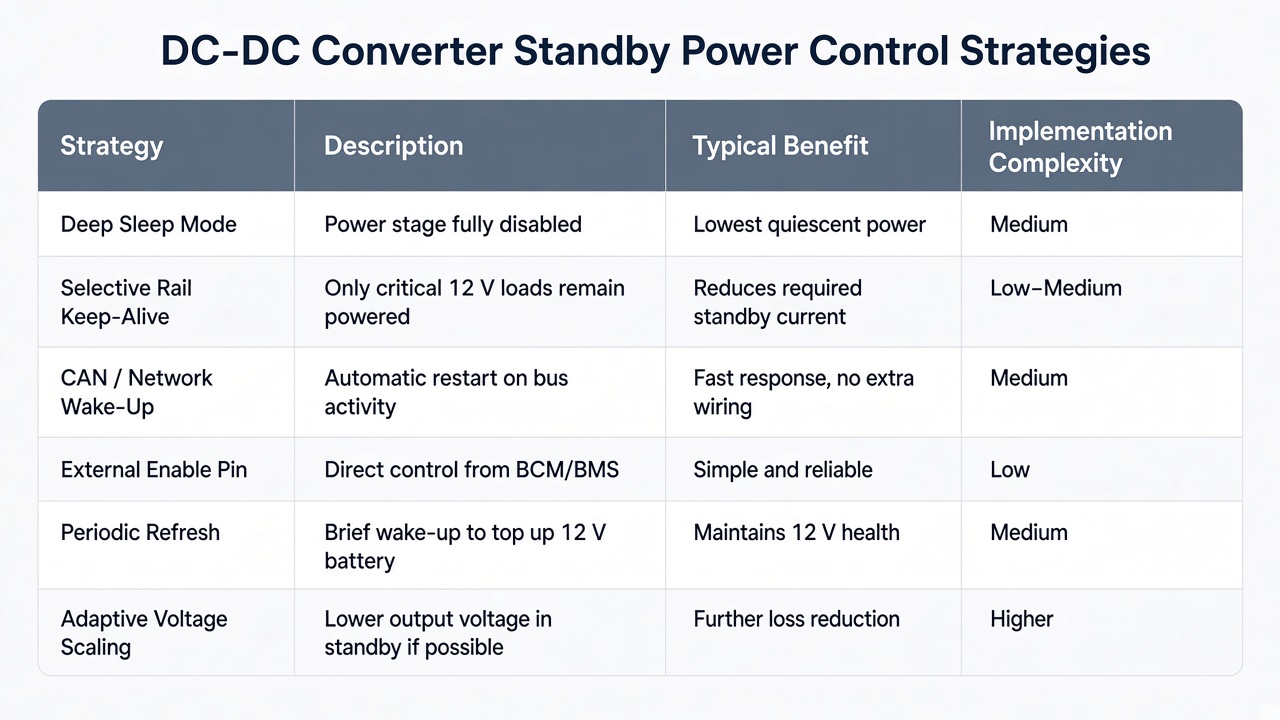 |
Ovar Tech integrates many of these features into its DC-DC and combined OBC + DC-DC products, allowing vehicle manufacturers to achieve very low key-off consumption while maintaining fast wake-up performance and high reliability.
5. Interaction with the 12 V Auxiliary Battery
In many architectures the 12 V battery acts as a buffer. During deep sleep the DC-DC may be completely off, and the 12 V battery supplies the tiny always-on loads. Periodically, or when the 12 V voltage drops below a threshold, the DC-DC wakes up briefly to recharge the 12 V battery from the HV pack. This hybrid approach further minimizes average HV battery drain.
6. Design Challenges and Best Practices
- Ensuring reliable wake-up under all temperature and voltage conditions
- Avoiding false wake-ups that increase average consumption
- Meeting functional safety (ISO 26262) requirements even in low-power states
- Validating long-term quiescent current over the full temperature range and lifetime
Proper validation includes multi-day or multi-week key-off tests measuring actual HV battery energy loss.
 |
Conclusion
Because the entire low-voltage electrical system depends on the high-voltage DC-DC converter, controlling its standby power consumption is essential for preserving high-voltage battery energy during vehicle-off periods. Through multi-level sleep modes, power gating, intelligent network wake-up, and careful load management, modern DC-DC designs can achieve quiescent power levels low enough for practical long-term parking without significant range loss. Solutions from manufacturers such as Ovar Tech incorporate these advanced low-standby techniques, helping OEMs meet strict energy-efficiency and customer-experience targets for electric and hybrid vehicles.
شارك هذا المقال