Isolated vs Non-Isolated DC-DC Converters: How to Choose in Automotive Applications
Isolated vs Non-Isolated DC-DC Converters: How to Choose in Automotive [...]
Isolated vs Non-Isolated DC-DC Converters: How to Choose in Automotive Applications
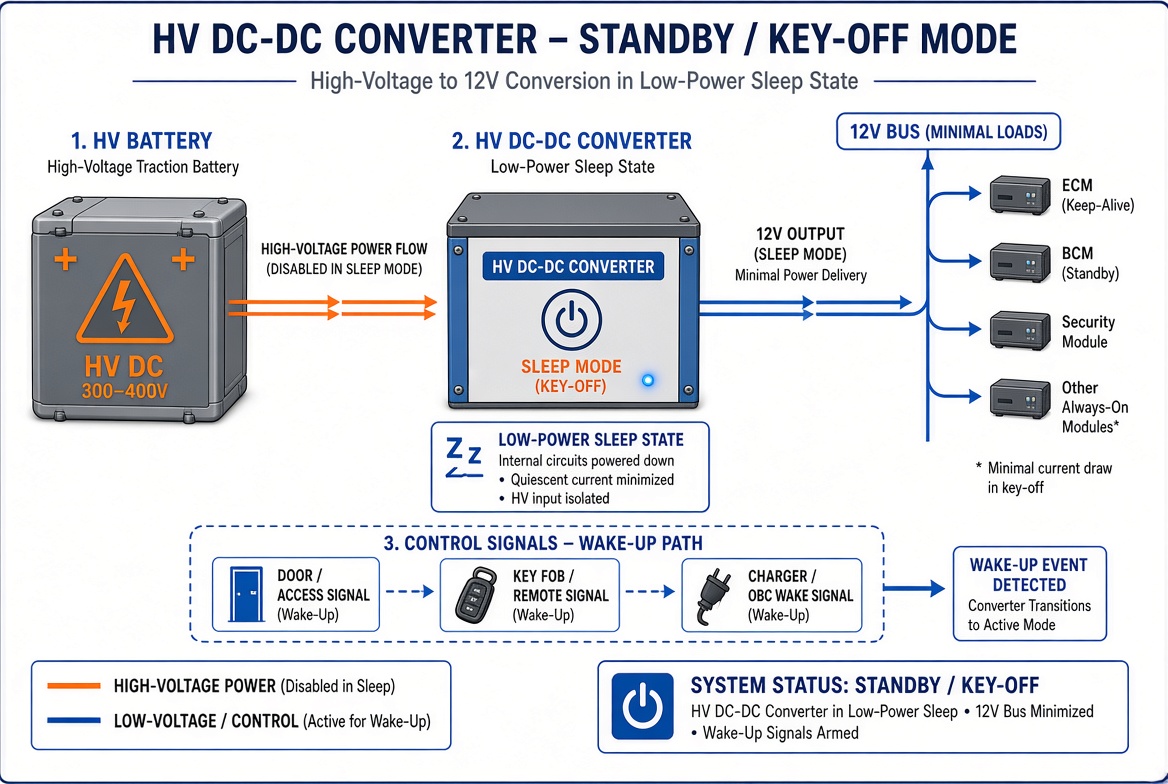
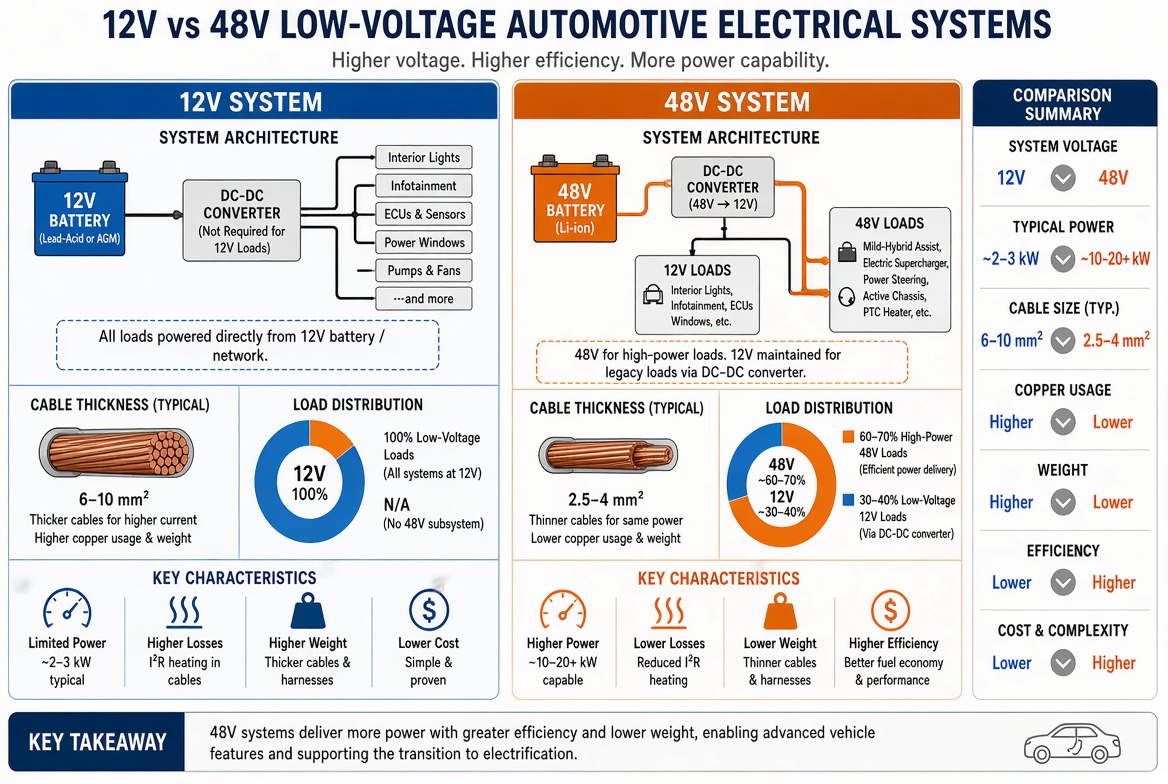
In automotive applications, isolated DC-DC converters are generally preferred when galvanic isolation is required for safety between high-voltage and low-voltage domains, while non-isolated DC-DC converters are chosen for higher efficiency, smaller size, and lower cost when isolation is not necessary. The decision depends on voltage domain separation, functional safety requirements, EMI performance, power level, and overall system cost. In electric and hybrid vehicles, the primary high-voltage-to-12V/24V converter is almost always isolated, whereas secondary regulators within the low-voltage network are frequently non-isolated.
 |
1. Fundamental Differences
Isolated DC-DC Converters
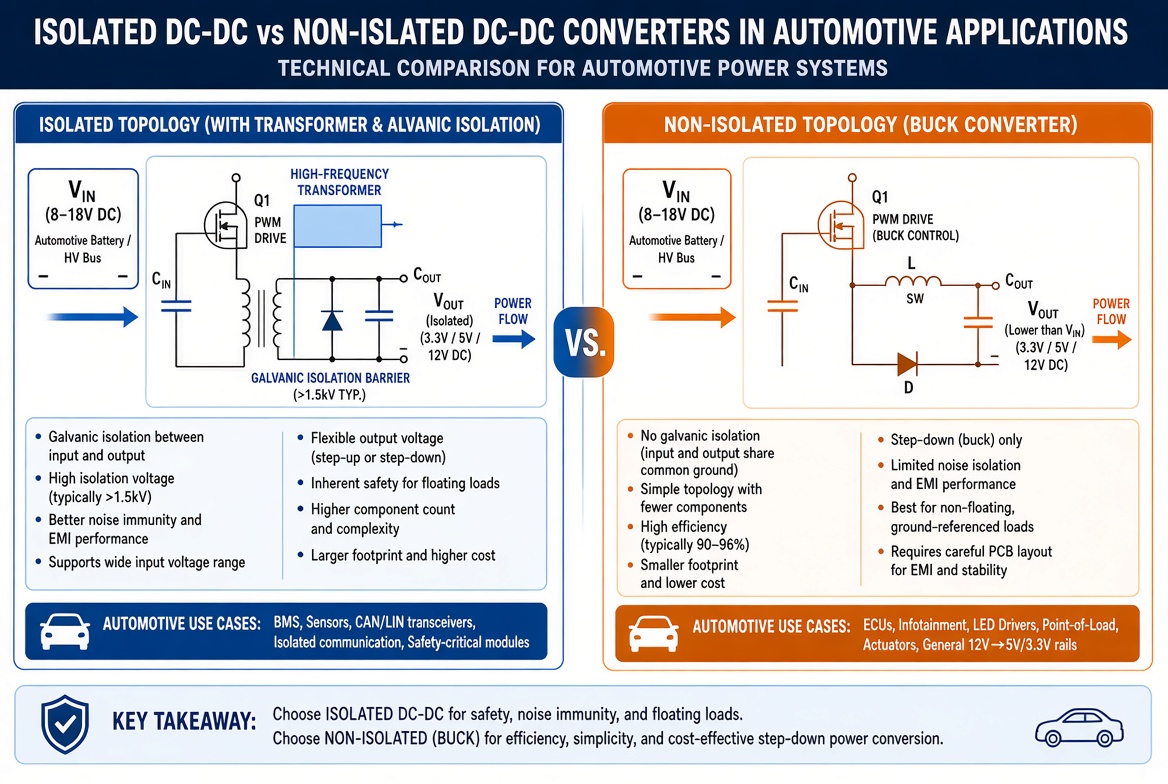
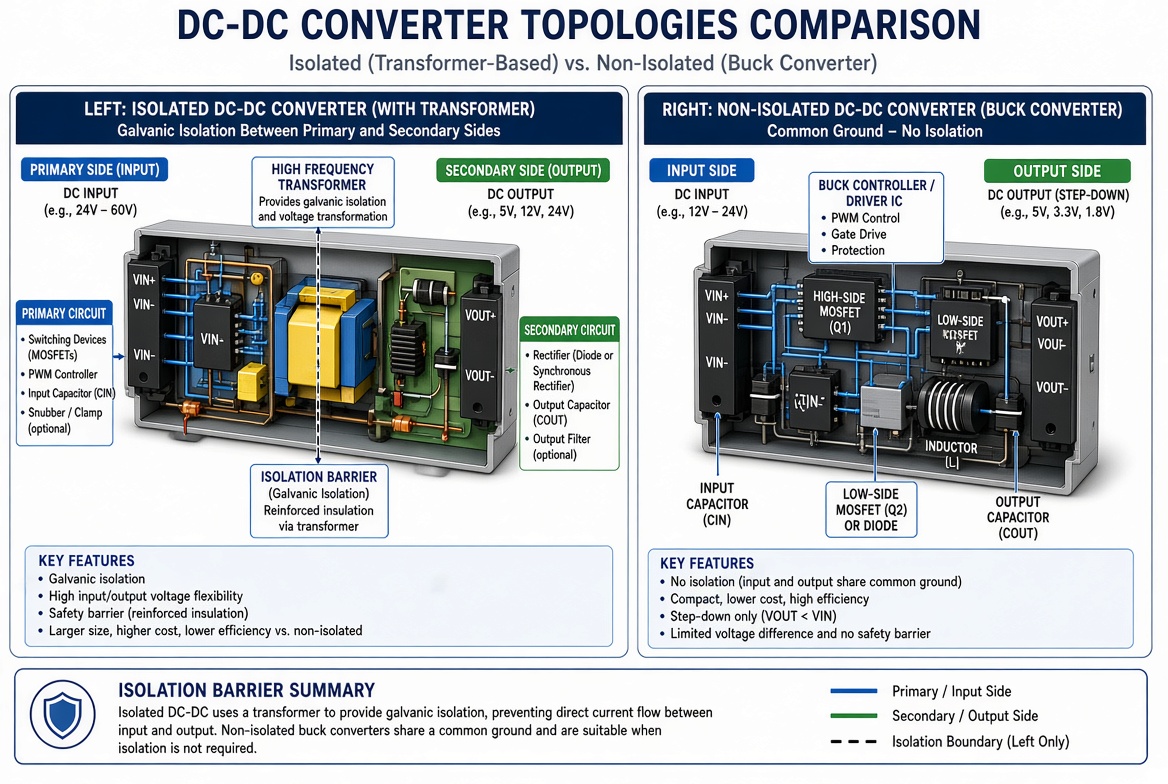
These use a high-frequency transformer to provide galvanic isolation between input and output. Common topologies include LLC resonant, flyback, forward, and dual active bridge (DAB). Isolation voltage is typically rated at 2.5 kV to 4 kV or higher to meet automotive safety standards.
Non-Isolated DC-DC Converters
These share a common ground between input and output. Typical topologies are buck, boost, buck-boost, or synchronous variants. They offer higher efficiency, higher power density, and lower cost because they avoid the transformer and associated magnetic losses.
2. Key Decision Factors in Automotive Environments
Safety and Isolation Requirements
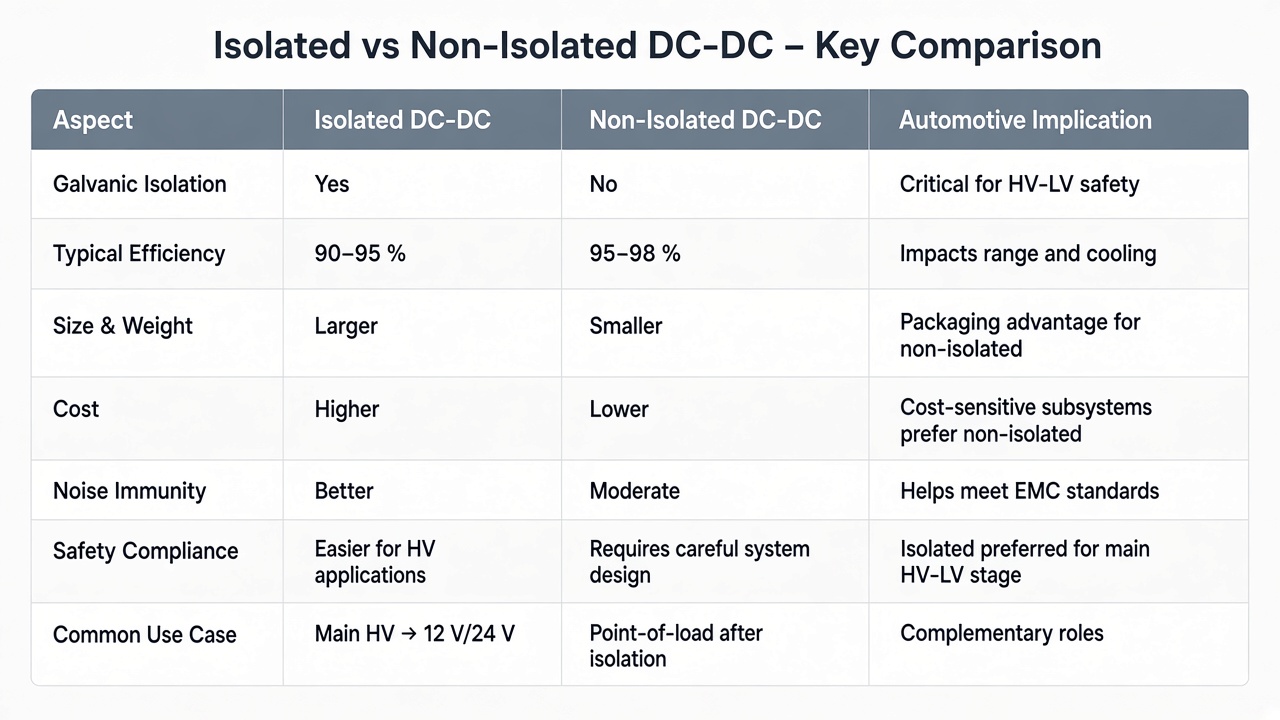
High-voltage battery systems (400 V / 800 V) must remain galvanically isolated from the low-voltage 12 V/24 V network and the vehicle chassis. Regulatory standards (ISO 6469, ISO 26262, ECE R100) mandate reinforced isolation. Therefore, the main HV-to-LV DC-DC converter is almost always isolated. Non-isolated converters are only used downstream of an already-isolated rail.
Efficiency and Thermal Performance
Non-isolated converters typically achieve 95–98 % efficiency, while isolated designs range from 90–95 %. The efficiency gap becomes significant at higher power levels and directly affects cooling requirements and energy consumption.
Size, Weight, and Cost
Isolation transformers increase volume, weight, and bill-of-materials cost. Non-isolated solutions are substantially more compact and economical, making them ideal for distributed point-of-load regulation inside the low-voltage domain.
EMI and Noise Immunity
Isolated converters provide better common-mode noise rejection and help contain high-voltage switching noise. Non-isolated converters can couple noise more directly and may require additional filtering.
Functional Safety and Diagnostics
Isolated designs naturally support independent monitoring of primary and secondary sides, which simplifies compliance with ASIL requirements. Non-isolated converters need careful ground and fault management.
3. Typical Automotive Application Scenarios
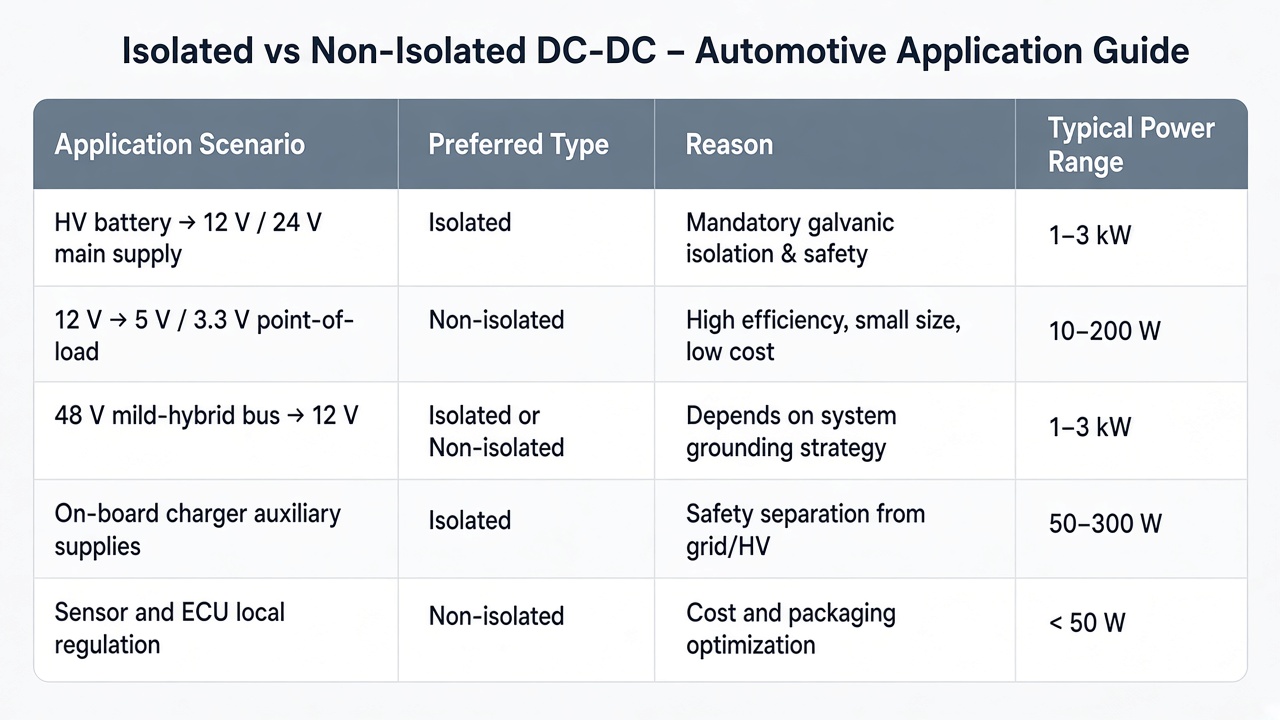 |
Ovar Tech’s DC-DC product range (1 kW, 1.5 kW, 2 kW, and 3 kW) and integrated OBC + DC-DC modules are designed as isolated converters to meet the stringent safety and isolation requirements of the primary HV-to-LV conversion stage. These units deliver high reliability, automotive-grade performance, and competitive efficiency for both passenger and commercial vehicle platforms.
4. Practical Selection Guidelines
1. Start with safety: If the input and output belong to different voltage domains (especially HV vs LV), isolation is mandatory.
2. Evaluate efficiency targets: For continuous high-power loads, the efficiency advantage of non-isolated designs can justify additional system-level isolation elsewhere.
3. Consider packaging constraints: Space- and weight-sensitive applications favor non-isolated solutions wherever isolation is already provided upstream.
4. Assess EMI and grounding: Complex vehicle grounding schemes or strict EMC limits may push designers toward isolated topologies even when not strictly required for safety.
5. Total cost of ownership: Include not only the converter cost but also filtering, cooling, cabling, and validation effort.
 |
5. Summary Comparison
 |
Conclusion
In automotive power systems, isolated and non-isolated DC-DC converters serve complementary roles. Isolated converters are the default choice for any conversion that crosses the high-voltage to low-voltage boundary because of mandatory safety and isolation requirements. Non-isolated converters excel in efficiency, size, and cost for secondary regulation within the same voltage domain. Vehicle architects typically combine both: an isolated main DC-DC (such as those offered by Ovar Tech) creates a safe 12 V or 24 V rail, while multiple non-isolated point-of-load converters distribute power efficiently to individual electronic control units. Understanding this division of roles enables optimal trade-offs among safety, efficiency, cost, and packaging in modern electrified vehicles.
Поделиться этой статьей