


2025: OBC vs DC Fast Charging Pile – What’s the Essential Difference?
2025: OBC vs DC Fast Charging Pile – What’s the [...]
2025: OBC vs DC Fast Charging Pile – What’s the Real Difference?
Why Can DC Fast Charging Bypass the OBC?
The core difference is straightforward: OBC (On-Board Charger) is an AC-to-DC converter built inside the electric vehicle with typical power of 3.3-22kW, ideal for convenient slow charging, while a DC fast charging pile performs the AC-to-DC conversion at the station itself with much higher power (50-350+kW), delivering DC power directly to the battery and completely bypassing the vehicle’s OBC for rapid charging.
According to the China Association of Automobile Manufacturers (CAAM) 2025 New Energy Vehicle Charging Systems White Paper, DC fast charging can bring a typical passenger EV from 20% to 80% state of charge in only 20–40 minutes, whereas using the on-board OBC usually requires 4–8 hours.

AC Level 2 vs DC Level 3 charging comparison (perfect for opening section) |
OBC vs. DC Fast Charging Pile: Side-by-Side Comparison
| Aspect | OBC (On-Board-Charger) | DC Fast Charging Pile |
| Conversion Location | Inside the vehicle | Inside the charging station |
| Input→ Output | AC input → DC Output via OBC | AC input converted to high-power DC at station |
| Typical Power | 3.3kW, 6.6kW, 11kW, 22kW | 50kW-350kW+ |
| Charging Speed | Slow (several hours) | Fast (20-60 minutes for 20-80%) |
| Passes Through OBC? | Yes | No – completely bypasses OBC |
| Best For | Home, office, overnight charging | Highway, long trips, quick top-ups |

Detailed AC Charging System vs DC Charging System diagram |
Why Can DC Fast Charging Bypass the OBC?
EV traction batteries only accept direct current (DC). Most public and home chargers supply alternating current (AC), so conversion is mandatory.
- With OBC: The charging pile delivers AC power, and the vehicle’s compact OBC performs the conversion. Limited by space, weight, and thermal management, OBC power is usually capped at 22 kW.
- With DC fast charging: The heavy rectification and power conversion happen inside the charging station. The station communicates directly with the vehicle’s Battery Management System (BMS) and sends high-voltage DC straight to the battery, bypassing the OBC entirely.
This design allows stations to deploy much larger cooling systems and power modules, enabling significantly higher charging speeds.
Non-obvious Insight: Pushing OBC power higher adds considerable weight (roughly 5–8 kg per additional kW) and cost to the vehicle. DC fast charging moves the heavy conversion hardware off the car, reducing on-board power electronics weight by 15%–25% while allowing the OBC to focus on efficient daily slow charging.
|
|

Ovar Tech’s Role in Modern EV Charging Solutions
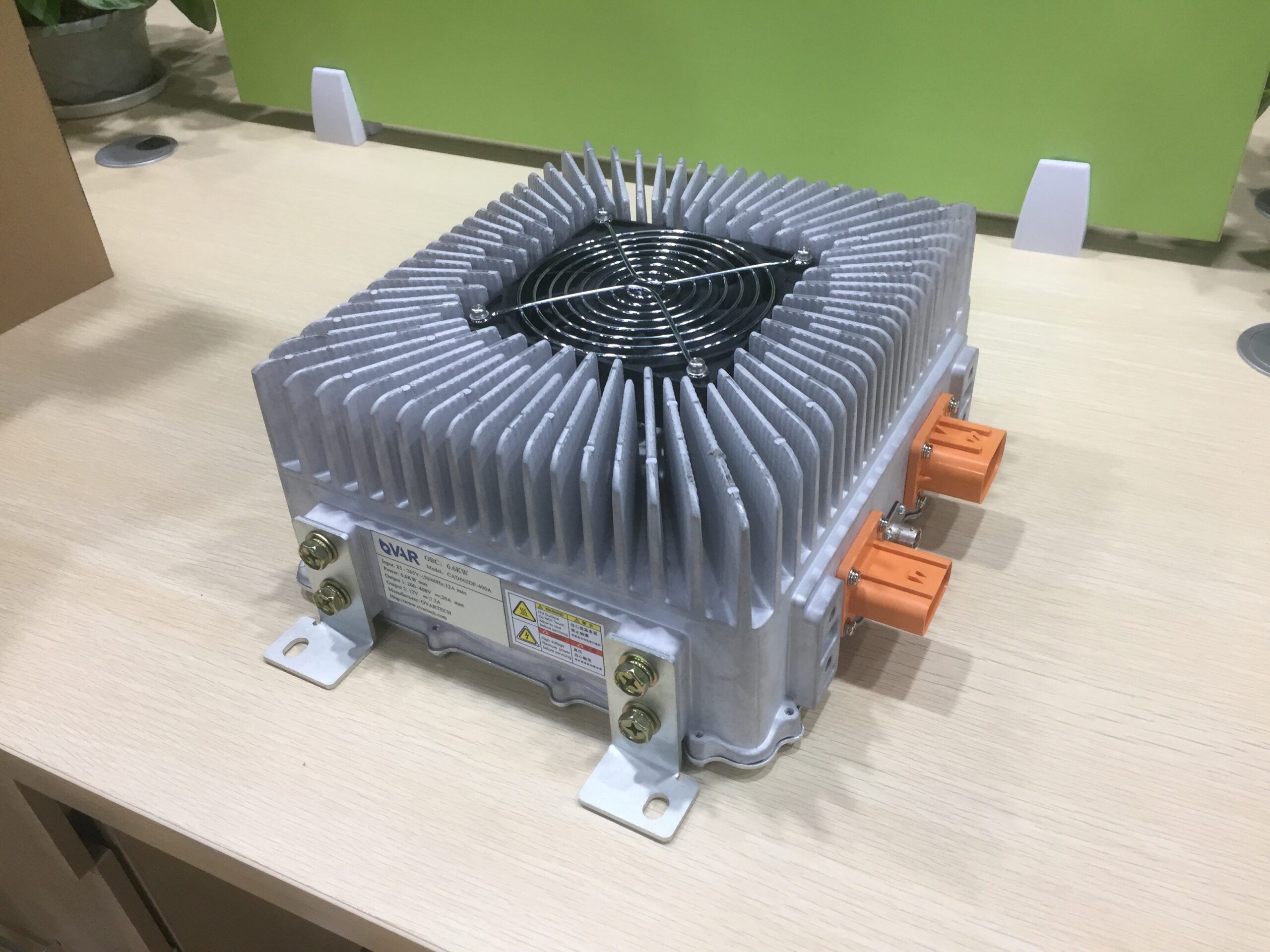
Dongguan Ovar Technology Co., Ltd., founded in 2010, has become a leading Chinese manufacturer of EV power supply solutions. Ovar offers both single OBC units and highly integrated charger + DC-DC systems that work seamlessly with both AC slow charging and DC fast charging scenarios.
Ovar’s product range includes:
- Single OBC: 3.3 kW, 6.6 kW, 11 kW, 22 kW
- Integrated chargers: 3.3 kW OBC + 1.5 kW DC-DC, 6.6 kW OBC + 1.5 kW DC-DC, bi-directional 6.6 kW OBC + 2 kW DC-DC, bi-directional 11 kW OBC + 3 kW DC-DC
- Standalone DC-DC Converters: 1–3 kW
All products support wide voltage platforms from 48 Vdc to 400–850 Vdc, making them suitable for passenger cars, commercial vehicles, industrial utility vehicles, marine applications, and yachts. With a 2,000 m² R&D center, 16,000 m² manufacturing base, and monthly capacity of 15,000–20,000 units, Ovar maintains strict IATF 16949 automotive-grade quality control.

Professional OBC / integrated charger hardware photo |
 Integrated vs Separate power electronics comparison Integrated vs Separate power electronics comparison |
Expert and User Perspectives
Expert View: “In the electrification era, OBC and DC fast charging are complementary. A reliable on-board OBC ensures daily convenience and battery health, while DC fast charging solves range anxiety. Integrated solutions from manufacturers like Ovar Tech are becoming the industry standard.” — Senior EV Power Systems Engineer, 2025 industry interview.
Real User Feedback: “Using Ovar’s 11 kW integrated OBC for home AC charging covers my daily commute perfectly — it’s cheaper and gentler on the battery. On long trips, I simply use DC fast chargers. The combination is ideal.” — EV owner, 2025 community review.
Conclusion and Recommendation
For everyday use, choose reliable AC charging with Ovar Tech’s high-quality OBC or integrated solutions. For long-distance travel or fast top-ups, rely on DC fast charging piles that intelligently bypass the OBC. Ovar’s flexible single and integrated power products allow vehicle makers and fleet operators to optimize both scenarios efficiently and cost-effectively.
Welcome to contact Ovar Technology for professional EV power supply solutions.
Share This Article

Written by : Ovar
Follow Us
Latest Articles

27 March, 2026
27 March, 2026