Understanding the On-Board Charger (OBC): The Core Conversion Device for AC Slow Charging in Electric Vehicles

Understanding the On-Board Charger (OBC): The Core Conversion Device for [...]
Understanding the On-Board Charger (OBC): The Core Conversion Device for AC Slow Charging in Electric Vehicles
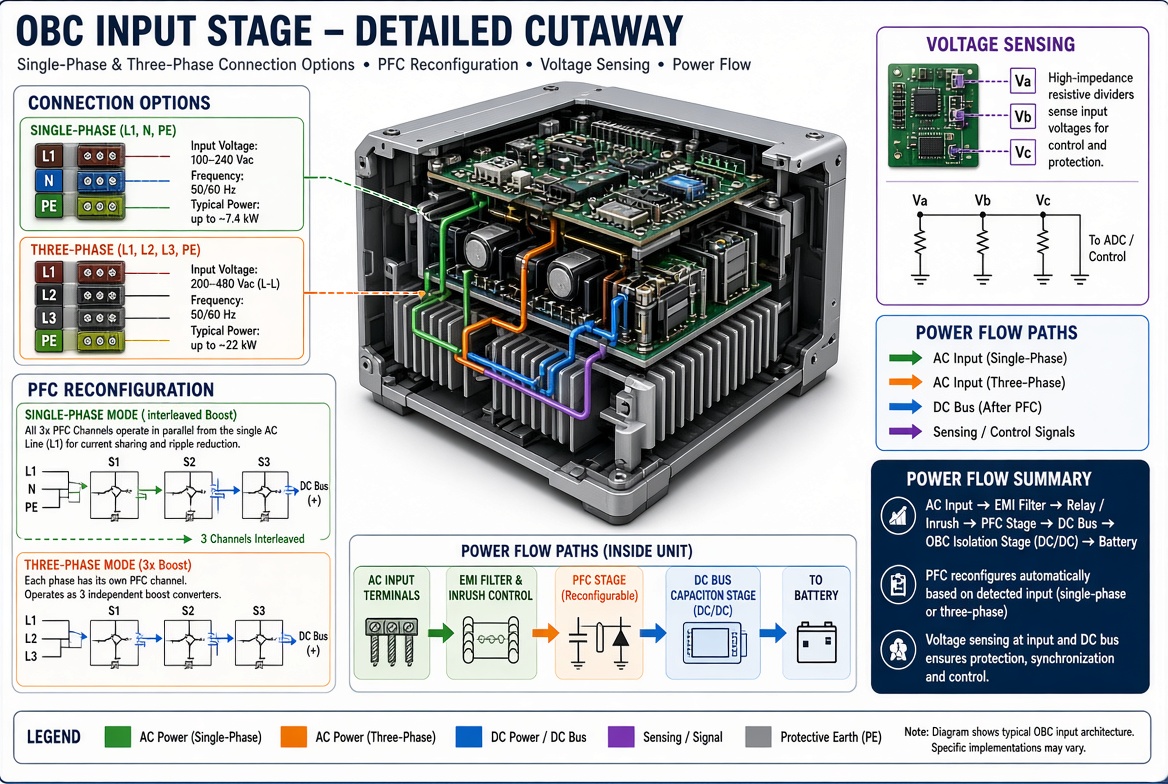
The On-Board Charger (OBC) is the critical power electronics device in electric vehicles responsible for converting grid AC power into DC power to charge the high-voltage battery pack. It serves as the primary interface between the vehicle and standard AC charging stations (Level 1 and Level 2), typically delivering 3.3kW to 22kW charging power. Modern OBCs integrate advanced power factor correction (PFC), resonant DC-DC conversion, and sophisticated control systems to achieve high efficiency, low harmonics, and reliable performance.
 |
1. Basic Architecture of the On-Board Charger
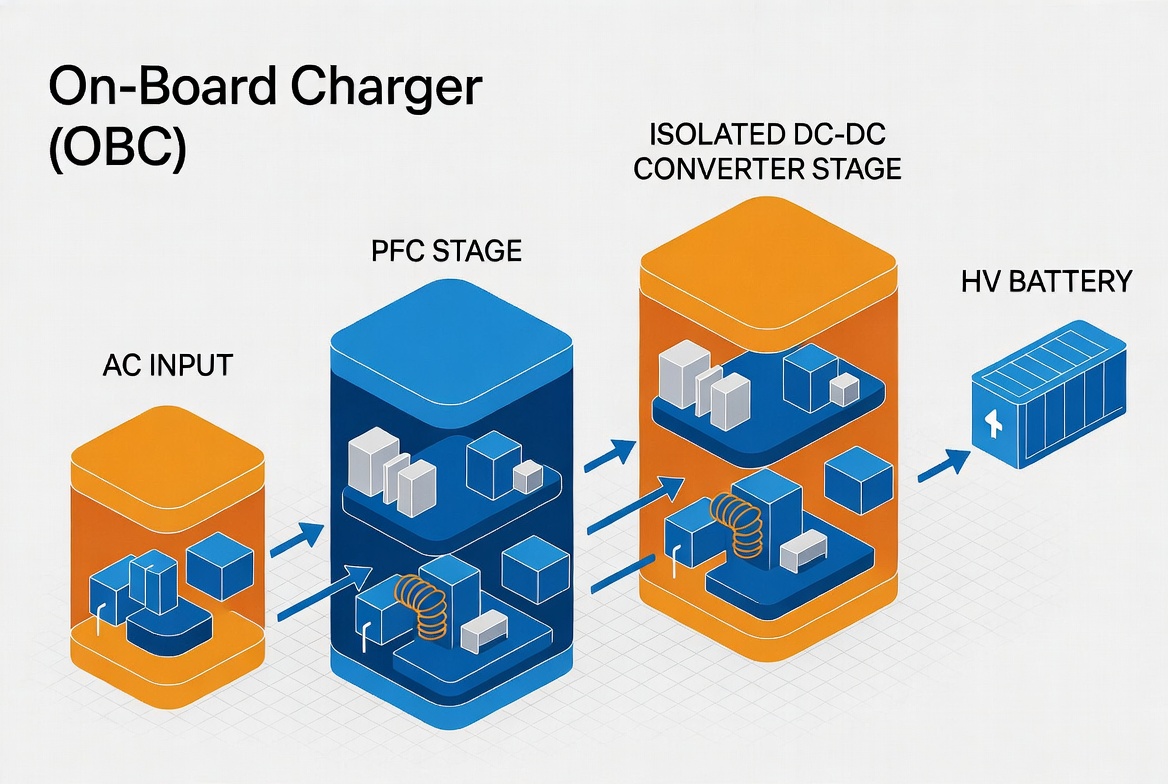
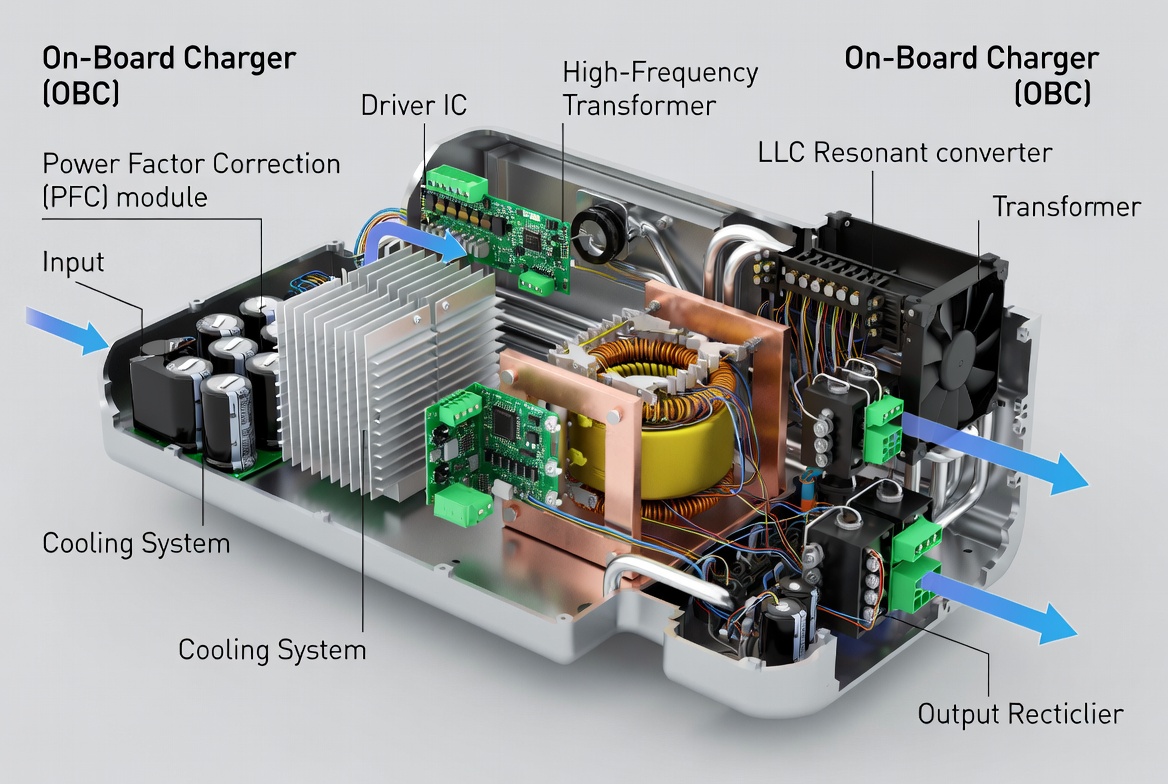
A typical OBC consists of two main stages:
- Front-End Power Factor Correction (PFC) Stage
This stage converts single-phase or three-phase AC input (85–265V or higher) into a stable high-voltage DC bus (typically 400V). It corrects the power factor to near unity (>0.99), reduces harmonic distortion, and complies with international standards such as IEC 61000-3-2. - Isolated DC-DC Converter Stage
This stage takes the high-voltage DC bus and converts it to the required battery voltage (200V–800V) with galvanic isolation for safety. Common topologies include LLC resonant converters or CLLC for bidirectional capability, which enable high efficiency and soft switching.
Ovar Tech’s OBC products, including the 6.6kW and 11kW integrated models, utilize these advanced architectures to deliver excellent performance across a wide input voltage range.
2. Detailed Working Principle Step by Step
Step 1: AC Input and Rectification
When connected to an AC charging station, the OBC first rectifies the incoming AC voltage using a diode bridge or active rectifier.
Step 2: Power Factor Correction
The PFC circuit (usually a boost topology) shapes the input current to be sinusoidal and in phase with the voltage. This maximizes power transfer efficiency and minimizes stress on the grid.
Step 3: DC Bus Regulation
A stable high-voltage DC link is maintained. This intermediate bus acts as a buffer between the grid and the battery.
Step 4: Isolated DC-DC Conversion
The isolated stage employs high-frequency transformers for safety isolation. Resonant converters (LLC/CLLC) operate at high frequencies (100–500kHz), significantly reducing the size of magnetic components while achieving peak efficiencies of 94–96%.
Step 5: Battery Management and Control
The OBC communicates with the Battery Management System (BMS) via CAN bus to dynamically adjust charging current and voltage according to the battery’s State of Charge (SOC), temperature, and health status.
 |
3. Key Technologies in Modern OBCs
- Wide Bandgap Semiconductors: SiC MOSFETs enable higher switching frequencies and lower losses.
- Digital Control: Advanced DSP or MCU platforms provide precise current/voltage regulation and protection functions.
- Thermal Management: Effective cooling (air or liquid) is essential for maintaining performance in engine compartments.
- Safety and Compliance: Features like galvanic isolation, over-voltage/current protection, and compliance with automotive standards (AEC-Q, ISO 26262).
Ovar Tech’s integrated OBC + DC-DC solutions (such as 6.6kW OBC + 1.5/2kW DC-DC and bi-directional 11kW models) combine these technologies into compact, high power-density units, making them ideal for commercial vehicles and marine applications.
4. Advantages of OBC in AC Slow Charging
- Convenient charging using standard household or public AC outlets
- Cost-effective compared to DC fast chargers
- Full control over charging process for optimal battery health
- Bidirectional capability in advanced models (V2G / V2L)
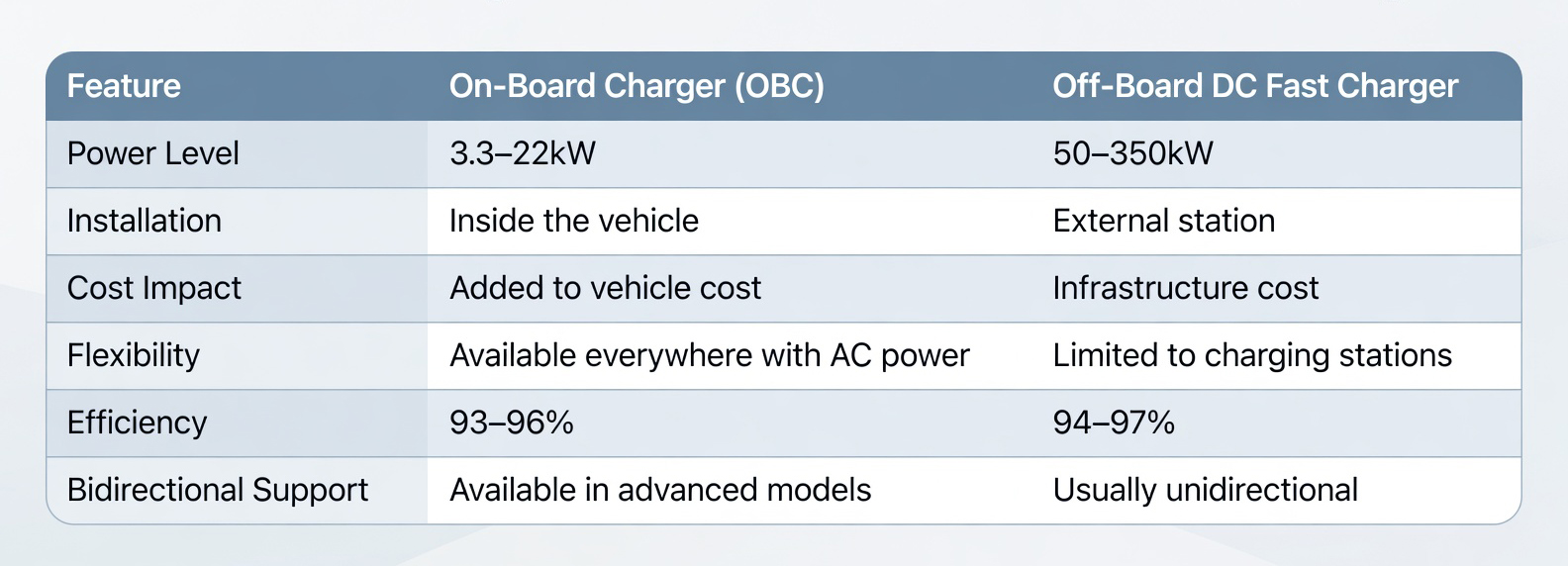
Comparison: OBC vs Off-Board DC Charger
 |
Conclusion
The On-Board Charger is the unsung hero of AC slow charging, transforming everyday grid electricity into safe, controlled DC power for electric vehicle batteries. Through sophisticated power electronics and intelligent control, modern OBCs like those from Ovar Tech deliver high efficiency, compact size, and excellent reliability.
Understanding the working principle of the OBC helps engineers, fleet operators, and EV enthusiasts appreciate the engineering behind convenient home and workplace charging. As vehicle electrification continues to grow, advancements in OBC technology — particularly integrated and bidirectional designs — will play a pivotal role in making electric mobility more practical and efficient.
이 글을 공유하세요