5 Critical Pitfalls to Avoid When Selecting an OBC for 800V High-Voltage Platform Vehicles

5 Critical Pitfalls to Avoid When Selecting an OBC for [...]
5 Critical Pitfalls to Avoid When Selecting an OBC for 800V High-Voltage Platform Vehicles
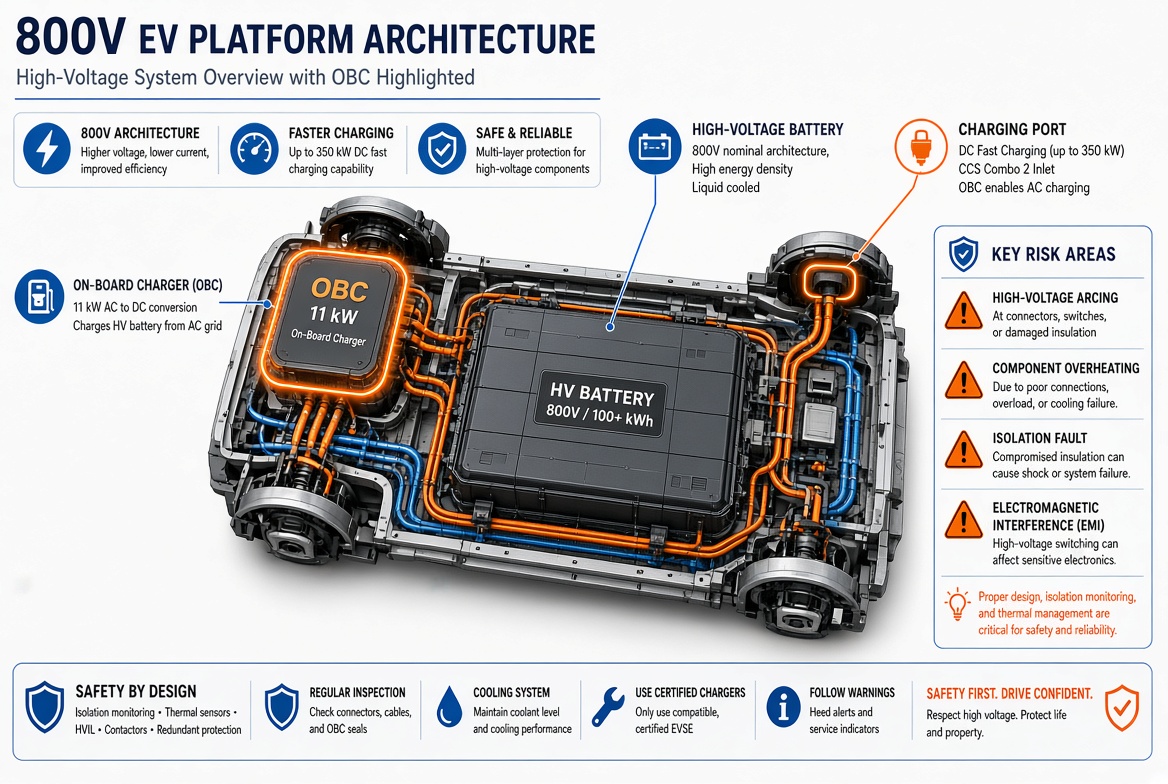
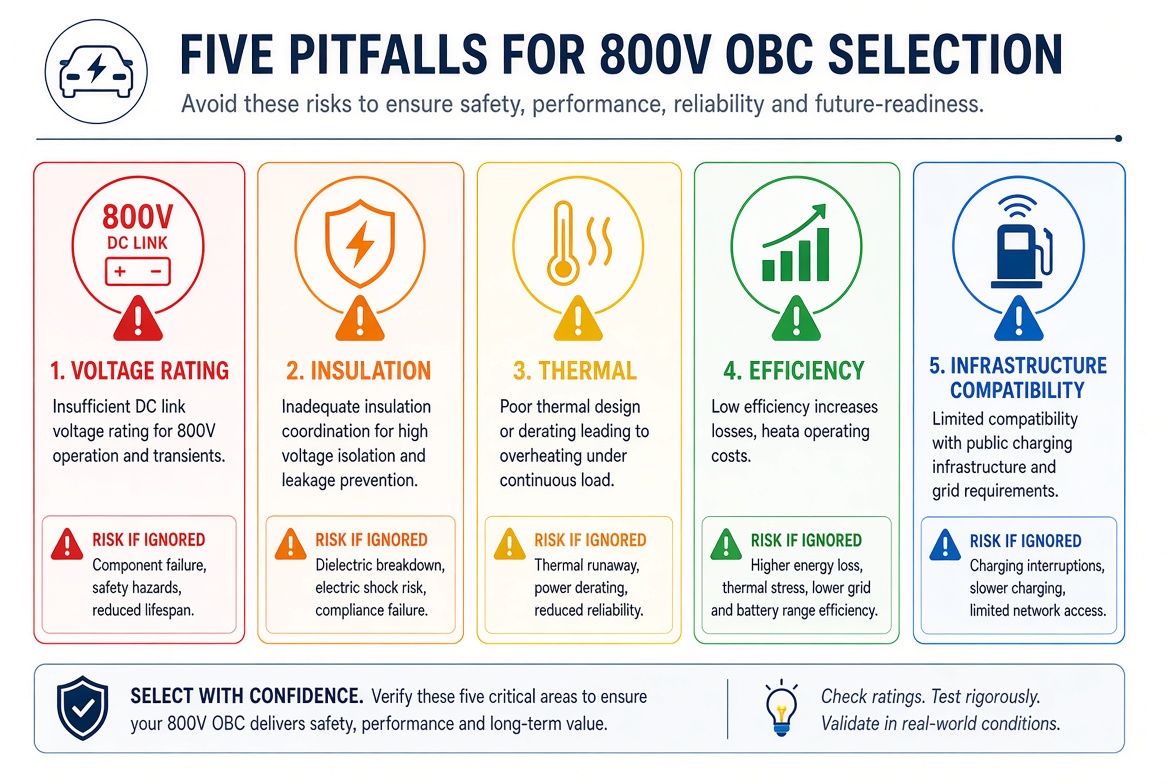
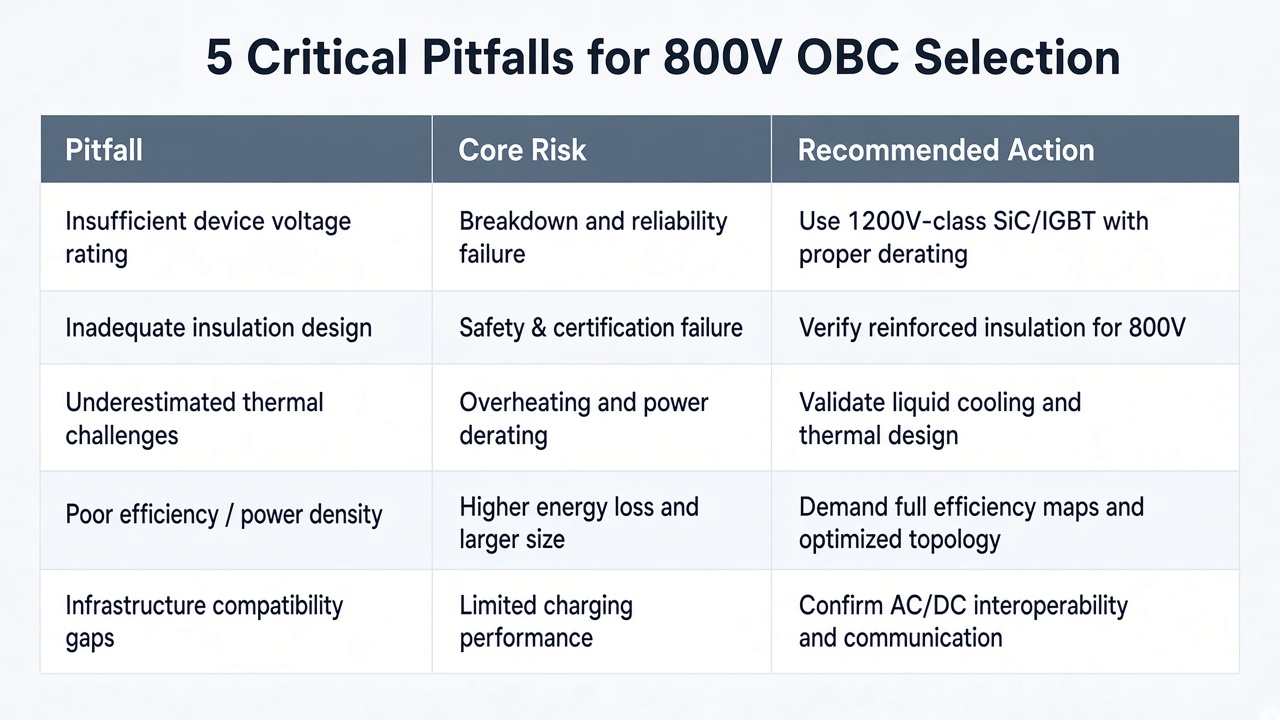
When selecting an On-Board Charger (OBC) for 800V high-voltage platform vehicles, the five most common and costly pitfalls are insufficient voltage rating of power devices, inadequate insulation design, underestimating thermal challenges, ignoring efficiency at high voltage, and overlooking charging infrastructure compatibility. Avoiding these issues is essential to ensure safety, reliability, charging performance, and long-term system cost control on 800V architectures.
 |
Pitfall 1: Insufficient Voltage Rating of Power Semiconductors
Many 400V-era OBCs use 650V or 900V power devices. On an 800V platform, the DC-link voltage can reach 850–900V under certain conditions, leaving insufficient safety margin.
Risks:
- Device breakdown under voltage spikes or regenerative events
- Reduced reliability and higher failure rates
- Potential safety hazards
Correct approach:
Select OBCs that use 1200V-class SiC MOSFETs or IGBTs with adequate derating. Wide-bandgap devices are preferred for both voltage capability and efficiency.
Ovar Tech’s high-voltage OBC solutions, including 22kW models designed for elevated voltage platforms, incorporate appropriately rated power devices to maintain robust safety margins on 800V systems.
Pitfall 2: Inadequate Insulation and Isolation Design
Higher system voltage significantly increases the requirements for creepage, clearance, and isolation barriers.
Common mistakes:
- Using isolation transformers or PCBs designed for 400V systems
- Insufficient reinforced insulation between primary and secondary sides
- Inadequate high-voltage connector and cable ratings
Consequences:
Failure to meet ISO 6469, IEC 60664, or OEM-specific insulation coordination requirements can lead to certification failure or field safety issues.
Designers must verify reinforced insulation, partial discharge performance, and high-potential (Hi-Pot) test results specifically for 800V operation.
Pitfall 3: Underestimating Thermal Management Challenges
Although higher voltage reduces current for the same power, switching losses, magnetic losses, and concentrated heat in power modules can still create serious thermal issues—especially in high-power 11kW or 22kW OBCs.
Pitfalls include:
- Relying on air cooling when liquid cooling is required
- Poor cold-plate design or thermal interface materials
- Inadequate temperature monitoring and derating strategies
An OBC that performs well on a 400V platform may overheat or require heavy derating on an 800V vehicle if thermal design is not re-validated.
Pitfall 4: Ignoring Efficiency and Power Density at High Voltage
Higher voltage enables lower current and potentially higher efficiency, but only if the topology and components are optimized. Some designs suffer from:
- Increased switching losses if gate drive or layout is not optimized for SiC
- Higher core losses in transformers at elevated voltage
- Larger magnetic components that hurt power density
Best practice:
Demand efficiency maps across the full voltage and load range, not just peak efficiency numbers. Look for soft-switching topologies (LLC, CLLC, or advanced resonant designs) proven on 800V platforms.
Ovar Tech’s high-voltage OBC portfolio focuses on high efficiency and compact packaging suitable for modern 800V electric vehicles.
Pitfall 5: Overlooking Charging Infrastructure and Communication Compatibility
An 800V vehicle must still charge reliably on both 400V and 800V DC fast chargers as well as AC infrastructure. The OBC itself mainly handles AC charging, but system-level compatibility is critical.
Key issues to check:
- Correct handling of AC input voltage range and power factor under high DC-link voltage
- Proper communication (ISO 15118, DIN 70121) and voltage negotiation when the vehicle also supports DC fast charging
- Smooth transition between AC and DC charging modes without bus voltage conflicts
Selecting an OBC without verifying full system compatibility can result in limited charging speed or interoperability problems in the field.
 |
Summary of the Five Pitfalls
 |
Conclusion
Moving to an 800V architecture brings clear benefits in charging speed, cable weight, and efficiency, but it also raises the technical bar for the On-Board Charger. The five pitfalls outlined above—voltage rating, insulation, thermal design, efficiency optimization, and infrastructure compatibility—are the most frequent sources of costly redesigns and field issues.
By carefully evaluating these areas and selecting proven high-voltage solutions, such as those offered by Ovar Tech for elevated voltage platforms, vehicle manufacturers can fully realize the advantages of 800V systems while maintaining safety, reliability, and competitive cost.
この記事を共有する