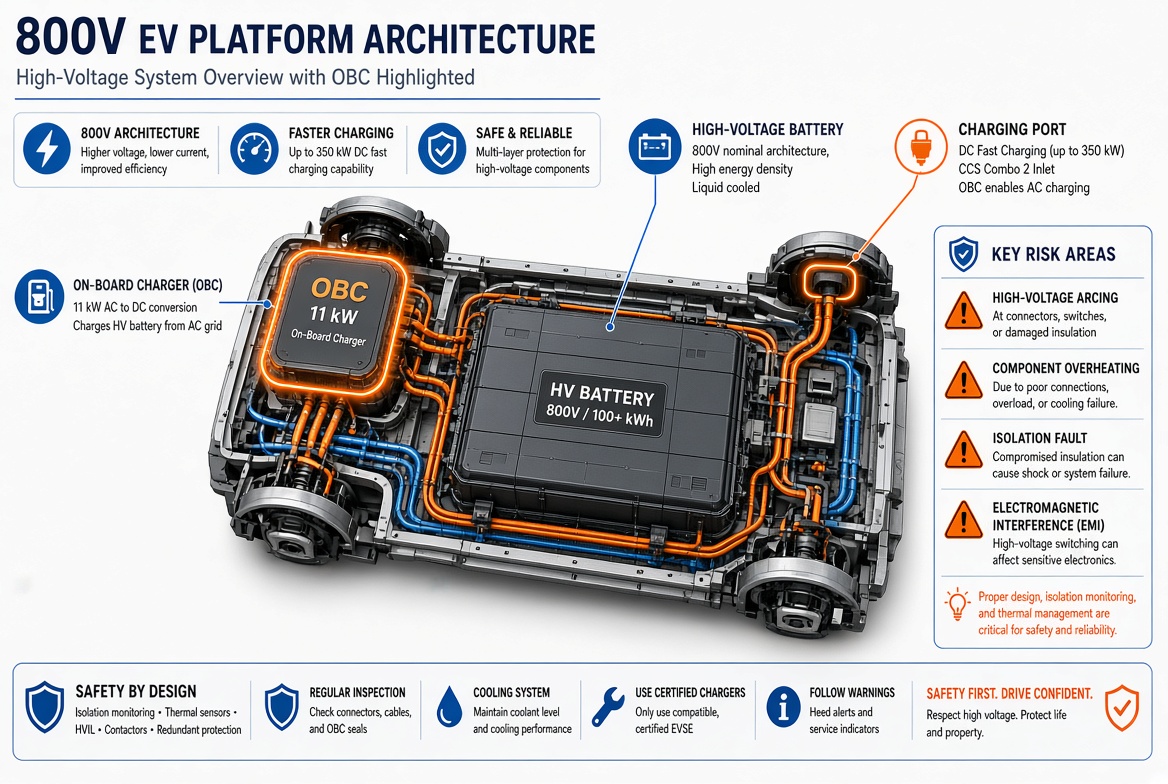
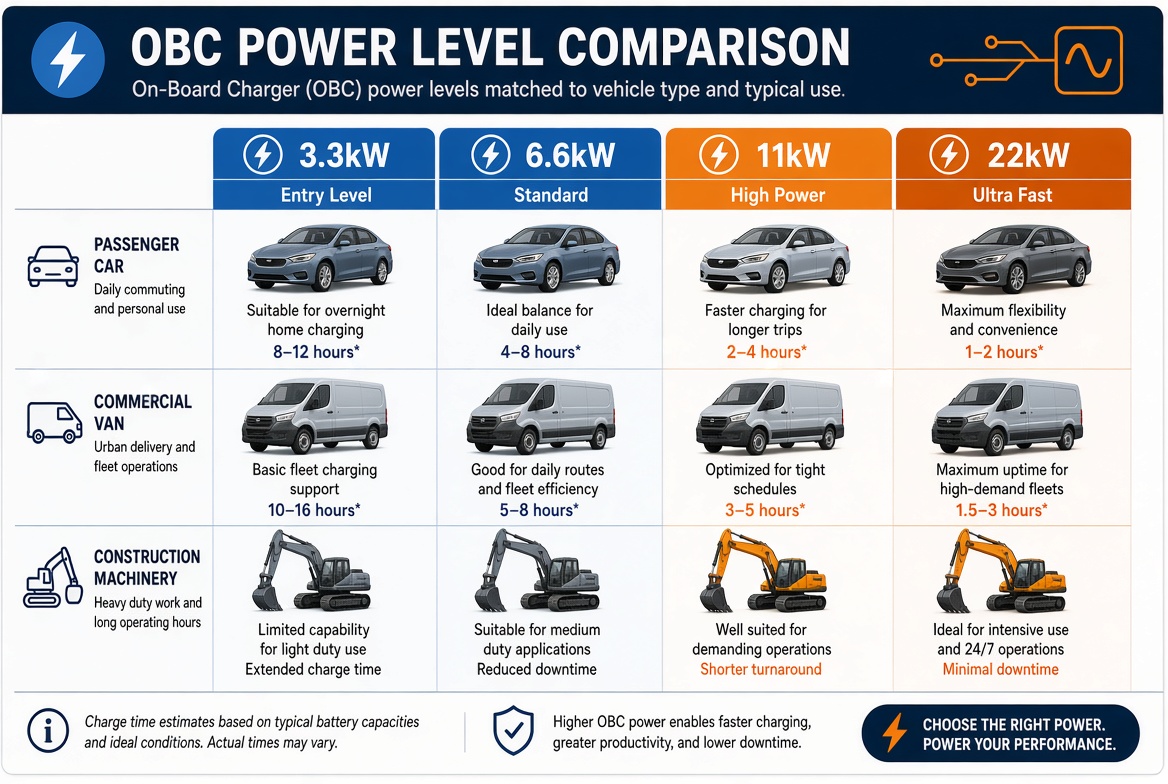
1kW / 1.5kW / 2kW / 3kW On-Board DC-DC Selection Guide: Matching Power to Vehicle Low-Voltage Loads

1kW / 1.5kW / 2kW / 3kW On-Board DC-DC Selection [...]
1kW / 1.5kW / 2kW / 3kW On-Board DC-DC Selection Guide: Matching Power to Vehicle Low-Voltage Loads
Selecting the correct on-board DC-DC converter power rating — 1 kW, 1.5 kW, 2 kW, or 3 kW — requires accurately matching the converter’s continuous and peak output capability to the vehicle’s total low-voltage (12 V / 24 V) electrical load. Undersizing leads to voltage drops, battery drain, or system shutdowns, while oversizing increases cost, weight, and standby losses. A systematic load analysis is the foundation of proper DC-DC selection.
 |
1. Why Accurate Power Matching Matters
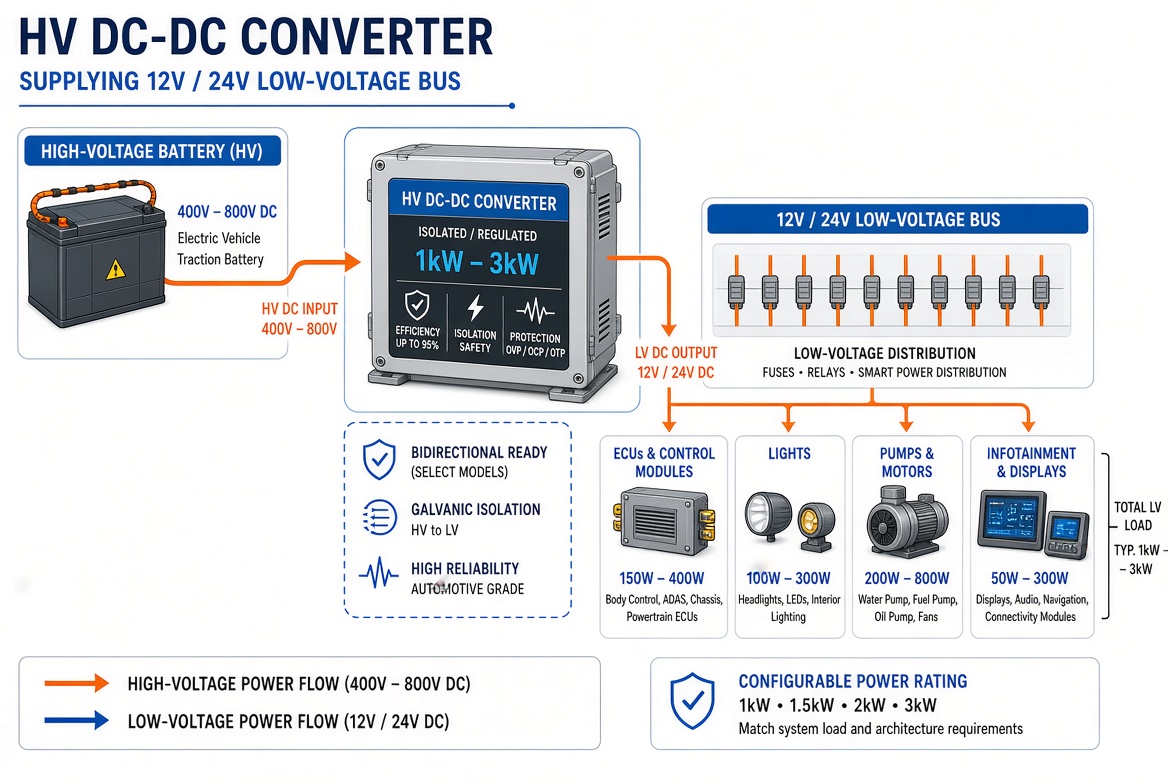
In electric and hybrid vehicles, the high-voltage battery is the primary energy source. The DC-DC converter continuously steps this voltage down to supply the entire low-voltage network. Typical loads include:
- Body control modules, ECUs, and sensors
- Lighting (interior and exterior)
- Infotainment and instrument cluster
- Electric pumps, fans, and compressors
- Safety systems (ABS, airbags, ADAS)
- Always-on loads (immobilizer, telematics, keyless entry)
The sum of these loads under worst-case conditions determines the minimum continuous power the DC-DC must deliver. Peak loads (e.g., simultaneous activation of multiple high-power devices) define the required short-term capability.
2. Typical Power Ratings and Their Application Range
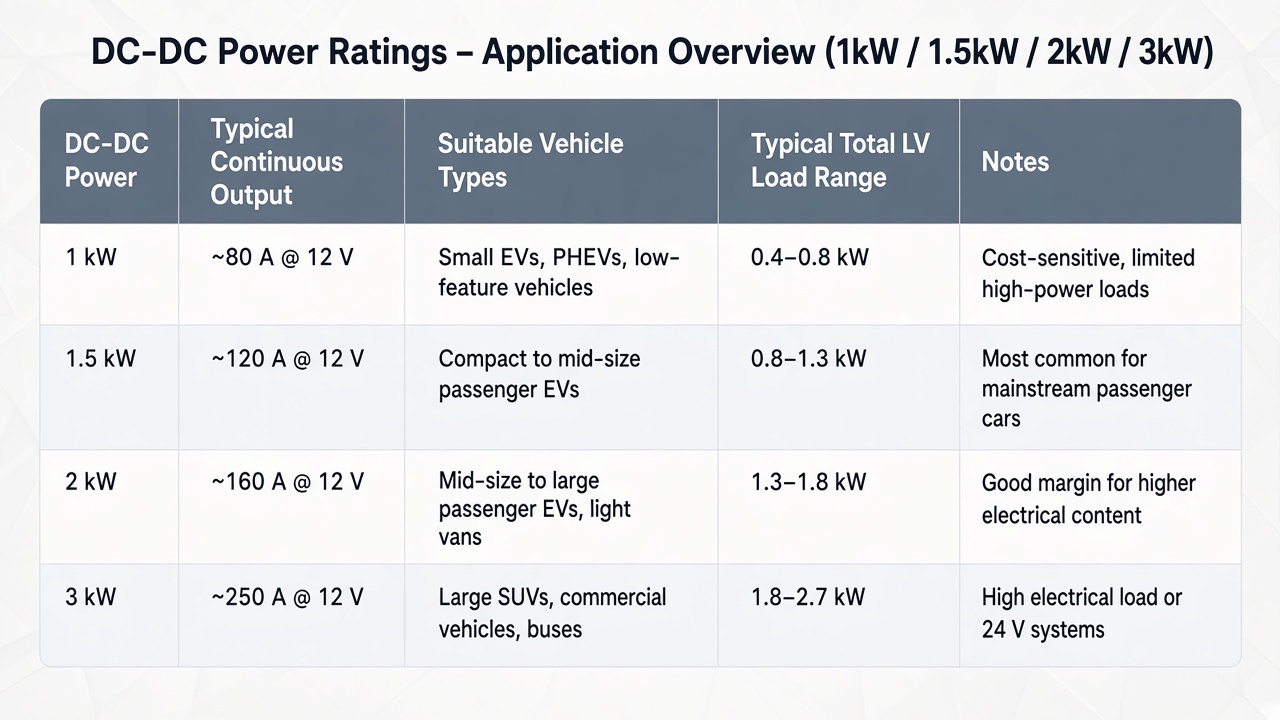 |
Ovar Tech offers a full range of automotive DC-DC converters at 1 kW, 1.5 kW, 2 kW, and 3 kW, as well as integrated OBC + DC-DC modules that combine charging and low-voltage power supply functions.
3. Step-by-Step Load Matching Method
Step 1: List all low-voltage loads
Create a comprehensive bill of electrical loads with their nominal and maximum current draw.
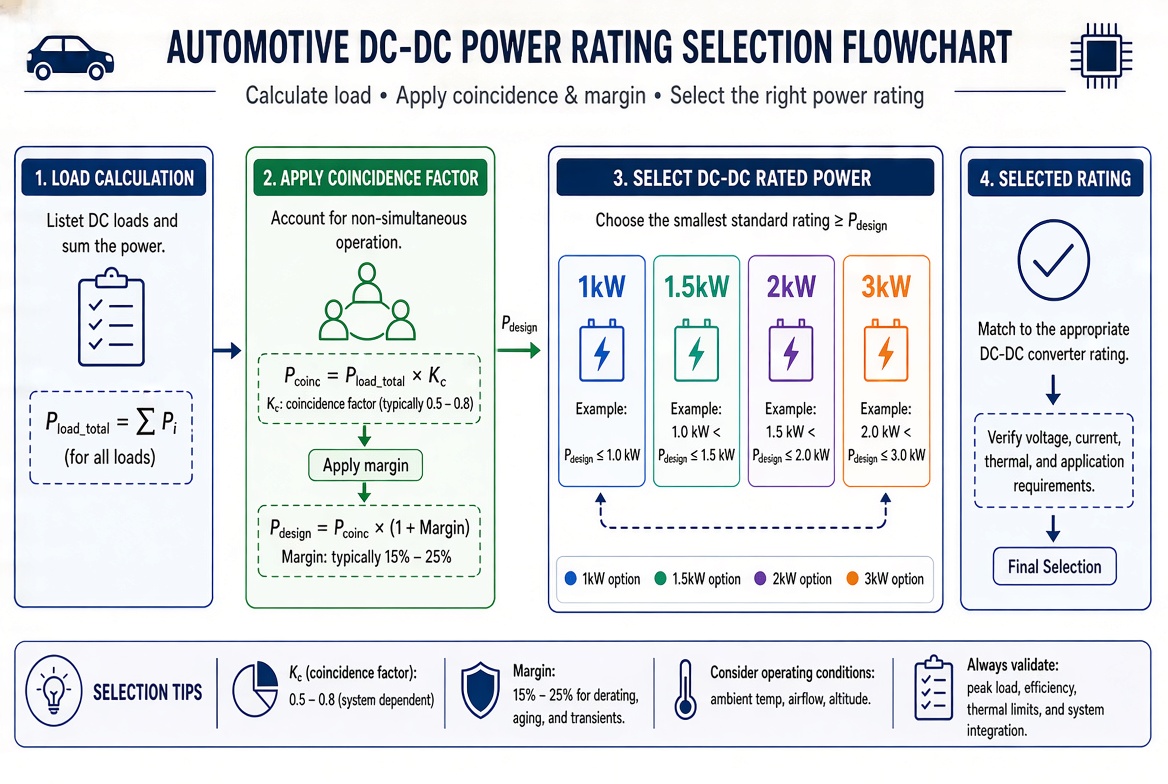
Step 2: Apply duty cycles and coincidence factors
Not all loads operate simultaneously. Use realistic coincidence factors (typically 0.6–0.85 for passenger cars) to calculate average and peak demand.
Step 3: Add safety margin
Apply a 20–30 % continuous power margin and a higher short-term peak margin to cover aging, temperature effects, and future load growth.
Step 4: Consider voltage platform
12 V systems are standard for passenger cars; 24 V is common in commercial vehicles and some construction equipment. Power ratings scale accordingly.
Step 5: Evaluate thermal and packaging constraints
Higher-power units require better cooling (air or liquid) and more installation space.
4. Selection Guidelines by Vehicle Category
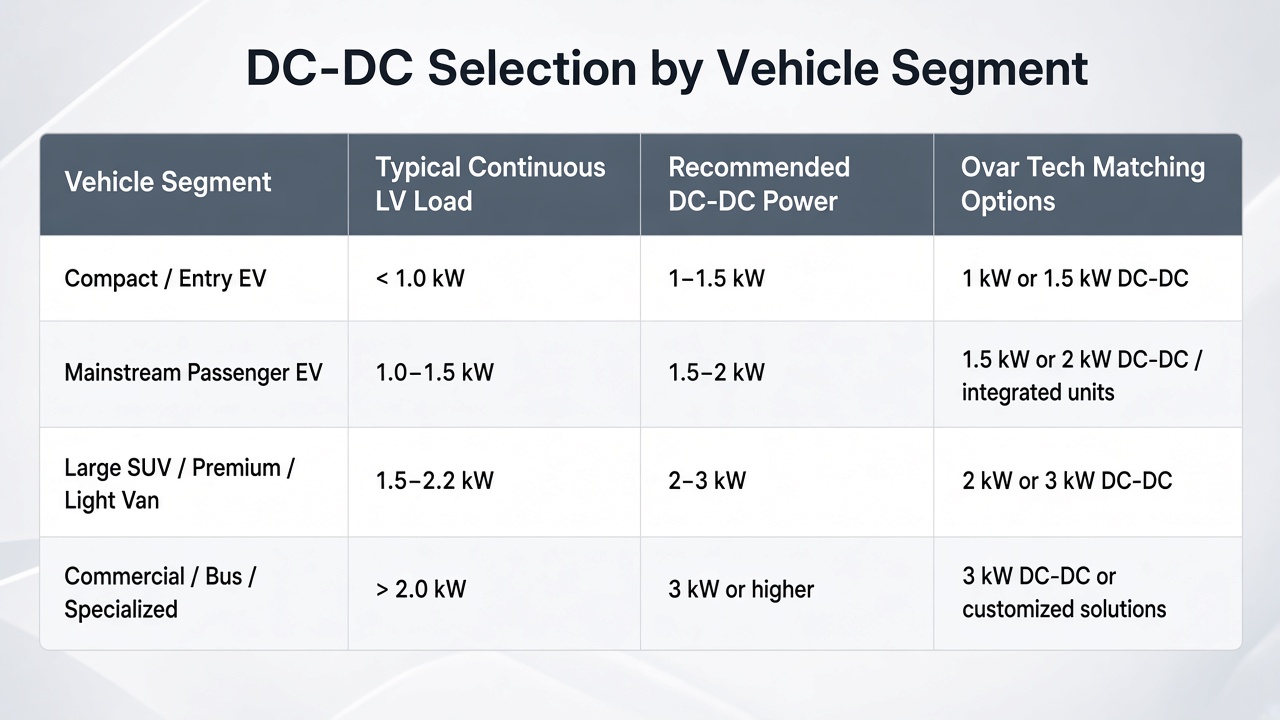
Compact and Entry-Level Passenger EVs
- Total LV load usually stays below 1 kW continuous
- Recommended: 1 kW or 1.5 kW
- Priority: cost and compact size
Mainstream Passenger Cars and Crossovers
- Growing electrical content (more ECUs, ADAS, comfort features)
- Recommended: 1.5 kW or 2 kW
- 1.5 kW is often the sweet spot for cost and performance
Large SUVs, Premium Vehicles, and Light Commercial Vans
- Higher continuous and peak loads
- Recommended: 2 kW or 3 kW
- Extra margin supports future feature additions
Commercial Vehicles, Buses, and Specialized Equipment
- Frequently use 24 V systems and have heavy auxiliary loads
- Recommended: 2 kW or 3 kW (or higher customized units)
- Emphasis on ruggedness and high reliability
5. Additional Selection Factors Beyond Power Rating
- Efficiency: Look for ≥ 92–94 % peak efficiency to minimize HV battery drain.
- Standby / Quiescent Power: Critical for key-off consumption; modern units should support deep-sleep modes.
- Cooling Method: Air-cooled for lower power; liquid-cooled preferred above 2 kW in many platforms.
- Isolation and Safety: Reinforced isolation is mandatory for HV-to-LV conversion.
- Communication: CAN interface and diagnostic capability are standard requirements.
- Environmental Robustness: Wide temperature range, vibration, and IP rating appropriate to the vehicle.
 |
6. Summary Recommendation Table
 |
Conclusion
Correct DC-DC power selection starts with a thorough understanding of the vehicle’s low-voltage load profile, including continuous, peak, and future growth requirements. The 1 kW, 1.5 kW, 2 kW, and 3 kW ratings cover the vast majority of passenger and light commercial electric vehicles when properly matched. By applying a structured load-analysis process and selecting proven automotive-grade products — such as the DC-DC range offered by Ovar Tech — engineers can ensure stable 12 V/24 V power delivery, optimal efficiency, and long-term system reliability without unnecessary cost or weight.
شارك هذا المقال