Electric Vehicle High-Voltage System Chain: Complete Logic of Battery – OBC – DC-DC – Low-Voltage Loads

Electric Vehicle High-Voltage System Chain: Complete Logic of Battery – [...]
Electric Vehicle High-Voltage System Chain: Complete Logic of Battery – OBC – DC-DC – Low-Voltage Loads
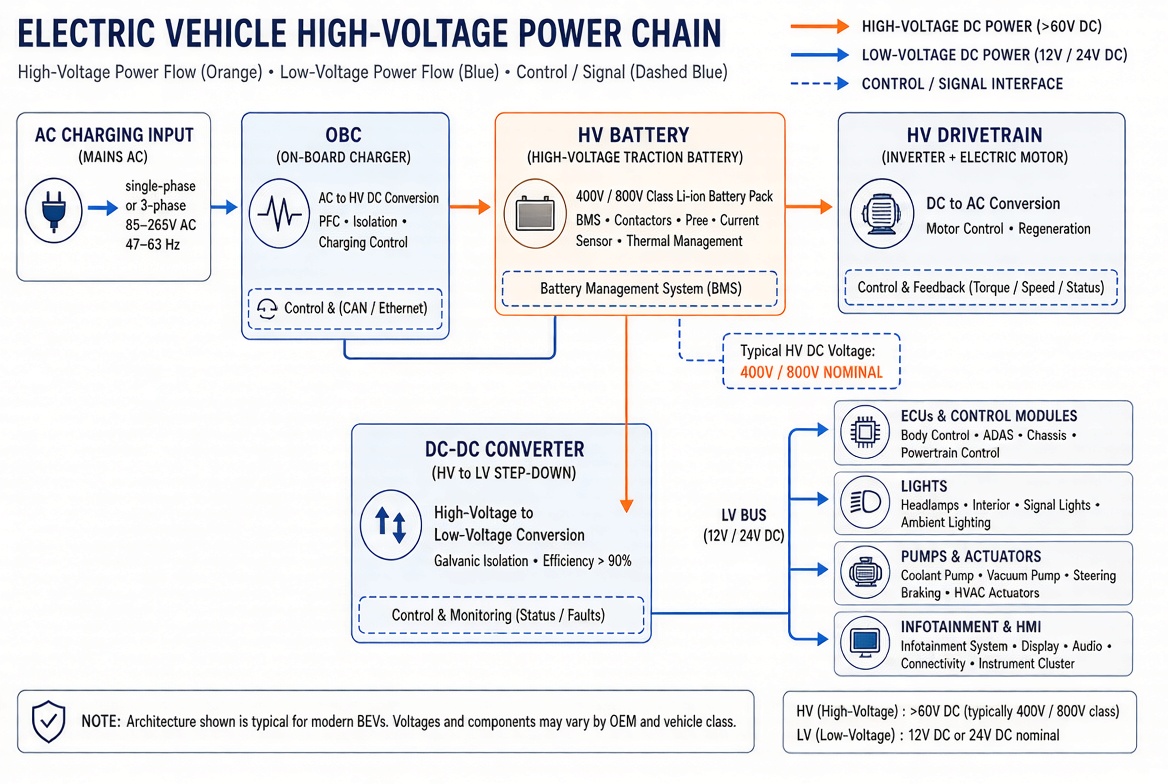
In an electric vehicle, the high-voltage battery serves as the central energy source. During charging, the On-Board Charger (OBC) converts AC grid power into high-voltage DC to replenish the battery. During driving and standby, the high-voltage DC-DC converter steps the battery voltage down to a stable 12 V or 24 V supply that powers all low-voltage loads. This complete energy chain — Battery → OBC (charging path) and Battery → DC-DC → Low-Voltage Loads (driving/standby path) — forms the core electrical architecture of every modern EV and hybrid.
 |
1. System Overview – Two Distinct Operating Modes
The high-voltage system operates in two primary modes:
Charging Mode
AC power from the charging station → OBC → High-voltage battery
Driving / Standby Mode
High-voltage battery → DC-DC converter → 12 V / 24 V low-voltage bus → All vehicle electrical loads
2. High-Voltage Battery – The Energy Hub
The traction battery (typically 400 V or 800 V nominal) stores energy and supplies it to:
- The traction inverter and electric motors (propulsion)
- The DC-DC converter (low-voltage supply)
- Auxiliary high-voltage loads (cabin heater, air-conditioning compressor, etc.)
Battery voltage, state of charge (SOC), and temperature are continuously monitored by the Battery Management System (BMS). The BMS also controls contactors that connect or disconnect the high-voltage bus for safety.
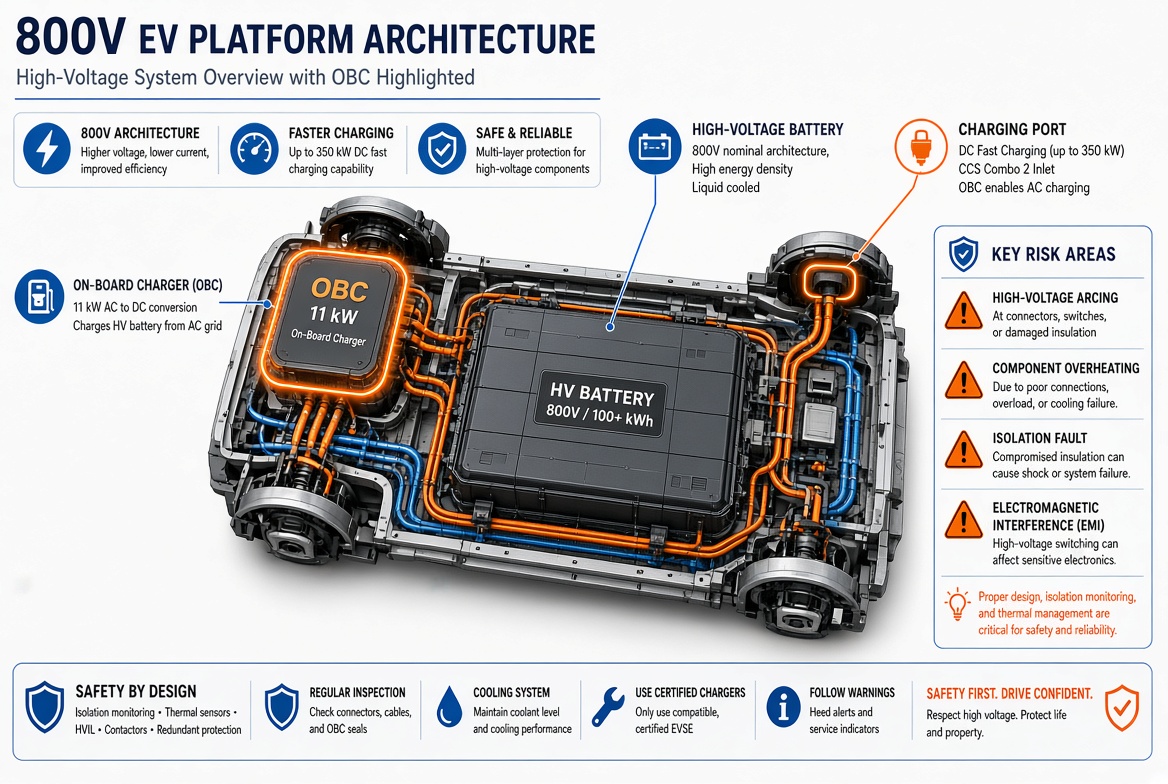
3. On-Board Charger (OBC) – The Charging Path
When the vehicle is plugged in:
- AC power (single-phase or three-phase) enters the OBC.
- The OBC performs power factor correction (PFC) and converts AC to regulated high-voltage DC.
- The DC output charges the traction battery under BMS supervision.
Typical OBC power levels range from 3.3 kW to 22 kW. Higher power shortens charging time but increases size, cost, and thermal requirements.
Ovar Tech provides a full range of OBCs (3.3 kW, 6.6 kW, 11 kW, 22 kW) as well as integrated OBC + DC-DC modules that combine both conversion functions in one compact unit, simplifying vehicle packaging.
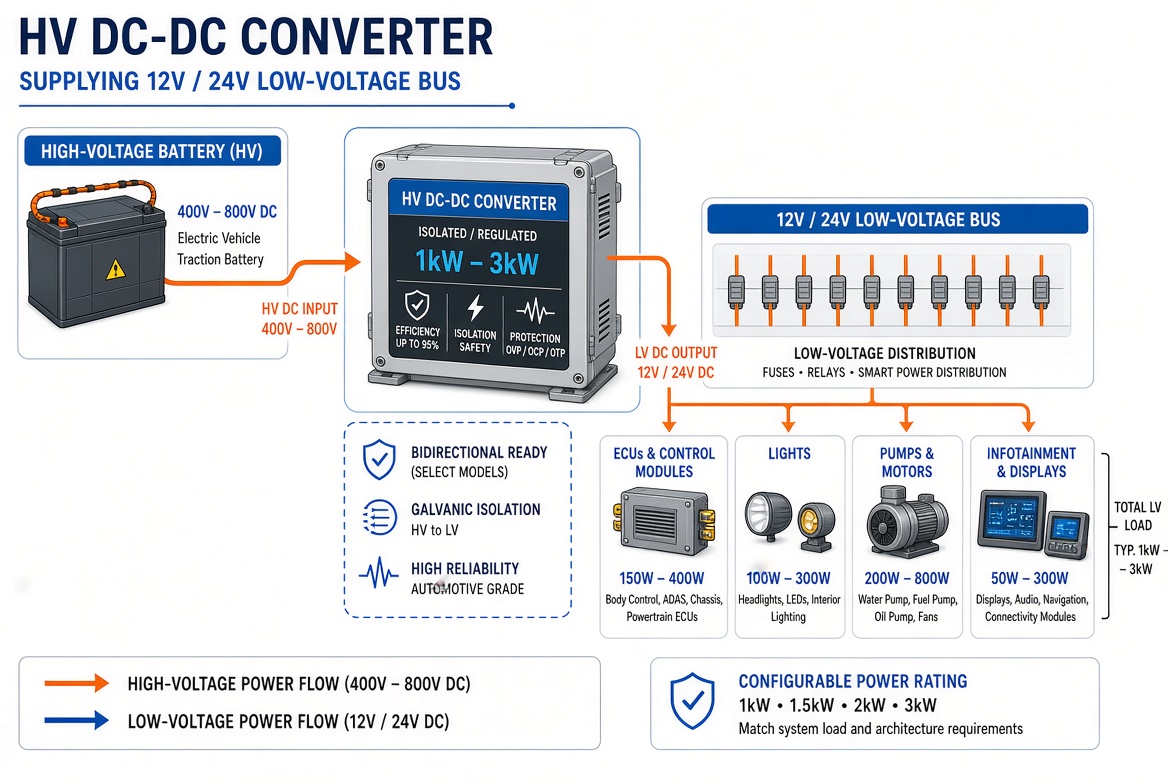
4. High-Voltage DC-DC Converter – The Low-Voltage Power Path
Once the high-voltage battery is charged, the DC-DC converter becomes the primary source of low-voltage power:
- High-voltage DC from the battery enters the isolated DC-DC converter.
- The converter steps the voltage down to a regulated 12 V or 24 V output.
- This low-voltage bus supplies every electrical load in the vehicle that does not run directly from the high-voltage system.
Typical DC-DC power ratings are 1 kW, 1.5 kW, 2 kW, and 3 kW, selected according to the total low-voltage load of the vehicle.
Key requirements for the DC-DC include:
- Galvanic isolation for safety
- High efficiency (≥ 92–95 %)
- Low standby power consumption
- Robust thermal design
- CAN communication and diagnostics
Ovar Tech’s DC-DC converters (1 kW–3 kW) and integrated OBC + DC-DC solutions are specifically designed to meet these automotive requirements.
5. Low-Voltage Loads – The Final Consumers
The 12 V / 24 V bus powers a wide range of systems:
- Body control modules and ECUs
- Lighting (headlamps, interior lights, signals)
- Infotainment, instrument cluster, and displays
- Electric pumps, fans, and compressors
- Safety systems (ABS, airbags, ADAS sensors)
- Always-on loads (immobilizer, telematics, keyless entry)
In conventional vehicles these loads were supplied by an alternator. In an EV the DC-DC converter completely replaces the alternator, making its reliability and continuous power capability critical.
6. Complete Energy Flow Logic
 |
The DC-DC converter must operate whenever the vehicle is powered, including during charging if low-voltage systems need to remain active.
 |
7. System-Level Design Considerations
- Isolation and Safety: Both the OBC and DC-DC must provide reinforced galvanic isolation between the high-voltage domain and the low-voltage / chassis domain.
- Thermal Management: Simultaneous operation of OBC and DC-DC (during charging) increases total heat dissipation; integrated modules can share cooling circuits.
- Efficiency Impact on Range: Losses in the DC-DC directly reduce driving range; high-efficiency designs are preferred.
- Standby Power: Modern DC-DC units support deep-sleep modes to minimize key-off battery drain.
- Integration Trend: Combining OBC + DC-DC (and sometimes PDU) into a single module reduces weight, volume, connectors, and cost.
Conclusion
The complete high-voltage system chain in an electric vehicle forms a closed energy loop: the battery stores energy delivered by the OBC during charging and supplies it through the DC-DC converter to every low-voltage load while driving or parked. Understanding this logic — Battery as the hub, OBC as the charging gateway, and DC-DC as the low-voltage power source — is essential for correct component selection, system integration, and vehicle performance optimization.
Ovar Tech supports this architecture with a comprehensive portfolio of standalone OBCs, DC-DC converters (1–3 kW), and integrated OBC + DC-DC modules, enabling vehicle manufacturers to implement efficient, reliable, and compact high-voltage power systems.
Share This Article