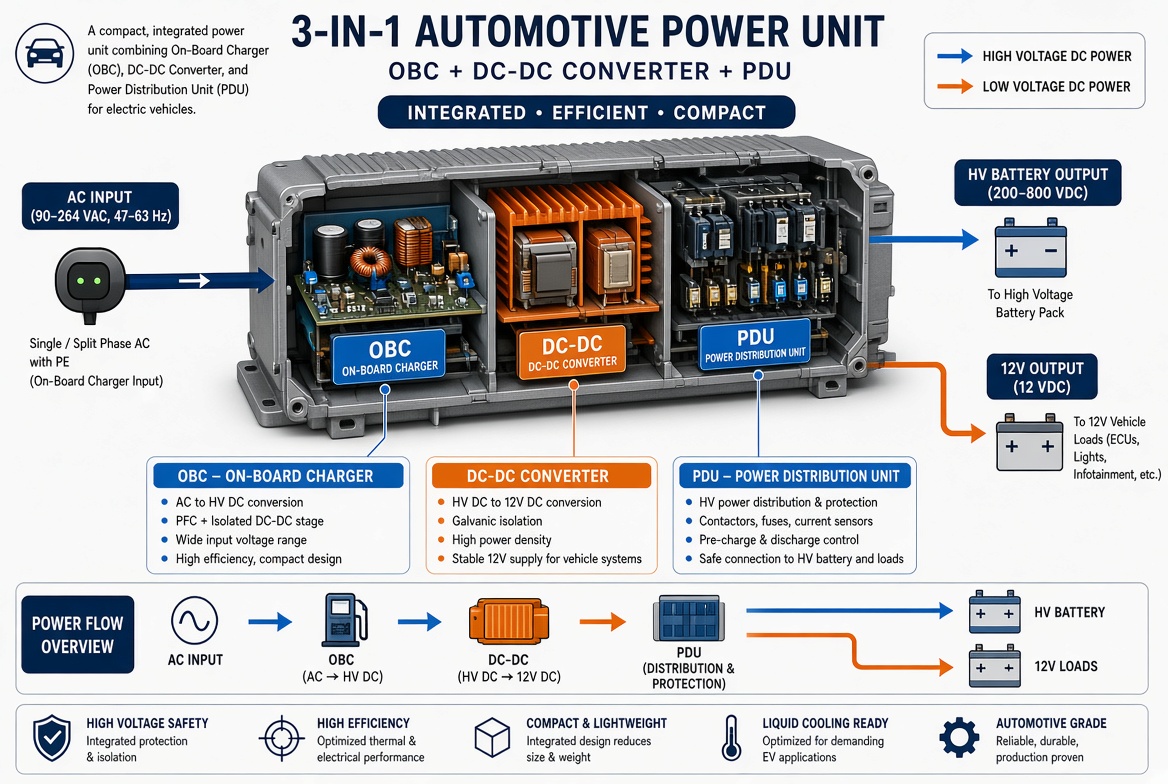
Unidirectional vs Bidirectional OBC Hardware Architecture: Understanding the Underlying Logic of V2G

Unidirectional vs Bidirectional OBC Hardware Architecture: Understanding the Underlying Logic [...]
Unidirectional vs Bidirectional OBC Hardware Architecture: Understanding the Underlying Logic of V2G
Unidirectional On-Board Chargers (OBCs) convert AC grid power into DC for battery charging only, while bidirectional OBCs support power flow in both directions, enabling Vehicle-to-Grid (V2G), Vehicle-to-Load (V2L), and Vehicle-to-Home (V2H) applications. The core hardware differences lie in power topology, semiconductor selection, isolation design, and control systems. Bidirectional OBCs form the foundational power electronics layer that makes V2G possible by allowing controlled reverse power flow from the vehicle battery back to the grid or external loads.
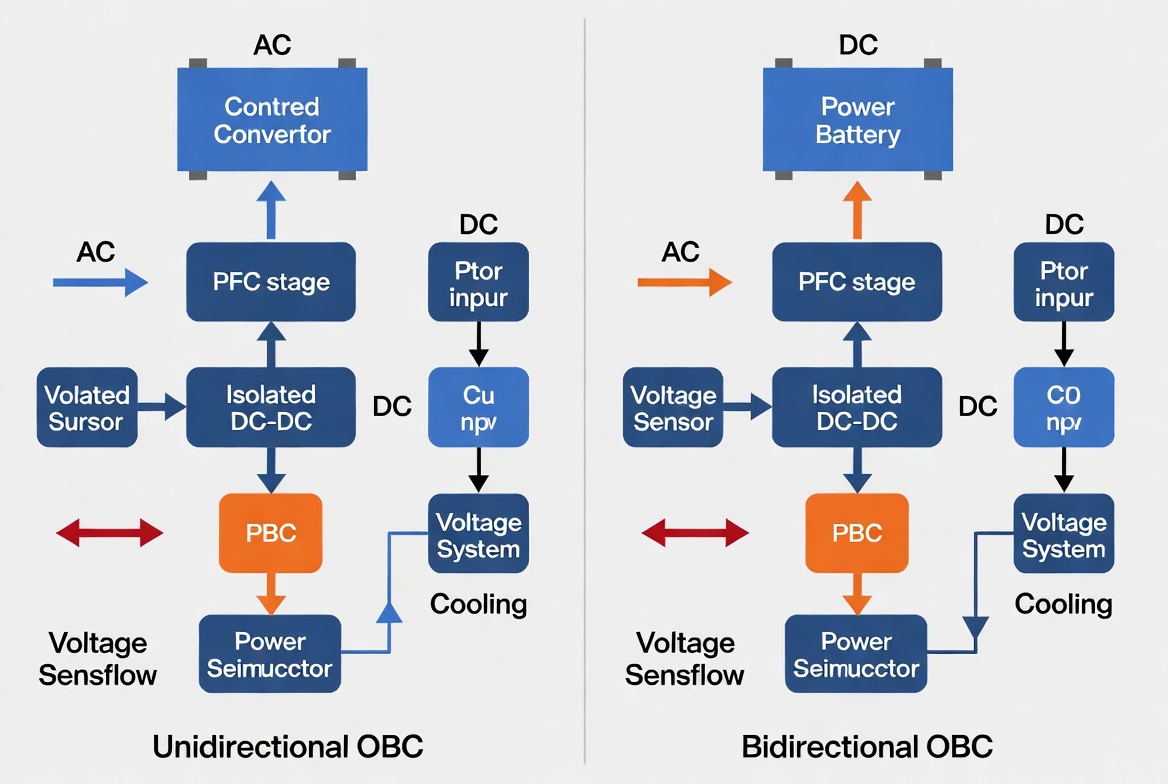 |
1. Unidirectional OBC Hardware Structure
- AC-DC Power Factor Correction (PFC) Stage
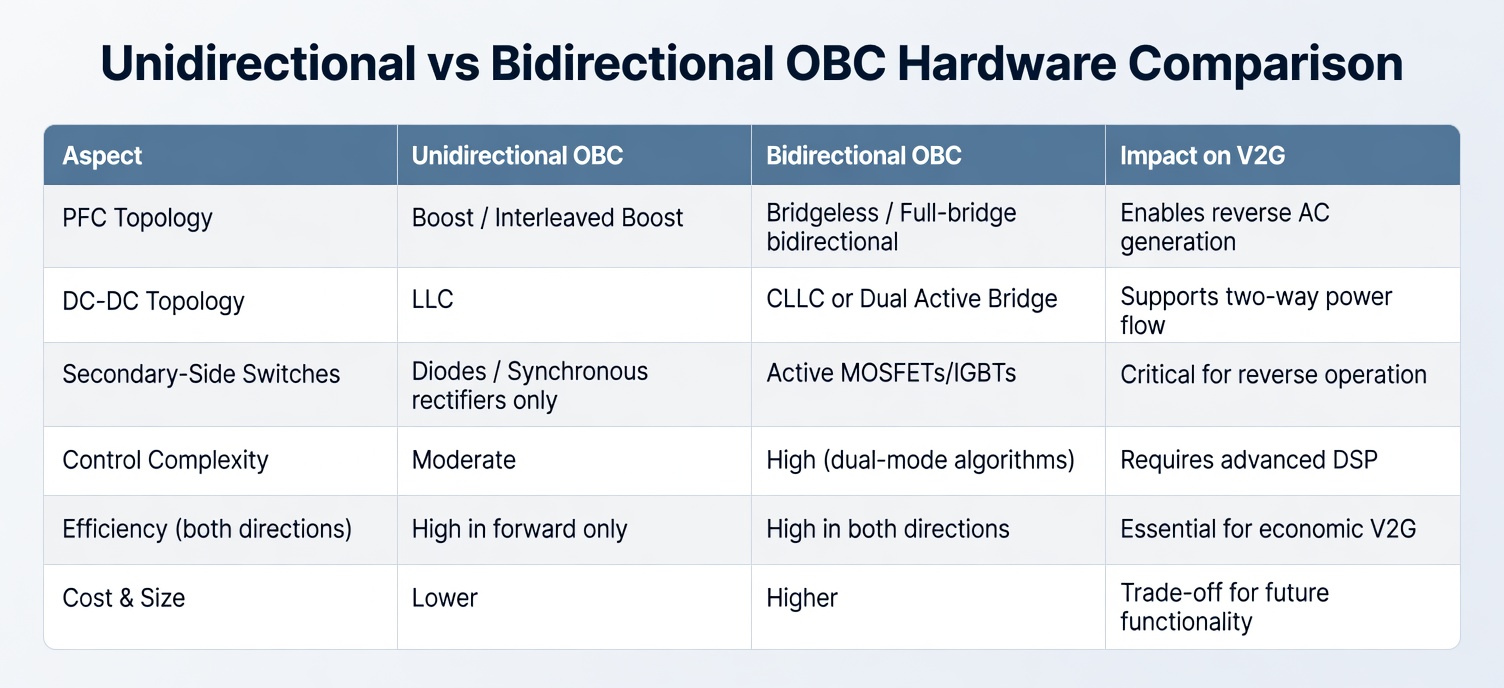
This stage rectifies the AC input and corrects the power factor. Common topologies include boost PFC or interleaved boost. Power flow is strictly one-way: from grid to the intermediate DC bus. - Isolated DC-DC Converter Stage
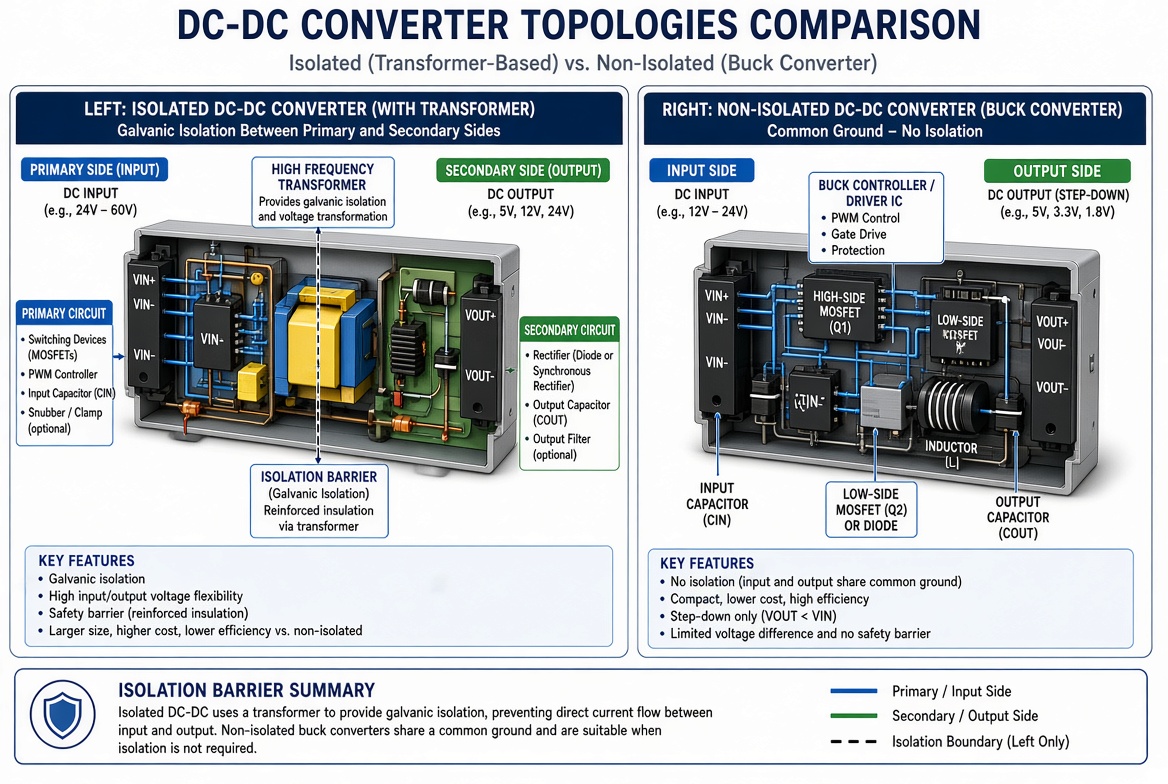
Usually an LLC resonant converter. It provides galvanic isolation and regulates the output voltage to match the high-voltage battery (400V or 800V). The transformer and secondary-side rectifiers are designed for unidirectional power transfer only.
Key characteristics of unidirectional designs include simpler control algorithms, lower component count on the secondary side, and lower cost. These systems are widely used in standard passenger EVs where only charging is required.
2. Bidirectional OBC Hardware Structure
Bidirectional OBCs require significant architectural upgrades to support reverse power flow:
- Bidirectional PFC Stage
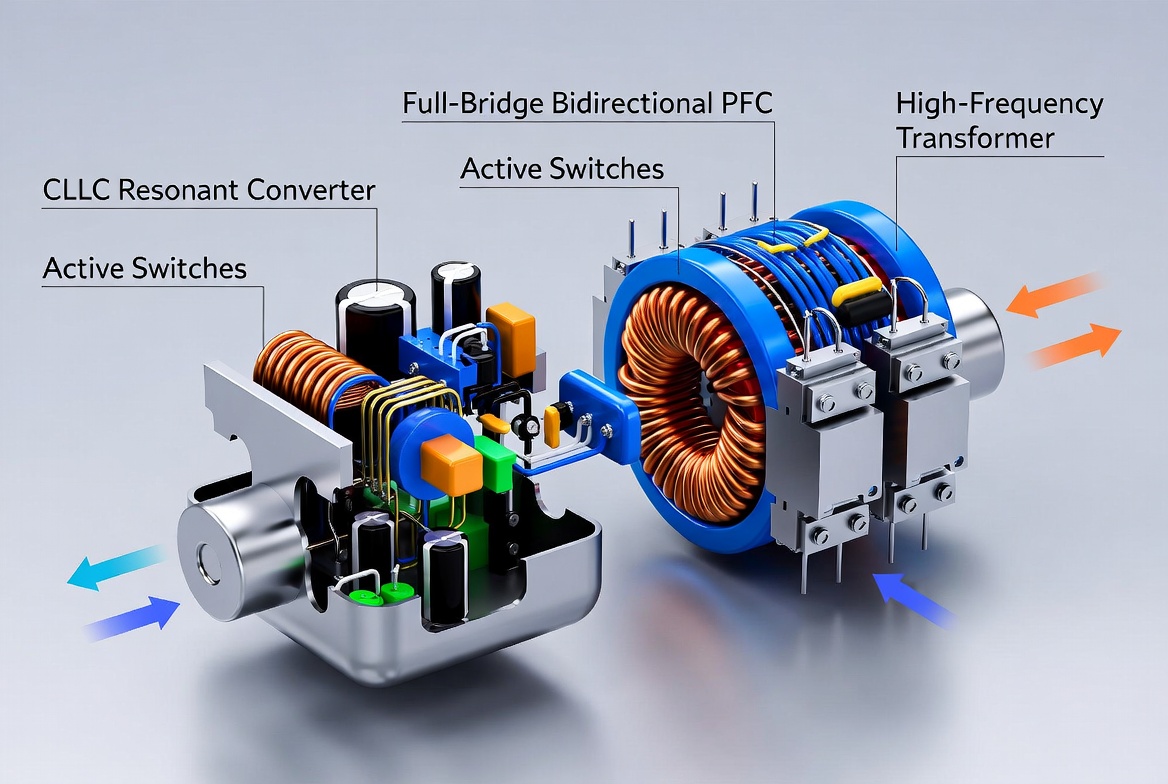
Instead of a simple diode rectifier or unidirectional boost, a full-bridge or totem-pole bridgeless PFC is used. Active switches on both sides allow current to flow back to the AC grid while maintaining power factor control and low harmonic distortion. - Bidirectional Isolated DC-DC Stage
The classic LLC is often replaced by a CLLC resonant converter or Dual Active Bridge (DAB). These topologies feature active switches on both primary and secondary sides of the transformer, enabling seamless bidirectional energy transfer. Soft-switching (ZVS/ZCS) is maintained in both directions to preserve high efficiency. - Enhanced Control and Protection
Dual-direction current sensing, more sophisticated digital control (usually DSP-based), and advanced protection against grid faults and islanding are mandatory.
Ovar Tech’s bi-directional models, such as the 11kW OBC + 3kW DC-DC and the bi-directional 6.6kW OBC + 2kW DC-DC, implement these advanced architectures. They support both vehicle charging and energy export while maintaining high efficiency (up to 95%) and automotive-grade reliability.
 |
3. How Bidirectional Hardware Enables V2G Logic
Vehicle-to-Grid (V2G) relies on the bidirectional OBC as the power conversion interface between the vehicle battery and the utility grid. The underlying logic works as follows:
- Forward Mode (Charging)
Grid AC → Bidirectional PFC → DC bus → Bidirectional DC-DC → Battery. - Reverse Mode (Discharging / V2G)
Battery → Bidirectional DC-DC (now operating in reverse) → DC bus → Bidirectional PFC (now acting as an inverter) → Grid AC.
The same hardware path is used in reverse. Precise synchronization with the grid voltage and frequency is achieved through Phase-Locked Loop (PLL) algorithms and grid-forming or grid-following control strategies. Communication with the Battery Management System (BMS) and external energy management systems ensures safe power limits and battery health protection.
4. Key Hardware Differences Summary
 |
5. Practical Considerations and Ovar Tech Solutions
Bidirectional OBCs introduce higher component cost and slightly larger size due to additional active devices and more complex magnetics. However, they unlock valuable new capabilities: peak shaving, emergency backup power, and participation in grid services.
Ovar Tech offers both unidirectional and bidirectional integrated solutions. Their bi-directional 11kW OBC + 3kW DC-DC modules are specifically engineered for commercial vehicles, industrial applications, and marine platforms that require future V2G readiness. These products combine high power density, robust thermal design, and full compliance with automotive safety and EMI standards.
Conclusion
The hardware evolution from unidirectional to bidirectional OBC is the key enabler of V2G technology. By replacing passive rectifiers with active bidirectional stages and adopting resonant topologies such as CLLC, modern OBCs can seamlessly reverse power flow while maintaining high efficiency and safety. Understanding these architectural differences helps engineers and system designers select the right solution for current charging needs and future vehicle-to-grid applications. Ovar Tech’s bidirectional product lineup demonstrates how these advanced hardware principles can be delivered in practical, production-ready form factors for the next generation of electrified vehicles.
Share This Article